
Last Updated: February 2026
Montenegro packs an extraordinary amount of beauty into one of Europe’s smallest countries. With its dramatic Adriatic coastline, medieval walled towns, and wild mountain interior, this Balkan gem has rapidly become one of the continent’s most sought-after destinations. Over 2.6 million visitors arrived in 2024, and the numbers keep climbing. From the fjord-like Bay of Kotor to the deep canyons of Durmitor, the party beaches of Budva to the serenity of Lake Skadar, here’s everything you need to know to plan your trip to Montenegro in 2026.
🇲🇪 Montenegro at a Glance
| Official Name | Montenegro (Crna Gora) |
| Capital | Podgorica |
| Population | ~620,000 (2026) |
| Currency | Euro (€ / EUR) — despite not being an EU member |
| Language | Montenegrin (also Serbian, Bosnian, Albanian widely spoken) |
| Time Zone | CET (UTC+1) / CEST (UTC+2) in summer |
| Plug Type | Type C and F · 230V / 50Hz |
| Driving Side | Right |
| International Driving Permit (IDP) | Required for non-EU licenses — see IDP guide |
| Schengen Member | No — Montenegro has its own immigration system. Time spent here does not count toward your Schengen 90 days. |
| Emergency Number | 112 |
Entry Requirements for Montenegro
Montenegro is not part of the Schengen Area or the European Union (though it is an EU candidate country). It operates its own visa and immigration system with rules that are generally very welcoming to international travelers. Montenegro uses a 90-day-in-180-day stay limit similar to the Schengen system — but the two are entirely separate.
🇺🇸 US Citizens: Visa-Free Entry
US citizens can enter Montenegro visa-free for up to 90 days within any 180-day period. No application, no fee — just show up with a valid US passport. The Montenegrin government officially requires your passport to be valid for at least three months beyond your intended stay, though some sources recommend six months of validity to be safe.
You may be asked for proof of accommodation, sufficient funds, or a return/onward ticket at the border, though this is not routine. If staying outside a hotel (in an Airbnb or with friends), you are technically required to register with the local tourism office within 24 hours of arrival in each municipality — hotels handle this automatically.
⚠️ Important: If you have a valid Schengen visa, UK visa, US visa, or permanent residence in an EU country, you can enter Montenegro visa-free for up to 30 days even if your nationality normally requires a visa.
🇪🇺 EU Citizens: Visa-Free Entry
Citizens of all EU and EEA countries can enter Montenegro visa-free for up to 90 days within a 180-day period. Most EU citizens can enter with either a valid passport or a national ID card. Montenegro’s visa policy closely mirrors the Schengen Area’s — essentially all nationalities that are visa-exempt for Schengen are also visa-exempt for Montenegro.
Other Nationalities
Montenegro grants visa-free entry to nationals of over 90 countries for stays up to 90 days. This includes citizens of the UK, Canada, Australia, New Zealand, Japan, South Korea, and most Latin American countries. Russia, Turkey, and several Middle Eastern countries also have visa-free access. For nationalities that require a visa, applications are submitted to the nearest Montenegrin embassy or consulate.
Use our Europe Travel Planner to check what your nationality requires for Montenegro.
Combining with Schengen Travel
Montenegro is one of the most popular non-Schengen destinations in the Balkans for travelers on a longer European trip. It’s well-connected to Schengen neighbors like Croatia and is frequently combined with other Western Balkan countries.
Your Schengen Clock Stops in Montenegro
Time spent in Montenegro does not count toward your Schengen 90-day limit. If you’ve used 45 of your 90 Schengen days in Croatia and Italy, then cross into Montenegro for two weeks, those two weeks don’t count. When you return to a Schengen country, you’ll still have 45 Schengen days remaining.
Montenegro is commonly used as part of a “Balkan rotation” — many long-term travelers alternate between Schengen countries and the non-Schengen Western Balkans (Montenegro, Albania, Serbia, Bosnia, North Macedonia) to extend their total time in Europe well beyond 90 days.
✅ Planning a long Europe trip? Use our Schengen Calculator to track your 90/180-day count, and build Montenegro into your itinerary strategically. A popular rotation: Schengen countries → Western Balkans → back to Schengen once your days have refilled.
Separate Documents for Each
Montenegro’s visa-free status does not grant access to Schengen countries, and a Schengen visa does not cover Montenegro (though holding one does grant 30-day visa-free entry). If your trip includes both regions, check the entry requirements separately. When ETIAS launches in late 2026, visa-exempt travelers visiting both Montenegro and the Schengen Area will need separate documentation for each.
Getting to Montenegro
Montenegro is compact but well-connected by air and overland. Many travelers arrive from neighboring Croatia, Serbia, or Albania.
By Air
Podgorica Airport (TGD) is the capital’s international airport with connections to major European cities. Tivat Airport (TIV), near the Bay of Kotor, is the more popular gateway for coastal tourism, handling a high volume of seasonal flights from across Europe — passenger traffic increased 25% in 2025. Both airports are small and straightforward. In summer, Tivat has direct flights from London, Paris, Vienna, and many other European cities.
Dubrovnik Airport (DBV) in Croatia is another popular option — it’s just 30 minutes from the Montenegrin border and is served by many more airlines year-round. Many travelers fly into Dubrovnik and cross overland into Montenegro.
By Land
Montenegro shares borders with Croatia, Bosnia and Herzegovina, Serbia, Kosovo, and Albania. The most common border crossings are from Croatia (Debeli Brijeg, on the coastal road from Dubrovnik) and from Albania (Sukobin, near Ulcinj). Bus services connect Montenegro to all neighboring capitals. The most popular route is the Dubrovnik to Kotor/Budva bus corridor. From Serbia, the Belgrade–Bar train is a scenic classic (see Getting Around). Border crossings can be slow in peak summer, particularly the Croatia–Montenegro coastal crossing.
By Sea
A ferry service connects Bar (Montenegro’s main port) to Bari, Italy. The crossing takes approximately 9 hours and operates regularly. Within the Bay of Kotor, a short car ferry between Kamenari and Lepetane (10 minutes, ~€4.50) lets you skip the long drive around the bay.
Getting Around Montenegro
Montenegro is small — just 13,812 sq km, roughly the size of Connecticut — but its mountainous terrain means distances take longer than you’d expect. A drive that looks like 100 km on the map can take 2–3 hours on winding mountain roads.
Buses
Buses are the backbone of public transport. A well-connected intercity network runs between all major towns, with frequent service along the coast (Herceg Novi – Kotor – Budva – Bar) and regular connections to the interior (Podgorica, Cetinje, Žabljak). Fares are very affordable — a coastal hop from Kotor to Budva costs about €2.50, and longer routes like Podgorica to Žabljak are €7–9. Buy tickets at bus stations or from the driver. Expect a small luggage fee (€1–2) for larger bags.
Trains
Montenegro’s rail network is limited but scenic. The main line runs from Bar on the coast through Podgorica to Serbia, where it continues as the Belgrade–Bar railway — one of Europe’s most dramatic train journeys, crossing 435 bridges and passing through 254 tunnels. A second line connects Podgorica to Nikšić. Trains are slow but cheap (Bar to Podgorica is about €2.40 second class). Check schedules on the official Montenegro Rail website.
Driving
A rental car gives you the most freedom, and Montenegro’s mountain drives are spectacular. Roads are generally in fair condition, though many are narrow, winding, and lack guardrails — especially in the interior. The coastal highway is the busiest and most straightforward. Montenegro drives on the right.
An International Driving Permit (IDP) is officially required for non-EU license holders, including Americans. In practice, rental companies in tourist areas may accept a US license alone, but having an IDP avoids complications with police and insurance. See our IDP guide for details. Headlights must be on at all times while driving, even during the day.
| Route | Mode | Duration | Approximate Cost |
|---|---|---|---|
| Kotor → Budva | Bus | 30–40 min | €2.50 |
| Podgorica → Kotor | Bus | 2–2.5 hrs | €6–7 |
| Podgorica → Budva | Bus | 1.5–2 hrs | €5–7 |
| Podgorica → Žabljak | Bus | 3–4 hrs | €7–9 |
| Bar → Podgorica | Train | 1 hr | €2.40 (2nd class) |
| Bar → Belgrade | Train | ~11 hrs | €21 (2nd class) |
| Dubrovnik → Kotor | Bus | 2–2.5 hrs | €15–20 |
✅ Getting around tip: The Kamenari–Lepetane car ferry across the Bay of Kotor (10 min, ~€4.50 for a car) saves a 45-minute drive around the bay. Ferries run continuously. In summer, budget for slow border crossings from Croatia — the Debeli Brijeg crossing can have long queues.
Where to Go in Montenegro
Despite its small size, Montenegro offers an impressive variety of landscapes — a UNESCO-listed bay, medieval walled towns, wild mountains, deep canyons, and over 290 km of Adriatic coastline with 117 beaches.
⛵ Bay of Kotor
Often called “Europe’s southernmost fjord,” the Bay of Kotor is Montenegro’s most dramatic landscape — a deep, winding inlet surrounded by towering mountains. Kotor is the star: a UNESCO World Heritage–listed medieval old town with narrow stone alleys, centuries-old churches, and a famous fortress hike with jaw-dropping views from the top. Just up the bay, Perast is a tiny Baroque village where you can take a short boat ride to Our Lady of the Rocks, a man-made island church. Herceg Novi, at the bay’s entrance, is a spa and resort town known for its mimosa trees and Fortemare fortress.
🏖️ Budva Riviera
Budva is Montenegro’s most popular beach destination — a lively coastal town with its own walled Old Town, over 25 beaches, and a vibrant nightlife scene. Nearby Sveti Stefan, an iconic fortified island connected to the mainland by a narrow causeway, is perhaps the most photographed spot in Montenegro (now an exclusive Aman resort, but visible from surrounding beaches). Petrovac and Bečići offer quieter beach alternatives, while the southern coast near Ulcinj (with its 13-km Velika Plaža) draws a more local crowd and offers better value.
🏔️ Durmitor National Park
Durmitor is Montenegro’s crown jewel for nature lovers — a UNESCO World Heritage–listed national park of towering peaks, glacial lakes, and the Tara River Canyon, the deepest canyon in Europe (1,300 meters) and the second deepest in the world after the Grand Canyon. The town of Žabljak is the base for hiking, rafting, and in winter, affordable skiing. Black Lake, a short walk from town, is one of Montenegro’s most beautiful spots. The Đurđevića Tara Bridge spanning the canyon is an iconic photo stop.
🏞️ Lake Skadar
Lake Skadar (Skadarsko jezero), shared with Albania, is the largest lake in southern Europe and a national park teeming with birdlife — including pelicans, herons, and cormorants. Boat excursions from Virpazar explore island monasteries and pristine coves. The surrounding area is one of Montenegro’s emerging wine regions, with tastings at family-run vineyards.
🏰 Cetinje and Lovćen
Cetinje, Montenegro’s old royal capital, is a small historic town nestled between the coast and the mountains. The Cetinje Monastery and the Palace Museum are worth a stop. Above it, Lovćen National Park is home to the Mausoleum of Petar II Petrović-Njegoš at 1,657 meters — a monument to Montenegro’s greatest poet-ruler, with panoramic views stretching to the coast and across to Italy on a clear day. The winding road from Kotor up to Lovćen is legendary.
How Much Does Montenegro Cost?
Montenegro is more affordable than Western Europe, but pricing varies dramatically by location and season. The coast — particularly Kotor, Budva, and Sveti Stefan — is considerably more expensive than the interior. Prices spike in July and August and drop significantly in the shoulder and off-seasons.
| Expense | Budget | Mid-Range | Comfortable |
|---|---|---|---|
| Accommodation (per night) | €15–30 (hostel / basic apartment) | €50–100 (apartment / 3-star hotel) | €150–300+ (boutique / resort) |
| Meals (per day) | €10–20 (markets / bakeries) | €25–40 (restaurants) | €50–80+ (upscale dining) |
| Transport (per day) | €5–10 (buses) | €15–30 (bus + taxi) | €30–50+ (rental car + fuel) |
| Activities | Free–€5 (hiking, beaches) | €10–30 (boat tours, museums) | €50–100+ (rafting, guided tours) |
| Total per day | €30–65 | €100–200 | €250–500+ |
Montenegro uses the euro despite not being in the EU or eurozone — it adopted the currency unilaterally. This means no currency exchange hassle for travelers coming from Schengen countries, though it also means prices in tourist areas have crept upward in recent years. ATMs are widely available in all towns and most villages. Credit cards are accepted at hotels and restaurants in tourist areas; carry cash for smaller shops, markets, and rural areas.
Practical Information
Power and Connectivity
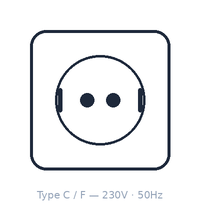
Montenegro uses Type C and F plugs — the same round two-pin plugs used across most of continental Europe. The standard voltage is 230V at 50Hz. If you’re coming from the US, you’ll need a European adapter. If you’re already carrying one from other European countries, it will work here.
Mobile coverage is good along the coast and in major towns, with 4G available from operators like Crnogorski Telekom, m:tel, and One. Coverage can be spotty in mountainous areas — don’t rely on phone navigation for remote mountain roads. Tourist SIM cards and eSIMs are available. Free Wi-Fi is common in hotels, cafés, and restaurants in tourist areas.
📱 Need mobile data? An eSIM is the easiest way to stay connected in Europe — no SIM swapping, activate before you land. Compare the best eSIM providers for Europe →
Health and Safety
Montenegro is generally very safe for travelers. Petty theft can occur in crowded tourist areas like Kotor and Budva Old Towns, especially when cruise ships are in port — keep valuables secure. The most common safety concerns are driving-related: mountain roads are narrow and winding, local driving can be aggressive, and guardrails are often absent at scenic overlooks.
Healthcare facilities are adequate in Podgorica and larger coastal towns but limited in rural and mountain areas. Private clinics in tourist areas provide a higher standard of care. All visitors should carry comprehensive travel insurance. In an emergency, call 112. Pharmacies (apoteka) are available in all towns.
Tap water is safe to drink in most of Montenegro, particularly from mountain sources, though bottled water is cheap and widely available.
Language
Montenegrin is the official language (closely related to Serbian, Bosnian, and Croatian — speakers of any of these languages communicate easily). English is widely spoken in tourist areas along the coast, especially in Kotor, Budva, and Tivat. In the interior and among older locals, English proficiency drops. Learning a few basics — zdravo (hello), hvala (thank you), molim (please) — is appreciated.
Food and Dining Culture
Montenegrin cuisine reflects the country’s geography — fresh seafood on the coast, hearty meat dishes in the mountains. On the coast, look for grilled squid, black risotto (crni rižoto), and the famous Adriatic black mussels. In the interior, try Njeguški steak (stuffed with prosciutto and cheese), lamb roasted ispod sača (under a metal dome with coals), and ćevapi (grilled minced meat rolls served in bread with onions).
Njeguški pršut (smoked prosciutto) and Njeguški sir (cheese) from the village of Njeguši in the mountains above Kotor are Montenegro’s most prized culinary specialties — try them at a tasting stop on the Kotor–Lovćen road. Wine is growing in reputation, particularly the Vranac red grape from the Lake Skadar region. A meal at a local restaurant (konoba) with wine rarely exceeds €15–25 per person in non-tourist areas.
Montenegro: Economy and Context
Montenegro is one of Europe’s smallest economies, with a GDP of approximately $7 billion and a population of just over 600,000. The country gained independence from Serbia in 2006 and has been an EU candidate country since 2010, with accession negotiations ongoing. It joined NATO in 2017.
Tourism is the dominant industry, accounting for nearly 30% of GDP — one of the highest ratios in Europe. In 2024, Montenegro recorded 2.6 million tourist arrivals and over 15.5 million overnight stays. The coast draws the vast majority of visitors (94%), with Serbia, Russia, Bosnia and Herzegovina, and an increasingly diverse Western European market as the top source countries. Arrivals from the UK grew 25% in 2024, and emerging markets like Israel and China showed strong growth. The government aims to develop year-round tourism beyond the coastal summer season, promoting mountain, eco, and cultural tourism.
Montenegro uses the euro despite not being in the eurozone — a legacy of adopting the German mark in 1999 during the Yugoslav currency instability. This simplifies travel for European visitors and provides currency stability, though it means Montenegro cannot set its own monetary policy.
Frequently Asked Questions
Do Americans need a visa for Montenegro?
No. US citizens can enter Montenegro visa-free for up to 90 days within a 180-day period. You just need a valid US passport. No application or fee is required.
Does time in Montenegro count toward my Schengen 90 days?
No. Montenegro is completely separate from the Schengen Area. Time spent in Montenegro does not count toward your Schengen 90/180-day limit. This makes it — along with the rest of the Western Balkans — a strategic stop on longer European trips. Use our Schengen Calculator to track your days.
What is the best time to visit Montenegro?
May–June and September–October offer the best combination of pleasant weather, swimmable seas, lower prices, and fewer crowds. July and August are peak season — the coast is packed and prices spike. The mountains are best from June through September for hiking, and January through March for skiing at Durmitor.
Is Montenegro expensive?
Montenegro is more affordable than Western Europe, but the coast — especially Kotor, Budva, and Sveti Stefan — has risen in price. Budget travelers can manage on €30–65 per day; mid-range travelers should expect €100–200. Inland and off-season prices are significantly lower. Montenegro uses the euro, which simplifies things if you’re coming from the eurozone.
Do I need a car to explore Montenegro?
It depends on your itinerary. The coast is well-served by buses, and you can comfortably visit Kotor, Budva, and surrounding towns by public transport. However, for the mountains (Durmitor, Lovćen), Lake Skadar, and the more scenic drives, a rental car is strongly recommended. Roads can be winding and narrow — confident drivers will find the mountain roads exhilarating.
Do I need an International Driving Permit (IDP)?
Officially, yes — non-EU license holders are required to carry an IDP alongside their domestic license. In practice, rental companies in tourist areas sometimes accept a US license alone, but an IDP avoids any issues with police or insurance. It costs $20 from AAA and takes minutes to get. See our IDP guide.
Do I need a different plug adapter than for other European countries?
No — Montenegro uses the same Type C and F plugs as most of continental Europe (230V/50Hz). If you have a standard European adapter, it will work here. If coming from the UK or Ireland, you’ll need to switch from your Type G plug.
Can I combine Montenegro with other Balkan countries?
Absolutely. Montenegro is ideally positioned for a Balkans road trip. Dubrovnik (Croatia) is a 2-hour drive from Kotor. Tirana (Albania) is 4–5 hours from the southern coast. Sarajevo (Bosnia) is about 4 hours from the north. Serbia is connected by bus and the scenic Belgrade–Bar railway. None of the other Western Balkan countries (Albania, Serbia, Bosnia, North Macedonia) are in Schengen, so your 90-day clock stays paused for the entire Balkan leg of your trip.
🌍 Plan Your Trip to Montenegro
Entry requirements, visa status, and a full travel briefing — personalized for your nationality.
Use the Europe Travel Planner →📚 Related Articles
- Schengen 90/180-Day Rule — How the visa-free stay limit works (Montenegro time doesn’t count)
- Non-Schengen Countries in Europe — Where your 90 days don’t count
- How to Split Time Between Schengen and Non-Schengen Countries
- ETIAS: Europe’s New Travel Authorization — Separate from Montenegro’s visa system
- International Driving Permit in Europe — Country-by-country IDP requirements
- Best Travel Insurance for Europe — Coverage for Balkans and Schengen trips
- Travel to Turkey — Another popular non-Schengen destination
- Travel to Albania — Another non-Schengen Balkan destination
- All Europe Country Guides
This article is for informational purposes only and does not constitute legal or travel advice. Entry requirements can change — always verify with official government sources before traveling. Last updated: February 2026.