
Pick a country
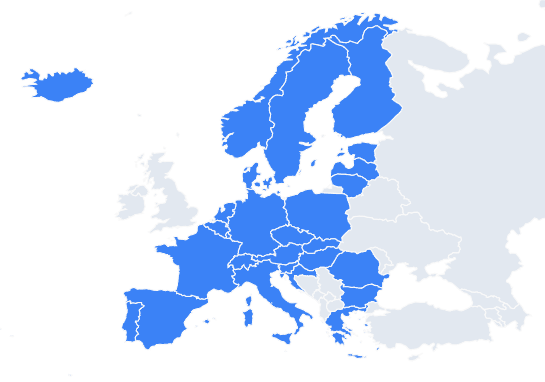
Click any country on the map to see whether it’s in the Schengen Area, the EU, and whether ETIAS will apply.
Last Updated: August 2026
The Schengen Area covers 29 European countries with no internal border controls and a single 90-day stay limit shared between them. But Schengen is not the EU, and neither is the same as the countries that will require ETIAS. Toggle between all three on the map below, or use the EU vs Schengen view to see where the two overlap.
The Three Zones
Every country on the map, grouped by what actually determines your entry rules. Verified August 2026.
🔵 In Schengen and in the EU — 25 countries
🇦🇹 Austria, 🇧🇪 Belgium, 🇧🇬 Bulgaria, 🇭🇷 Croatia, 🇨🇿 Czech Republic, 🇩🇰 Denmark, 🇪🇪 Estonia, 🇫🇮 Finland, 🇫🇷 France, 🇩🇪 Germany, 🇬🇷 Greece, 🇭🇺 Hungary, 🇮🇹 Italy, 🇱🇻 Latvia, 🇱🇹 Lithuania, 🇱🇺 Luxembourg, 🇲🇹 Malta, 🇳🇱 Netherlands, 🇵🇱 Poland, 🇵🇹 Portugal, 🇷🇴 Romania, 🇸🇰 Slovakia, 🇸🇮 Slovenia, 🇪🇸 Spain, 🇸🇪 Sweden
🔷 In Schengen, not in the EU — 4 countries
🇮🇸 Iceland, 🇱🇮 Liechtenstein, 🇳🇴 Norway, 🇨🇭 Switzerland
All four draw from your Schengen 90 days and all four will require ETIAS, because Schengen membership is what triggers it. EU roaming rules do not apply in any of them, so check your mobile plan separately.
🏛️ In the EU, not in Schengen — 2 countries
Days here never touch your Schengen 90. The two are otherwise nothing alike: Cyprus will require ETIAS, and Ireland opted out of it entirely.
🌍 Outside both — 15 countries
🇦🇱 Albania · 🇦🇩 Andorra · 🇧🇦 Bosnia and Herzegovina · 🇬🇪 Georgia · 🇽🇰 Kosovo · 🇲🇩 Moldova · 🇲🇨 Monaco · 🇲🇪 Montenegro · 🇲🇰 North Macedonia · 🇸🇲 San Marino · 🇷🇸 Serbia · 🇹🇷 Turkey · 🇺🇦 Ukraine · 🇬🇧 United Kingdom · 🇻🇦 Vatican City
Separate immigration rules, separate stay limits, no ETIAS. This is the group long-term travellers use as bases while their Schengen days replenish. The UK is the exception that catches people out: British days never count against your Schengen 90, but a UK ETA is still mandatory before you board.
Understanding the 90/180-Day Rule
The rule that makes the map matter: you can stay a maximum of 90 days within any rolling 180-day period across all 29 Schengen countries combined. It is not a fixed calendar period and it does not reset when you cross a border or when the year turns over. Every day in any Schengen country draws from the same pool, whichever country it is.
Time in the countries outside that zone does not count. Many long-term travellers use this deliberately, spending 90 days inside Schengen and then moving to Albania, Georgia or the UK while their days replenish. How the rolling window works →
Since the Entry/Exit System became fully operational in April 2026, every crossing of a Schengen external border is recorded biometrically rather than stamped by hand. Miscounting used to be survivable. It is not any more. Count your days →
🛡️ One policy for both sides of the map
If you are moving between Schengen and non-Schengen countries, you want one policy that covers both rather than booking country by country. SafetyWing’s Nomad Insurance covers emergency medical treatment and hospital care abroad on a continuous monthly plan with no fixed itinerary and no long-term commitment, and it meets the €30,000 minimum if any part of your trip needs a Schengen visa. For a full comparison including AXA and Allianz, see our best travel insurance for Europe guide.
Get a Quote from SafetyWing →Affiliate partner — we may earn a commission at no extra cost to you.
What Changes When ETIAS Launches
ETIAS is not operational. The EU removed the previously confirmed Q4 2026 launch target in July 2026, and 2027 is now the most likely launch year. Until then, visa-exempt travellers need only a valid passport. When it arrives it will cost €20 for adults aged 18 to 70, be free outside that range, stay valid for three years, and cover all 30 participating countries. It does not change the 90/180-day rule. Track the timeline →
Crossing more than one zone?
A trip mixing Schengen, the UK and the Balkans can need more than one entry document. iVisa checks what your passport requires for each leg, flags the mistakes that cause refusals, and tracks each application to a decision. A flat service fee applies on top of the government fee.
Check What You Need →Affiliate partner — we may earn a commission at no extra cost to you.
Frequently Asked Questions
How many countries are in the Schengen Area in 2026?
There are 29 countries in the Schengen Area as of 2026. Twenty-five are EU member states; Iceland, Liechtenstein, Norway and Switzerland are Schengen members without being in the EU. The most recent additions are Bulgaria and Romania, which joined in 2024. Croatia joined in 2023.
Is the Schengen Area the same as the European Union?
No. They overlap but neither contains the other. 25 countries belong to both. Ireland and Cyprus are EU members outside Schengen. Iceland, Liechtenstein, Norway and Switzerland are Schengen members outside the EU. For travel, Schengen membership is what determines your 90/180-day allowance, not EU membership.
Which countries appear on the map but are not in Schengen?
The United Kingdom, Ireland, Cyprus, Albania, Andorra, Bosnia and Herzegovina, Georgia, Kosovo, Moldova, Monaco, Montenegro, North Macedonia, San Marino, Serbia, Turkey, Ukraine and Vatican City. Time spent in any of them does not count toward your 90-day Schengen limit.
Which countries will require ETIAS?
Thirty countries: all 29 Schengen members plus Cyprus. Ireland is the only EU member that opted out entirely. ETIAS is not operational yet. The EU removed the Q4 2026 launch target in July 2026, and 2027 is now the most likely launch year.
Does Cyprus need ETIAS if it is not in Schengen?
Yes. Cyprus is an EU member that has not joined the Schengen Area, but it will still require ETIAS. It is the one country that breaks the rule of thumb that ETIAS follows Schengen membership, and it catches people out regularly.
Is Norway in the Schengen Area?
Yes. Norway is part of the Schengen Area despite not being an EU member, and ETIAS will apply there. The same is true of Iceland, Switzerland and Liechtenstein. One practical consequence: EU roaming rules do not apply in any of the four, so check your mobile plan separately.
Did the Schengen map change in 2024?
Yes. Bulgaria and Romania joined the Schengen Area in 2024, first for air and sea borders, with land borders following in January 2025. Both now show as Schengen members on the map and days spent there count toward your 90-day limit.
Are Andorra, Monaco, San Marino and Vatican City in the Schengen Area?
Not formally. All four have open borders with the Schengen countries surrounding them and function as de facto Schengen territory, but none is a signatory. You reach all four by passing through a Schengen country, which is where the entry rules actually apply.
Is Turkey in the Schengen Area?
No. Turkey is partly in Europe geographically but sits outside the Schengen Area with its own entry rules, and time spent there does not count toward your 90 Schengen days. Ordinary passport holders from the US, UK, Canada, Australia, New Zealand and the EU enter visa-free for up to 90 days in any 180-day period.
What do the grey countries on the map mean?
Grey countries are European countries outside the zone shown in the active view. In the Schengen view, grey means the country has its own immigration rules and its own stay limit, and time there does not count toward your 90-day Schengen limit — which is why many long-term travellers use them as bases between Schengen stays.
🌍 Check entry rules for your nationality
See whether you need a visa, an ETIAS or nothing at all for every country on this map, generated for your passport and your specific route.
Open the Travel Planner →📚 Related Guides
- Schengen Area Countries: Full List — all 29 member states in detail
- Non-Schengen Countries in Europe — visa-free bases and nomad hubs
- The 90/180-Day Rule — how the rolling window works
- Schengen Day Calculator — track days across all 29 countries
- Splitting Time Schengen and Non-Schengen — the classic 90/90 loop
- What Happens If You Overstay? — fines, bans, EES detection
- ETIAS: Complete Guide — €20 authorisation, 2027 launch likely
- Best Travel Insurance for Europe — the €30k Schengen visa requirement
Last updated: August 2026. Schengen Traveler is an independent publication and is not affiliated with the European Union, the European Commission, eu-LISA, or any government agency. Schengen membership can change — always confirm with official government sources before you travel.