
Last Updated: February 2026
Italy needs no introduction. From the ruins of Rome to the canals of Venice, the rolling hills of Tuscany to the cliffside villages of the Amalfi Coast, Italy has been captivating travelers for centuries. It’s one of the most visited countries on Earth, with a density of art, architecture, history, and culinary excellence that’s hard to match anywhere. Here’s everything a visitor needs to know to plan a trip to Italy in 2026.
🇮🇹 Italy at a Glance
| Capital | Rome |
| Population | ~59 million |
| Currency | Euro (€) |
| Language | Italian |
| Time Zone | CET (UTC+1) · CEST in summer (UTC+2) |
| Plug Type | Type C and L · 230V / 50Hz |
| Driving Side | Right |
| International Driving Permit (IDP) | Recommended — see IDP guide |
| Schengen Member | Yes — founding member |
| Emergency Number | 112 (EU-wide) · 118 (medical) · 113 (police) · 115 (fire) |
Entry Requirements for Italy
Italy is part of the Schengen Area, meaning it follows the same entry rules as the other 28 Schengen member countries. What you need to enter Italy depends on your nationality.
Visa-Exempt Visitors (US, UK, Canada, Australia, and Others)
Citizens of 59 visa-exempt countries — including the United States, United Kingdom, Canada, Australia, New Zealand, Japan, and most Latin American nations — can enter Italy without a visa for short stays of up to 90 days within any 180-day period. This is the standard Schengen 90/180-day rule, and it applies across all 29 Schengen countries combined, not just Italy.
To enter Italy as a visa-exempt visitor, your passport must meet two requirements. It must have been issued within the last 10 years at the time of entry, and it must remain valid for at least three months after your planned departure date from the Schengen area.
At the border, Italian authorities may ask for proof of sufficient funds, proof of accommodation (hotel bookings or an invitation letter), and evidence of onward or return travel. These documents aren’t always requested, but having them available avoids potential complications.
Visitors Who Need a Visa
If your country is not on the visa-exempt list, you’ll need to apply for a Schengen short-stay visa (Type C) through the Italian consulate in your home country before traveling. This visa allows stays of up to 90 days within a 180-day period and typically costs €80 for adults.
For longer stays — work, study, or family reunification — you’ll need an Italian national long-stay visa (Type D), which must be applied for separately from a Schengen visa. Use our Europe Travel Planner to find out exactly what your nationality requires.
What’s Changing at Italy’s Borders in 2026
Two major systems are transforming how non-EU visitors enter Italy and the rest of the Schengen area. Both are rolling out in 2026, and travelers need to be aware of the timeline.
Entry/Exit System (EES)
The Entry/Exit System began its phased rollout on October 12, 2025, and is expected to be fully operational at all Schengen border crossings by April 10, 2026. EES replaces the old passport-stamping process with a digital system that records biometric data — fingerprints and facial images — along with your passport details and entry/exit dates.
The first time you enter the Schengen area under EES, border officials will collect your fingerprints and take a facial photograph. This is done either at a self-service kiosk (if you have a biometric passport) or by a border guard. Once you’re registered, the data stays valid for three years, and subsequent entries only require identity verification rather than a full re-registration.
ETIAS — Europe’s New Travel Authorization
The European Travel Information and Authorization System (ETIAS) is expected to launch in late 2026, likely in October or November. Once operational, all visa-exempt travelers — including Americans, Britons, Canadians, and Australians — will need to apply for ETIAS authorization before boarding a flight or train to Italy or any other Schengen country.
The ETIAS application is completed online and takes roughly 10 minutes. It asks for personal details, passport information, and security-related questions. The fee is €20 for travelers aged 18 to 70 (free for those younger or older). Once approved, ETIAS is valid for three years or until your passport expires, whichever comes first. It covers all 29 Schengen countries, so you don’t need a separate authorization for each destination.
Getting to Italy
Italy has excellent air connectivity from virtually everywhere in the world, plus rail and ferry links to neighboring countries.
By Air
Rome Fiumicino (FCO) is Italy’s main international hub, handling most long-haul flights. Milan Malpensa (MXP) is the second-busiest, with strong European and intercontinental connections. Venice Marco Polo (VCE), Naples (NAP), Bologna (BLQ), Florence (FLR), Catania (CTA), and Palermo (PMO) all handle significant international traffic.
Budget carriers like Ryanair (which has major bases across Italy), EasyJet, Vueling, and Wizz Air connect Italian cities with the rest of Europe at very competitive prices. For long-haul routes, ITA Airways (Italy’s national carrier, replacing Alitalia), and major international airlines offer nonstop service from North America, the Middle East, and Asia.
By Train
Italy’s rail connections to neighboring countries are excellent. Direct high-speed trains connect Milan to Paris (via TGV), Zurich (via the Gotthard Base Tunnel), and Munich. From the northeast, trains link Venice and Trieste to Ljubljana and Vienna. Thello night trains connect Italy with France. The Trenitalia and Italo networks handle domestic high-speed routes.
By Ferry
Italy has extensive ferry connections across the Mediterranean. Regular services link the mainland to Sardinia and Sicily (from Genoa, Livorno, Naples, and Civitavecchia), to Croatia (from Ancona, Bari, and Venice), to Greece (from Bari, Brindisi, and Ancona), and to Spain (Civitavecchia and Genoa to Barcelona). Major operators include Grimaldi Lines, Tirrenia, and GNV.
Getting Around Italy
Italy has an excellent high-speed rail network connecting major cities, complemented by regional trains, buses, and well-maintained roads. The country is uniquely shaped — long and narrow — so distances between north and south are significant.
Trains
Italy has two competing high-speed rail operators, which keeps prices competitive and service quality high. Understanding the options helps you plan and save money.
| Train Type | What It Is | Key Details |
|---|---|---|
| Frecciarossa | Trenitalia’s flagship high-speed trains | Up to 300 km/h · 4 classes (Standard, Premium, Business, Executive) · Milan to Rome ~2h55, Rome to Naples ~1h10, Rome to Florence ~1h25 · Café-bar on board |
| Frecciargento | Trenitalia’s secondary high-speed trains | Up to 250 km/h · Mix of high-speed and conventional track · Connects Rome to Venice, Verona, Bari, Lecce |
| Italo | Private high-speed competitor (NTV) | Up to 300 km/h · 3 classes (Smart, Prima, Club) · Leather seats, free Wi-Fi · Same routes as Frecciarossa, often cheaper · Compare prices on italotreno.com |
| InterCity | Long-distance express trains | Connects mid-sized cities · Night trains available (InterCityNotte) to Sicily and other destinations |
| Regionale | Local and regional trains | No reservation needed · Connects smaller towns · Must validate ticket before boarding or face fines up to €200 |
Buses
Long-distance buses are an affordable alternative, especially for routes not well served by rail. FlixBus operates extensively across Italy. For local and regional routes, particularly in the south and in rural areas, bus may be the only public transport option. Itabus (connected with Italo trains) also operates intercity coach services.
Driving
A car is the best way to explore rural Tuscany, Umbria, the Dolomites, the Amalfi Coast (though the roads are narrow and nerve-wracking), Puglia, and Sicily’s interior. Italy drives on the right. The autostrada (motorway) network is extensive and mostly toll-based.
Speed limits are 130 km/h on motorways (110 km/h in rain), 110 km/h on dual carriageways, 90 km/h on rural roads, and 50 km/h in urban areas. The blood alcohol limit is 0.5 g/L (0.05%) for most drivers and zero for new drivers (first 3 years).
International Driving Permit: While Italian law technically allows visitors to drive with their home license for short stays, an IDP is strongly recommended. Rental companies commonly request one, and police may require a translation of your license. EU/EEA license holders do not need an IDP. See our International Driving Permit guide for how to get one in your country.
City Transit
Rome, Milan, Naples, and Turin all have metro systems. Rome’s Metro has three lines but limited coverage — the city’s archaeology makes new construction painfully slow. Milan’s Metro is far more extensive and efficient. Buses, trams, and ferries (vaporetti in Venice) round out local transit. Single rides are typically €1.50–2.00, and day passes offer better value if you’re making multiple trips.
Where to Go in Italy
Italy offers an almost overwhelming diversity of destinations. Every region has distinct character, cuisine, dialect, and landscape. Here are the areas most visitors focus on.
Rome
The Eternal City layers 2,700 years of history into a living, chaotic, magnificent capital. The Colosseum, Roman Forum, and Palatine Hill anchor ancient Rome. Vatican City (technically an independent state within Rome) holds St. Peter’s Basilica, the Sistine Chapel, and the Vatican Museums. The Pantheon, Trevi Fountain, Spanish Steps, and Trastevere neighborhood are essential, and the food — from supplì to cacio e pepe to pizza al taglio — is reason enough to visit. Book tickets for major sites well in advance, particularly the Colosseum and Vatican Museums.
Florence and Tuscany
Florence is the birthplace of the Renaissance and home to an extraordinary concentration of art and architecture. The Uffizi Gallery, Accademia (home of Michelangelo’s David), the Duomo and its Brunelleschi dome, Ponte Vecchio, and the Palazzo Pitti are all within walking distance. Beyond Florence, Tuscany offers the medieval towers of San Gimignano, the Palio horse race in Siena, the wine country of Chianti and Montalcino, and the Val d’Orcia’s iconic rolling hillscapes.
Venice
Venice is unlike any other city in the world — built on 118 islands connected by over 400 bridges, with canals serving as streets. St. Mark’s Basilica, the Doge’s Palace, the Rialto Bridge, and a gondola ride through the canals are the highlights. The nearby islands of Murano (glass-making), Burano (colorful houses), and Torcello are worth half-day trips. Venice is crowded, expensive, and prone to overtourism — visiting in the shoulder season (March–May or October–November) makes a significant difference.
Amalfi Coast and Naples
Naples is gritty, vibrant, and home to arguably the best pizza on Earth. The nearby archaeological sites of Pompeii and Herculaneum are extraordinary. South of Naples, the Amalfi Coast — Positano, Amalfi, Ravello — clings to dramatic cliffs above turquoise water. Capri and the islands of the Bay of Naples are easily reached by ferry. The Amalfi Coast road is famously narrow and nerve-wracking to drive; consider the SITA bus or ferries instead.
Milan and the Lakes
Italy’s business capital and fashion hub is often underrated as a tourist destination. Leonardo da Vinci’s Last Supper (book months ahead), the Duomo, the Galleria Vittorio Emanuele II, and the Brera district are highlights. Milan is also the gateway to the Italian lakes — Como, Garda, and Maggiore — which offer spectacular scenery, elegant villas, and a more relaxed pace.
Cinque Terre and the Italian Riviera
Five colorful fishing villages (Monterosso, Vernazza, Corniglia, Manarola, Riomaggiore) clinging to the Ligurian coastline, connected by hiking trails and a local train line. Cinque Terre is stunning but very popular — visit outside of July and August if possible. Nearby Portofino and the rest of the Italian Riviera offer more options along this gorgeous coast.
The Dolomites and Northern Italy
The Dolomites are among the most spectacular mountain ranges in Europe — a UNESCO World Heritage Site with dramatic peaks, alpine meadows, and world-class hiking and skiing. Bolzano, Cortina d’Ampezzo (host of the 2026 Winter Olympics), and the Val Gardena are popular bases. The region has a strong Austrian cultural influence — German is widely spoken alongside Italian, and the food blends Italian and Tyrolean traditions.
Sicily and Sardinia
Sicily is a world unto itself — ancient Greek temples at Agrigento, the mosaics of Palermo’s Cappella Palatina, the baroque cities of Noto and Ragusa, Mount Etna (Europe’s most active volcano), and a food culture that draws from centuries of Arab, Norman, Spanish, and Italian influences. Sardinia offers some of the Mediterranean’s most beautiful beaches (particularly the Costa Smeralda and Cala Goloritzé), along with the mysterious Nuragic stone structures and a distinct Sardinian identity. Both islands are part of the Schengen Area.
Puglia and Southern Italy
Puglia (the “heel of the boot”) has emerged as one of Italy’s most exciting destinations — the trulli stone houses of Alberobello (UNESCO World Heritage), the baroque old town of Lecce (“the Florence of the South”), the whitewashed city of Ostuni, excellent seafood, and orecchiette pasta. Matera, just across the border in Basilicata, has ancient cave dwellings (sassi) transformed into hotels and restaurants. Southern Italy offers better value and fewer crowds than the north, with an authenticity that’s increasingly hard to find in more touristed regions.
Practical Information for Visitors
Money and Costs
Italy uses the euro (€). Credit and debit cards are widely accepted in hotels, restaurants, and shops, though small businesses, market vendors, and some trattorias may prefer cash. Contactless payment is increasingly standard. ATMs (bancomat) are easy to find in cities and towns.
Costs vary significantly by region and city. Venice and the Amalfi Coast are among Italy’s most expensive destinations. Milan, Florence, and Rome are moderately expensive. Naples, Sicily, Puglia, and much of the south offer significantly better value. Budget travelers can get by on €80–120 per day; mid-range travelers should plan €150–220 per day. An espresso costs €1–1.50 (always cheaper standing at the bar than sitting at a table), a pizza margherita €6–10, and a three-course meal at a trattoria €25–45.
Tipping is not expected in Italy the way it is in many countries. A coperto (cover charge) of €1–3 per person is commonly added to restaurant bills and covers bread and table service. Rounding up or leaving small change is appreciated but never obligatory. At upscale restaurants, 5–10% for exceptional service is generous.
Language
Italian is the official language. English is spoken in tourist areas, major hotels, and by younger Italians in cities, but far less common in rural areas, the south, and among older generations. Italian regional dialects are strong and vary enormously — Neapolitan, Sicilian, and Venetian are effectively separate languages, though everyone speaks standard Italian as well. In South Tyrol (Alto Adige), German is co-official and widely spoken.
Making an effort with basic Italian is genuinely appreciated. “Buongiorno” (good morning), “per favore” (please), and “grazie” (thank you) go a long way, and Italians almost always respond warmly to the effort.
Power and Connectivity
Italy uses Type C and Type L power plugs at 230V/50Hz. Type L is unique to Italy — it has three round pins in a row. Most modern European Type C plugs fit Italian sockets, but if your charger has a thicker plug or you encounter an older Italian outlet, you may need a specific Italy adapter. Travelers from the US, Canada, UK, or Australia will definitely need a plug adapter.
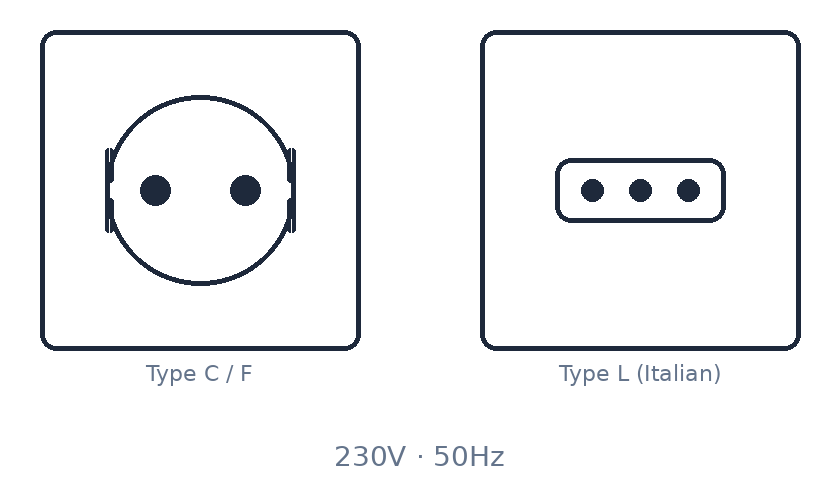
Most modern electronics (phones, laptops, cameras) handle the voltage difference automatically — check the label on your charger for “INPUT: 100-240V” to confirm. Hair dryers and straighteners from North America may need a voltage converter, or it’s easier to buy or borrow one locally.
Italy has good mobile coverage and widespread Wi-Fi, though speeds can be slower than in northern Europe, particularly in rural areas. EU residents benefit from “roam like at home” regulations with no extra charges. For visitors from outside the EU, TIM, Vodafone, and WindTre all offer prepaid tourist SIM options available at airports and phone shops.
📱 Need mobile data? An eSIM is the easiest way to stay connected in Europe — no SIM swapping, activate before you land. Compare the best eSIM providers for Europe →
Health and Safety
Italy has a good healthcare system. EU citizens can use the European Health Insurance Card (EHIC) or its replacement, the Global Health Insurance Card (GHIC), for necessary medical treatment. Non-EU visitors should carry comprehensive travel insurance — healthcare costs for uninsured visitors can be substantial.
In a medical emergency, call 118 (ambulance) or 112 (EU-wide emergency number). Pharmacies (farmacie, marked with a green cross) are well-stocked and pharmacists can provide advice and dispense many medications over the counter. A rotating schedule ensures at least one pharmacy stays open outside normal hours in every area (farmacia di turno).
Italy is generally safe for visitors. Pickpocketing is the main concern, particularly in Rome (around the Colosseum, Termini station, and crowded buses), Florence (central tourist areas), Naples (the train station area), and Milan (the Metro and Duomo area). Organized groups of thieves operate at major tourist sites — be wary of distraction techniques. Don’t leave belongings visible in parked cars, especially in southern Italy.
Food and Dining Culture
Italian food culture is central to daily life and varies enormously by region — Italians take regional food identity seriously, and what’s traditional in Bologna may be unheard of in Palermo. A few customs are worth knowing. Lunch is typically 12:30–2:30 PM and dinner from 7:30–8:00 PM onward (later in the south). Many restaurants close between services. The coperto (cover charge) is standard and legal — it’s not a tip.
A traditional Italian meal follows a specific structure: antipasto (starter), primo (pasta or risotto), secondo (meat or fish with contorno/side dish), and dolce (dessert). You don’t need to order every course — it’s perfectly acceptable to have just a primo, or an antipasto and a secondo. Coffee comes after dessert, never with the meal. Cappuccino is a morning drink — ordering one after lunch draws looks.
Regional specialties are a reason to travel Italy in themselves: pizza in Naples, ragù alla bolognese in Bologna (never called “spaghetti bolognese” — it’s served with tagliatelle), risotto alla milanese in Milan, bistecca alla fiorentina in Florence, orecchiette with broccoli rabe in Puglia, arancini in Sicily, and pesto in Liguria. The wine is outstanding and remarkably affordable, even at restaurants.
Italy: Economy and Context
Italy is the world’s fifth-most visited country, welcoming over 60 million international visitors annually. Tourism accounts for roughly 13% of GDP — one of the highest shares in Europe — and the infrastructure in major tourist areas reflects this long tradition of hospitality.
Italy is a founding member of the EU, the Eurozone, and the Schengen Area. The country holds the most UNESCO World Heritage Sites of any nation (59), more than Spain (50) or France (53). This extraordinary cultural density means that even small towns and lesser-known regions reward exploration.
Italy’s economy is the eighth-largest in the world, with significant regional variation. The industrialized north (Milan, Turin, Bologna) is prosperous and efficient; the south (Mezzogiorno) has lower incomes, higher unemployment, and a different pace of life — but also offers more authentic experiences and dramatically better value for travelers. Understanding this north-south dynamic helps set expectations.
Frequently Asked Questions
Do I need a visa to visit Italy?
Citizens of 59 countries, including the US, UK, Canada, and Australia, can visit Italy without a visa for up to 90 days within any 180-day period. This is the Schengen 90/180-day rule, which applies across all Schengen countries combined. Use our Europe Travel Planner to find out if your nationality requires a visa.
Will I need ETIAS to visit Italy in 2026?
ETIAS is expected to launch in late 2026, likely October or November. Once operational, visa-exempt visitors will need to apply online before traveling. The EU will confirm the exact date at least six months in advance. Until ETIAS launches, you only need your valid passport. See our ETIAS guide for the latest timeline.
What is the best time to visit Italy?
Spring (April–June) and autumn (September–October) offer the best combination of pleasant weather, manageable crowds, and reasonable prices. Summer (July–August) brings intense heat, peak crowds, and the highest prices — but also the best beach weather. Winter is ideal for skiing in the Dolomites and visiting cities without the crowds, though some coastal and rural attractions close for the season.
Do people speak English in Italy?
English is spoken in tourist areas, major hotels, and among younger Italians in cities. Outside these areas, particularly in rural Italy, the south, and smaller towns, English proficiency drops significantly. Learning basic Italian phrases will noticeably improve your experience and the warmth of local interactions.
How much does a trip to Italy cost?
Budget roughly €80–120 per day for budget travel, or €150–220 per day for mid-range travel including accommodation, meals, transport, and activities. Venice and the Amalfi Coast are Italy’s most expensive areas. Naples, Sicily, Puglia, and the rural south offer the best value.
Is Italy safe for tourists?
Italy is generally safe. Pickpocketing is a persistent issue at major tourist sites in Rome, Florence, Naples, and Milan, but violent crime against tourists is rare. Keep valuables secure, be aware of distraction scams, and don’t leave items visible in parked cars.
Do I need an International Driving Permit to drive in Italy?
EU/EEA license holders do not need an IDP. Non-EU visitors should carry an IDP alongside their home license — rental companies commonly request one, and police may require a translation of your license. See our IDP guide for how to get one in your country.
What is a ZTL zone?
A Zona a Traffico Limitato (ZTL) is a restricted traffic area in Italian city centers. Cameras photograph every plate that enters, and fines are sent directly to rental companies, who pass them to your credit card — often €50–100+ per violation. ZTL zones are poorly signed and change by time of day. Research the rules for every Italian city you plan to drive through.
🌍 Plan Your Trip to Italy
Entry requirements, visa status, and a full travel briefing — personalized for your nationality.
Use the Europe Travel Planner →📚 Related Articles
- Schengen 90/180-Day Rule — How the visa-free stay limit works across Europe
- ETIAS: Europe’s New Travel Authorization — What you’ll need starting late 2026
- Entry/Exit System (EES) — How the new biometric borders work
- International Driving Permit in Europe — Country-by-country IDP requirements
- Best Travel Insurance for Europe — Protect your trip
- Travel to France: Complete Guide
- Travel to Spain: Complete Guide
- Travel to Greece: Complete Guide
- All Europe Country Guides
This article is for informational purposes only and does not constitute legal or travel advice. Entry requirements can change — always verify with official government sources before traveling. Last updated: February 2026.