
Last Updated: February 2026
Greece is where European civilization began — and where millions of travelers come every year to see ancient ruins, swim in impossibly clear water, and eat grilled octopus overlooking the Aegean Sea. Athens anchors the mainland with 3,000 years of layered history, but it’s the islands that define Greek travel: over 200 inhabited islands scattered across multiple seas, each with its own character. From the whitewashed cliffs of Santorini to the pine-covered coves of the Ionian, Greece delivers something between archaeological pilgrimage and Mediterranean escape. Here’s everything you need to know to plan a visit in 2026.
🇬🇷 Greece at a Glance
| Capital | Athens |
| Population | ~10.4 million |
| Currency | Euro (€) |
| Language | Greek |
| Time Zone | EET (UTC+2) · EEST in summer (UTC+3) |
| Plug Type | Type C and F · 230V / 50Hz |
| Driving Side | Right |
| International Driving Permit (IDP) | Required for non-EU licenses — see IDP guide |
| Schengen Member | Yes |
| Emergency Number | 112 (EU-wide) · 166 (ambulance) · 100 (police) · 199 (fire) |
Entry Requirements for Greece
Greece is part of the Schengen Area, meaning it follows the same entry rules as the other 28 Schengen member countries. What you need to enter Greece depends on your nationality.
Visa-Exempt Visitors (US, UK, Canada, Australia, and Others)
Citizens of 59 visa-exempt countries — including the United States, United Kingdom, Canada, Australia, New Zealand, Japan, and most Latin American nations — can enter Greece without a visa for short stays of up to 90 days within any 180-day period. This is the standard Schengen 90/180-day rule, and it applies across all 29 Schengen countries combined, not just Greece.
To enter Greece as a visa-exempt visitor, your passport must meet two requirements. It must have been issued within the last 10 years at the time of entry, and it must remain valid for at least three months after your planned departure date from the Schengen area.
Not sure what applies to your nationality? Use the Europe Travel Planner to find out exactly what you need.
Visa-Required Visitors
If your country is not on the visa-exempt list, you’ll need to apply for a Schengen short-stay visa (Type C) before traveling to Greece. This visa allows stays of up to 90 days within a 180-day period across the entire Schengen Area.
You’ll typically need to apply at the Greek embassy or consulate in your home country, or through an authorized visa application center. Required documents generally include a completed application form, a passport-sized photo, proof of accommodation, travel insurance with minimum €30,000 coverage, proof of financial means, and a round-trip flight reservation.
Processing times are usually 15 calendar days but can take up to 45 days during peak season. Apply early. For a full walkthrough, see the Schengen Visa Application Guide.
What’s Changing at Greece’s Borders
Two major systems are being introduced at Schengen borders, including Greece’s, that will change how travelers enter Europe.
The Entry/Exit System (EES) will replace passport stamps with digital biometric records — fingerprints and facial scans — when it goes live. It will automatically track how long you’ve stayed in the Schengen Area and flag overstays. No more counting stamps.
Following that, the European Travel Information and Authorization System (ETIAS) will require visa-exempt travelers (including Americans, Brits, Canadians, and Australians) to apply for a travel authorization online before arriving. It’s expected to cost €7, be valid for three years, and take minutes to complete. ETIAS is expected to launch in late 2026.
Neither system is active yet, but they’re coming. Bookmark our ETIAS launch date tracker for the latest updates.
Getting to Greece
Greece’s main international gateway is Athens International Airport “Eleftherios Venizelos” (ATH), with direct flights from across Europe, the Middle East, North America, and Asia. Aegean Airlines (Greece’s flag carrier and a Star Alliance member) and its subsidiary Olympic Air operate an extensive domestic and European network. Direct transatlantic routes from the US include flights from New York (JFK), Newark, Chicago, Philadelphia, and Atlanta — with additional seasonal routes in summer.
Thessaloniki Airport “Makedonia” (SKG) is the second-largest hub, with strong European connections. During summer, many Greek islands receive direct international flights — particularly Crete (Heraklion and Chania), Rhodes, Corfu, Mykonos, Santorini, Kos, and Zakynthos — primarily from European cities on charter and low-cost carriers like Ryanair, easyJet, and Wizz Air.
By sea, Greece is connected to Italy by ferry routes from Ancona, Bari, Brindisi, and Venice to Patras, Igoumenitsa, and Corfu. Major operators include Superfast Ferries, ANEK Lines, Minoan Lines, and Grimaldi. Crossings range from 7 hours (Brindisi–Igoumenitsa) to 22 hours (Venice–Patras). By land, you can enter Greece from Bulgaria, North Macedonia, Albania, and Turkey — all with border controls, as only Greece is in the Schengen Area among its neighbors.
Getting Around Greece
Greece’s geography — mountainous mainland, thousands of islands — means getting around involves multiple transport modes. Ferries are as essential as roads.
Ferries
Ferries are the backbone of Greek island travel. The main departure port is Piraeus (Athens’ port), with connections to the Cyclades, Dodecanese, Crete, and the Saronic Islands. Rafina (east of Athens) serves many Cycladic islands. Lavrio serves Kea and Kythnos. In the north, Thessaloniki and Kavala connect to the northeastern Aegean islands.
Ferry types range from slow conventional ferries (cheapest, 5–8 hours to popular Cycladic islands) to high-speed catamarans (roughly half the time, roughly double the price). Major operators include Blue Star Ferries, Seajets, Hellenic Seaways, and Minoan Lines. Book through Ferryhopper or Direct Ferries for schedules and tickets.
Trains
Greece’s rail network is limited compared to Western Europe but useful for the Athens–Thessaloniki corridor. Hellenic Train (formerly TrainOSE, now owned by Italy’s FS Group) operates InterCity services between Athens and Thessaloniki in approximately 4–5 hours, with tickets starting around €16–€45. The ETR 470 “Silver Arrow” tilting trains introduced in 2022 are the fastest option. Suburban trains connect Athens to its airport, Piraeus, Kiato, and Chalkida.
Book at hellenictrain.gr. The rail network doesn’t reach the islands or most of the Peloponnese, so trains are really only practical for mainland travel between major cities.
Getting Around Comparison
| Mode | Best For | Cost Range | Notes |
|---|---|---|---|
| Ferry (conventional) | Island hopping on a budget | €20–€50 | Slow but cheap. Deck class is fine for daytime routes. |
| Ferry (high-speed) | Popular Cycladic islands | €40–€80 | Half the time. Book early in summer. Wind cancellations possible. |
| InterCity train | Athens ↔ Thessaloniki | €16–€45 | ~4–5 hours. Book at hellenictrain.gr. |
| KTEL buses | Mainland cities + towns | €5–€40 | Extensive network. Reaches places trains don’t. Book at ktelbus.com. |
| Domestic flights | Athens ↔ islands, long hops | €30–€120 | Aegean/Olympic Air. Essential for distant islands (Crete, Rhodes). |
| Athens Metro | City + airport | €1.20/ride | 3 lines. Line 3 runs to the airport (€9 one-way). |
| Rental car | Mainland touring, large islands | €25–€60/day | Essential for Crete, Peloponnese. IDP required for non-EU licenses. |
| Scooter/ATV rental | Small islands | €15–€30/day | Common on islands. License required. Insurance often minimal. |
Where to Go in Greece
Athens
The Greek capital is dominated by the Acropolis — the Parthenon, the Erechtheion, and the Temple of Athena Nike perched on a rocky outcrop above the city. The Acropolis Museum at its base is one of the best archaeological museums in the world. But Athens extends well beyond ancient ruins. The Plaka and Monastiraki neighborhoods offer tavernas, street markets, and Byzantine churches. Psyrri and Gazi are the nightlife districts. Exarchia is the countercultural and street art hub. The Athens Riviera — a stretch of coastline south from Glyfada to Cape Sounion (where the Temple of Poseidon stands on a cliff overlooking the Aegean) — is an easy day trip by tram or car.
The National Archaeological Museum houses one of the world’s greatest collections of ancient Greek art, from Mycenaean gold to classical bronzes. The Benaki Museum and the Museum of Cycladic Art are also worth a visit. Athens’ food scene has evolved significantly in recent years, blending traditional Greek taverna cooking with modern Mediterranean cuisine.
The Cyclades
The Cyclades are the postcard Greece — whitewashed buildings, blue-domed churches, and dramatic caldera views. Santorini is the most famous, with the villages of Oia and Fira perched on the rim of a volcanic caldera. Mykonos is the party island, known for beach clubs, nightlife, and the windmills above Chora. But the Cyclades extend far beyond these two. Paros offers a more relaxed alternative with excellent beaches and the traditional village of Naoussa. Naxos is the largest Cycladic island, with green valleys, mountain villages, and long sandy beaches — arguably the best all-rounder for families. Milos has extraordinary volcanic rock formations and over 70 beaches, including the lunar landscape of Sarakiniko. Smaller islands like Folegandros, Sifnos (famous for its food), and Koufonisia offer a quieter, more authentic Cycladic experience.
Crete
Greece’s largest island is practically a country in itself — 260 km long, with its own distinct culture, cuisine, and dialect. The north coast has the major cities: Heraklion (home to the Minoan palace of Knossos, Europe’s oldest civilization), Chania (a Venetian harbor town and arguably Crete’s most beautiful city), and Rethymno (a Renaissance-era old town). The south coast is wilder and less developed — Matala, Loutro (accessible only by boat or on foot), and the Libyan Sea beaches are highlights. The Samariá Gorge, a 16 km hike from the White Mountains to the sea, is one of Europe’s longest gorges and a national park. Cretan food — dakos (barley rusk salad), kalitsounia (cheese pastries), lamb with stamnagathi (wild greens), and local olive oil — is considered the purest expression of the Mediterranean diet.
The Dodecanese
Rhodes, the largest island in the Dodecanese, has a UNESCO-listed medieval old town built by the Knights of St. John — one of the best-preserved medieval cities in Europe. Kos offers a mix of ancient Greek and Roman ruins, long beaches, and easy access to the Turkish coast. Patmos, where St. John reportedly wrote the Book of Revelation, has a monastery and a cave that draw pilgrims and travelers seeking something more contemplative. The smaller islands — Symi (with its neoclassical harbor), Karpathos, and Leros — are increasingly popular for travelers looking to escape the Cycladic crowds.
The Ionian Islands
The Ionian Islands — Corfu, Kefalonia, Zakynthos, Lefkada, and Ithaca — sit in the western sea and have a distinctly different character from the Aegean islands: greener, wetter, with Venetian and British colonial influences in the architecture. Corfu’s old town is a UNESCO World Heritage Site. Kefalonia’s Myrtos Beach is regularly ranked among the most beautiful in Europe. Zakynthos has the famous Navagio (Shipwreck) Beach, one of the most photographed spots in Greece. Lefkada offers some of Greece’s best beaches (Porto Katsiki, Egremni) plus a land bridge to the mainland. These islands are particularly popular with sailors and yachters.
The Peloponnese
The Peloponnese peninsula is mainland Greece’s archaeological heartland and one of its most underrated travel destinations. Ancient Olympia (birthplace of the Olympic Games), Mycenae (the Bronze Age citadel of Agamemnon), Epidaurus (with its near-perfect ancient theater, still hosting performances), and the Byzantine ghost town of Mystras are all here. Nafplio, a Venetian-era coastal town often called the most beautiful small city in Greece, makes an excellent base. The Mani Peninsula in the south is wild and dramatic — stone tower villages, empty beaches, and the Diros Caves.
Northern Greece
Thessaloniki, Greece’s second city, is a university town with outstanding food (it’s widely considered the culinary capital of Greece), Byzantine churches, Roman ruins, a vibrant waterfront, and a nightlife scene that rivals Athens. The Halkidiki peninsula southeast of the city has three prong-like peninsulas with resort beaches — the easternmost, Mount Athos, is a monastic republic restricted to male visitors with special permits. Further north, the lakes and mountains of Epirus and Western Macedonia offer hiking, rafting in the Vikos Gorge (one of the deepest in the world), and the stone villages of Zagori — some of Greece’s most spectacular and least-visited landscapes.
Practical Information for Visitors
Money and Costs
Greece uses the euro (€). It remains one of the more affordable destinations in southern Europe, though popular islands (Santorini, Mykonos) and central Athens have become noticeably expensive.
As a rough guide: a meal at a taverna costs €10–€18 per person. A Greek coffee or freddo espresso is €1.50–€3.50. A glass of house wine runs €3–€5. A gyros/souvlaki wrap is €3–€4.50. A three-course meal at a mid-range restaurant in Athens or on a popular island is €25–€45 per person. Budget travelers eating at local tavernas, taking conventional ferries, and staying in guesthouses can manage on €60–€90 per day on the mainland and €80–€120 on the islands.
Credit cards are widely accepted in cities and tourist areas, but smaller islands, village tavernas, and some ferries still prefer cash. ATMs are available on all but the smallest islands — but on tiny islands, they sometimes run out of cash in peak season. Bring backup.
Language
Greek is the official language. English is widely spoken in Athens, Thessaloniki, and on tourist islands — Greece has high English proficiency by Mediterranean standards, especially among younger people. In rural areas and on smaller islands, English is less common. The Greek alphabet can be initially confusing for navigation, but most road signs and menus in tourist areas are bilingual. A few phrases go a long way: “efcharistó” (thank you), “kalimera” (good morning), “parakaló” (please/you’re welcome), “yassas” (hello, formal).
Power and Connectivity
Greece uses Type C and Type F power plugs at 230V/50Hz. If you’re traveling from the US, Canada, UK, or Australia, you’ll need a plug adapter.
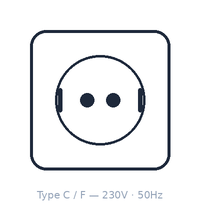
Most modern electronics (phones, laptops, cameras) handle the voltage difference automatically — check the label on your charger for “INPUT: 100-240V” to confirm. Hair dryers and straighteners from North America may need a voltage converter, or it’s easier to buy or borrow one locally.
Mobile coverage is good on the mainland and on larger islands. Smaller or more remote islands may have patchy signal. EU/EEA travelers benefit from “roam like at home” regulations with no extra charges. For visitors from outside the EU, purchasing a local SIM card or eSIM is straightforward — Cosmote, Vodafone, and Wind (Nova) all offer prepaid options available at airports and phone shops. Wi-Fi is widely available at hotels, restaurants, and cafés.
📱 Need mobile data? An eSIM is the easiest way to stay connected in Europe — no SIM swapping, activate before you land. Compare the best eSIM providers for Europe →
Health and Safety
Greece has a public healthcare system, and EU/EEA citizens can use their European Health Insurance Card (EHIC) or Global Health Insurance Card (GHIC) for treatment. Non-EU visitors should carry travel insurance with medical coverage — private hospital treatment can be expensive, and on smaller islands, medical facilities are limited (serious cases may require an airlift to Athens or Crete). Pharmacies (farmakeía, marked with a green cross) are well-stocked and pharmacists can advise on minor ailments. A rotation system ensures at least one pharmacy is always open in each area.
Greece is very safe for visitors. Violent crime against tourists is rare. The main concerns are petty theft (pickpocketing around Monastiraki and Omonia in Athens, on crowded ferries, and at busy island ports) and road safety — Greek driving culture is assertive, and island roads can be hazardous. Stray dogs are common throughout Greece but are generally harmless and often community-fed. Jellyfish can be an issue at some beaches in summer.
Food and Dining Culture
Greek cuisine is one of the foundations of the Mediterranean diet — built on olive oil, fresh vegetables, herbs, grains, fish, and lamb. Meals in Greece are meant to be shared and stretched over time, especially dinner.
Start with mezedes (small shared plates): tzatziki, melitzanosalata (eggplant dip), fava (yellow split pea purée), saganaki (fried cheese), grilled octopus, and dolmades (stuffed grape leaves). Main dishes include moussaka (layered eggplant, potato, and meat with béchamel), pastitsio (baked pasta), souvlaki (grilled meat skewers), and fresh grilled fish — sold by weight at seaside tavernas. Horiatiki salad (the real “Greek salad” — tomato, cucumber, onion, olives, and a slab of feta, dressed only with olive oil and oregano) appears on virtually every table.
Cretan cuisine deserves special mention — it’s the purest expression of the Mediterranean diet, built around wild greens, barley, fresh cheese, and olive oil that locals have been producing for thousands of years. Thessaloniki is considered Greece’s food capital, with influences from Asia Minor, the Balkans, and the Ottoman period adding depth to the standard Greek repertoire.
Greek wine has been undergoing a renaissance, with indigenous grape varieties like Assyrtiko (from Santorini), Xinomavro (from Naoussa), and Agiorgitiko (from Nemea) gaining international recognition. Ouzo (anise-flavored spirit, always served with water) and tsipouro (a clear grape spirit) are the traditional accompaniments to seafood mezedes. Greek coffee (strong, unfiltered, served in a small cup) is a cultural institution, though freddo espresso and freddo cappuccino have become the modern everyday drinks.
Mealtimes in Greece are later than most of Europe. Lunch runs from 1:30 to 3:30 PM. Dinner rarely starts before 9:00 PM, and on islands in summer, 10:00 PM is normal. Many tavernas don’t take reservations — you just show up.
Greece: Economy and Context
Greece has a GDP of approximately $282 billion (nominal), making it the 50th largest economy in the world. Tourism is the single most important sector, accounting for roughly 20% of GDP and supporting about 25% of jobs during peak season. In 2024, Greece welcomed a record 36 million international tourists, generating over €22 billion in revenue — with Germany, the UK, and Italy as the top source markets.
The country’s economic trajectory over the past 15 years has been defined by crisis and recovery. Greece’s debt crisis (2010–2018) led to severe austerity, multiple bailouts, and a GDP contraction of roughly 25%. The recovery has been steady — GDP growth of around 2% annually in recent years, investment-grade credit ratings restored in 2023–2025, and unemployment dropping from a peak of 28% to approximately 10%. However, challenges remain: public debt is still around 160% of GDP, youth unemployment is above the EU average, and the cost of living in Athens has risen significantly, partly driven by tourism and the short-term rental market.
Greece is a founding member of NATO, an EU member since 1981, and part of both the Eurozone and the Schengen Area. The country also has the world’s largest merchant shipping fleet by tonnage — a pillar of the economy that’s often overlooked by visitors focused on islands and ruins.
Frequently Asked Questions
Do I need a visa to visit Greece?
Citizens of 59 countries, including the US, UK, Canada, and Australia, can visit Greece without a visa for up to 90 days within any 180-day period. This is the standard Schengen 90/180-day rule. Other nationalities need a Schengen visa. Use the Europe Travel Planner at schengentraveler.com to find out if your nationality requires a visa.
What’s the best time to visit Greece?
May–June and September–October offer the best balance of warm weather, manageable crowds, and reasonable prices. July and August are peak season — hot, crowded, and expensive on popular islands. The meltemi wind blows strong in the Aegean from mid-July through August, which can cancel ferries but keeps temperatures bearable. April is good for the mainland and archaeological sites; October is excellent for Crete and the Dodecanese.
How do I get from Athens to the islands?
By ferry from Piraeus, Rafina, or Lavrio ports (2–8 hours depending on island and ferry type) or by domestic flight with Aegean Airlines or Olympic Air (30–60 minutes). High-speed ferries are faster but cost more and are more affected by wind. Conventional ferries are reliable and affordable.
Is island hopping easy to organize?
Yes. The Cyclades and Dodecanese are particularly well-connected by ferry. Use Ferryhopper.com to check routes and book. In summer, services are frequent. In shoulder season, connections thin out. Always check schedules — not every island connects directly to every other island.
Do I need an International Driving Permit to drive in Greece?
EU/EEA license holders do not need an IDP. Non-EU visitors are legally required to carry an IDP alongside their home license. This is enforced by Greek police and by rental agencies — most will refuse to rent without one. See our IDP guide for how to get one in your country.
Is Greece expensive?
Greece is mid-range for Western Europe. The mainland and less-touristed islands are affordable — budget €60–€90 per day. Santorini and Mykonos are expensive, especially for accommodation in summer. Eating at tavernas rather than restaurants near attractions keeps food costs reasonable everywhere.
Is Greece safe?
Greece is very safe for tourists. Violent crime is rare. The main risks are pickpocketing in Athens’ tourist areas and scooter accidents on the islands. Greek driving can be aggressive — take extra care on the roads, especially on islands where rental scooters and narrow roads are a dangerous combination.
What is the Climate Crisis Resilience Fee?
Introduced in 2024, this is a nightly accommodation fee that applies to all visitors. It ranges from €0.50 per night for 1–2 star hotels to €10 per night for 5-star hotels. Short-term rentals (Airbnb, etc.) are also subject to the fee. It’s usually added to your bill automatically.
🌍 Plan Your Trip to Greece
Entry requirements, visa status, and a full travel briefing — personalized for your nationality.
Use the Europe Travel Planner →📚 Related Articles
- Schengen 90/180-Day Rule — How the visa-free stay limit works across Europe
- ETIAS: Europe’s New Travel Authorization — What you’ll need starting late 2026
- Entry/Exit System (EES) — How the new biometric borders work
- International Driving Permit in Europe — Country-by-country IDP requirements
- Best Travel Insurance for Europe — Protect your trip
- Travel to Italy: Complete Guide
- All Europe Country Guides
This article is for informational purposes only and does not constitute legal or travel advice. Entry requirements can change — always verify with official government sources before traveling. Last updated: February 2026.