
Last Updated: February 2026
Belgium is proof that great things come in small packages. This compact country wedged between France, Germany, the Netherlands, and Luxembourg packs in medieval canal cities, world-class beer and chocolate, the headquarters of the European Union and NATO, and a cultural richness that draws nearly 10 million international visitors a year. From the cobblestoned lanes of Bruges to the art nouveau streets of Brussels to the battlefields of Flanders, Belgium consistently surprises travelers who expected a quick stopover but ended up staying for days. Here’s everything a visitor needs to know to plan a trip to Belgium in 2026.
🇧🇪 Belgium at a Glance
| Capital | Brussels |
| Population | ~11.9 million (2026) |
| Currency | Euro (€) |
| Languages | Dutch (Flemish), French, German |
| Time Zone | CET (UTC+1) · CEST in summer (UTC+2) |
| Plug Type | Type C and E · 230V / 50Hz |
| Driving Side | Right |
| International Driving Permit (IDP) | Recommended — see IDP guide |
| Schengen Member | Yes — founding member (1985) |
| Emergency Number | 112 (EU-wide) · 101 (police) · 100 (fire/ambulance) |
Entry Requirements for Belgium
Belgium is part of the Schengen Area — in fact, it’s one of the five original countries that created the Schengen Agreement in 1985. It follows the same entry rules as the other 28 Schengen member countries. What you need to enter Belgium depends on your nationality.
Visa-Exempt Visitors (US, UK, Canada, Australia, and Others)
Citizens of 59 visa-exempt countries — including the United States, United Kingdom, Canada, Australia, New Zealand, Japan, and most Latin American nations — can enter Belgium without a visa for short stays of up to 90 days within any 180-day period. This is the standard Schengen 90/180-day rule, and it applies across all 29 Schengen countries combined, not just Belgium.
To enter Belgium as a visa-exempt visitor, your passport must meet two requirements. It must have been issued within the last 10 years at the time of entry, and it must remain valid for at least three months after your planned departure date from the Schengen area.
At the border, Belgian officials may ask for proof of accommodation, proof of sufficient funds, and evidence of onward or return travel. These documents aren’t always requested — especially at airports with intra-Schengen flights — but having them available avoids potential complications.
Visitors Who Need a Visa
If your country is not on the visa-exempt list, you’ll need to apply for a Schengen short-stay visa (Type C) through the Belgian consulate or embassy in your home country before traveling. This visa allows stays of up to 90 days within a 180-day period and typically costs €80 for adults.
For longer stays — work, study, or family reunification — you’ll need a Belgian national long-stay visa (Type D), which must be applied for separately from a Schengen visa. Use our Europe Travel Planner to find out exactly what your nationality requires.
What’s Changing at Belgium’s Borders in 2026
Two major systems are transforming how non-EU visitors enter Belgium and the rest of the Schengen area. Both are rolling out in 2026, and travelers need to be aware of the timeline.
Entry/Exit System (EES)
The Entry/Exit System began its phased rollout on October 12, 2025, and is expected to be fully operational at all Schengen border crossings by April 10, 2026. EES replaces the old passport-stamping process with a digital system that records biometric data — fingerprints and facial images — along with your passport details and entry/exit dates.
The first time you enter the Schengen area under EES, border officials will collect your fingerprints and take a facial photograph. This is done either at a self-service kiosk (if you have a biometric passport) or by a border guard. Once you’re registered, the data stays valid for three years, and subsequent entries only require identity verification rather than a full re-registration.
Brussels Airport (Zaventem) was among Belgium’s first points of entry to implement EES checks starting October 2025. Brussels South Charleroi Airport has followed, with all Belgian border crossings — including the Eurostar terminal at Brussels-Midi — expected to be fully operational by April 2026. Expect longer wait times during the transition period, particularly for Eurostar passengers arriving from London.
ETIAS — Europe’s New Travel Authorization
The European Travel Information and Authorization System (ETIAS) is expected to launch in late 2026, likely in October or November. Once operational, all visa-exempt travelers — including Americans, Britons, Canadians, and Australians — will need to apply for ETIAS authorization before boarding a flight or train to Belgium or any other Schengen country.
The ETIAS application is completed online and takes roughly 10 minutes. It asks for personal details, passport information, and security-related questions. The fee is €20 for travelers aged 18 to 70 (free for those younger or older). Once approved, ETIAS is valid for three years or until your passport expires, whichever comes first. It covers all 29 Schengen countries, so you don’t need a separate authorization for each destination.
Getting to Belgium
Belgium’s central location in Western Europe and its role as the EU capital make it one of the continent’s most connected and accessible countries by air, rail, and road.
By Air
Brussels Airport (BRU, also called Zaventem) is Belgium’s main international gateway, with direct connections to major cities across Europe, North America, Africa, and the Middle East. It’s a hub for Brussels Airlines (part of the Lufthansa Group). From North America, United, American Airlines, and Brussels Airlines offer nonstop flights to Brussels.
Brussels South Charleroi Airport (CRL), about 60 km south of Brussels, is a major hub for Ryanair and serves dozens of European destinations at budget prices. Despite the name, it’s not in Brussels — factor in an hour’s bus or shuttle ride to the city center. Antwerp (ANR) and Liège (LGG) airports handle some European and cargo traffic but are less relevant for most visitors.
By Train
Brussels is one of Europe’s great rail hubs. Eurostar runs high-speed trains to London (2 hours) and the Eurostar network (formerly Thalys) connects Brussels with Paris (1 hour 22 minutes), Amsterdam (2 hours), and Cologne (1 hour 50 minutes). In December 2024, OUIGO launched a budget Brussels–Paris service on the classic line, taking about 3 hours from €10 — a much cheaper alternative to the high-speed Eurostar.
Deutsche Bahn ICE trains connect Brussels with Frankfurt and other German cities. ÖBB’s Nightjet sleeper service connects Brussels with Vienna, Innsbruck, and other Austrian cities overnight. Belgian Railways (SNCB/NMBS) EuroCity Direct trains run between Brussels and Amsterdam via Antwerp, Rotterdam, and Schiphol Airport in about 2 hours.
By Car
Belgium borders France, the Netherlands, Germany, and Luxembourg. As a Schengen member, there are normally no border controls between Belgium and its neighbors. Belgium’s motorways link seamlessly with the French, Dutch, German, and Luxembourg highway systems. From Calais, Bruges is just over an hour’s drive; Brussels is about two and a half hours. The Channel Tunnel makes Belgium easily accessible from the UK by car.
Getting Around Belgium
Belgium’s compact size — about the area of Maryland — makes it remarkably easy to get around. No major city is more than a few hours from any other, and the train network connects virtually every town of consequence.
Trains
The Belgian rail network, operated by SNCB/NMBS (Nationale Maatschappij der Belgische Spoorwegen / Société Nationale des Chemins de fer Belges), is one of Europe’s densest. Belgian domestic trains run on a simple, turn-up-and-go basis with fixed-price tickets based on distance — no reservations needed or possible.
| Mode | Best For | Cost Range | Notes |
|---|---|---|---|
| InterCity (IC) | Major city connections | €10–28 | Brussels–Bruges ~1h · Brussels–Ghent ~35min · Brussels–Antwerp ~40min · Brussels–Liège ~1h · Trains every 15–30 min on main routes |
| Local/Regional (L/S) | Smaller towns, suburbs | €3–15 | More stops, slower · Connects smaller stations · No reservation needed |
| Eurostar | London, Paris, Amsterdam | From €29 (advance) | High-speed · Brussels–London ~2h · Brussels–Paris ~1h 22min · Book early for best fares |
| OUIGO Train Classique | Budget Brussels–Paris | From €10 | Launched Dec 2024 · ~3h via classic line · 3 daily departures · No catering on board |
| EuroCity Direct | Amsterdam, Rotterdam | From €16 | Brussels–Amsterdam ~2h via Antwerp and Rotterdam · Reservation required |
Belgian domestic tickets: A standard second-class ticket from Brussels to Bruges or Antwerp costs €17.60, and first class is €28. Tickets are valid on any train on the date printed — so if you miss your intended train, just take the next one. Under-26 travelers can buy a Go Pass (10 trips for €56), while adults can get a Rail Pass (10 trips for €93). On weekends, return trips get a 50% discount, making Saturday and Sunday the cheapest days to explore.
Brussels Public Transit
Brussels has an efficient public transit system operated by STIB/MIVB, comprising four metro lines, an extensive tram network, and bus routes. A single ticket costs €2.10, a one-day pass is €8, and a three-day pass is €16. The system covers the entire Brussels-Capital Region, including connections to both Brussels Airport (via train, not STIB) and the city’s main stations. Most visitors use a combination of metro and walking — Brussels is a surprisingly walkable city once you’re in the center.
Driving
While Belgium’s cities are best explored by train and on foot, a car is useful for the Ardennes region, the Belgian coast, and the Flemish countryside — places where public transit is less frequent. Major international rental companies are available at airports and city stations.
Belgium drives on the right. Speed limits are 120 km/h on motorways, 90 km/h on rural roads in Wallonia (70 km/h in Flanders), and 50 km/h in built-up areas (30 km/h in residential zones and near schools). Speed cameras — including average-speed cameras — are widespread and fines are steep, particularly in Flanders.
Motorway tolls: Belgium’s motorways are toll-free for passenger vehicles. The only exception is the Liefkenshoek Tunnel near Antwerp (about €6). Unlike France, Austria, or Switzerland, there’s no vignette system.
Priority from the right: Belgium uses the “priorité à droite” rule — vehicles coming from the right have priority at intersections unless signs indicate otherwise. This catches many foreign drivers off guard, especially in residential areas. Trams always have priority over all other traffic.
International Driving Permit: Belgium doesn’t require an IDP for visitors with licenses from EU countries, the US, Canada, or Australia. However, having one adds a French/Dutch translation of your license that can simplify interactions with rental companies or police. See our International Driving Permit guide for details.
Where to Go in Belgium
Belgium’s small size makes multi-city trips easy — you can see Brussels, Bruges, and Ghent in a long weekend. But the country rewards deeper exploration with surprising variety, from medieval art cities to forested highlands to windswept North Sea beaches.
Brussels
Belgium’s capital and the de facto capital of the European Union, Brussels is a city of contrasts — monumental and quirky, international and fiercely local. The Grand-Place, a UNESCO World Heritage Site, is one of Europe’s most stunning city squares, ringed by ornate guild houses and the Gothic town hall. Beyond the headlines, Brussels rewards explorers with outstanding art nouveau architecture (the city has the world’s densest concentration of it), world-class museums including the Magritte Museum and the Royal Museums of Fine Arts, and a food scene that takes its waffles, chocolate, frites, and especially its beer very seriously. Brussels recorded nearly 9.8 million overnight stays in 2024, a new record.
Bruges
Bruges is the medieval masterpiece that most visitors picture when they think of Belgium. Its entire city center is a UNESCO World Heritage Site, crisscrossed by canals and filled with beautifully preserved Gothic and Renaissance architecture. The Belfry tower, the Basilica of the Holy Blood, and the Memling Museum are highlights, but much of the magic is simply in wandering. Bruges is also a serious beer destination — the De Halve Maan brewery runs a beer pipeline under the city center, and the city has more chocolate shops per square meter than arguably anywhere on earth. One hour from Brussels by direct train, Bruges works perfectly as either a day trip or an overnight stay.
Ghent
Ghent may be Belgium’s best-kept secret. A vibrant university city with a medieval core as impressive as Bruges but with a more local, lived-in atmosphere, Ghent offers St. Bavo’s Cathedral (home to the van Eyck brothers’ “Adoration of the Mystic Lamb,” one of the most important artworks in Western art history), the imposing Gravensteen castle, and a waterfront Graslei and Korenlei that’s spectacular day or night. The city has a thriving food and nightlife scene fueled by its large student population, and it hosts the massive Gentse Feesten festival every July. Just 35 minutes from Brussels by train.
Antwerp
Belgium’s second-largest city is the country’s fashion and design capital, home to a globally influential fashion scene centered on the Royal Academy of Fine Arts. Antwerp’s Central Station is often called one of the most beautiful railway stations in the world. The city is also the world’s diamond capital, with a dedicated diamond district. Rubens lived and worked here — his house and studio are now a museum — and the Museum aan de Stroom (MAS) offers a modern counterpoint to the historic harbor. The Antwerp street food scene and bar culture rival Brussels.
The Ardennes and Wallonia
Southern Belgium is a world apart from the flat, Flemish north. The Ardennes region is a landscape of deep river valleys, dense forests, and hilltop castles — ideal for hiking, kayaking, and mountain biking in summer and cross-country skiing in winter. The towns of Dinant (birthplace of Adolphe Sax, inventor of the saxophone) and Durbuy (which bills itself as the world’s smallest city) are popular bases. Wallonia’s cuisine leans toward the hearty and rustic — game, trout, and local cheeses — and the region produces excellent beers, including several Trappist varieties.
Flanders Fields
The area around Ypres (Ieper) in western Flanders is hallowed ground for anyone interested in World War I history. The In Flanders Fields Museum, housed in the reconstructed Cloth Hall, is one of Europe’s finest war museums. The Menin Gate Memorial hosts a moving Last Post ceremony every evening at 8 PM — a tradition unbroken since 1928. The surrounding countryside is dotted with cemeteries, memorials, and preserved trenches. Tyne Cot Cemetery, the largest Commonwealth war cemetery in the world, is a deeply powerful place. Ypres is about 1 hour 30 minutes from Brussels by car or 2 hours by train with a connection in Kortrijk.
The Belgian Coast
Belgium’s 67-kilometer North Sea coastline runs from De Panne near the French border to Knokke-Heist near the Netherlands. Ostend is the main resort town, with a lively boardwalk, excellent seafood restaurants, and a handful of good museums. The Belgian Coast Tram — the world’s longest tram line at 68 kilometers — runs the entire length of the coast, making it easy to hop between beach towns. The coast is most popular with Belgian and Dutch holidaymakers in summer and makes an unconventional but enjoyable day trip from Bruges or Brussels.
Practical Information for Visitors
Money and Costs
Belgium uses the euro (€). Credit and debit cards are widely accepted, and contactless payment has become standard at most restaurants, shops, and transit systems. Belgium is somewhat less cash-dependent than its southern European neighbors, but carrying some cash is wise for smaller shops, market stalls, and friteries.
Belgium is moderately expensive — roughly comparable to the Netherlands and France, somewhat cheaper than the Nordic countries, and more expensive than Southern and Eastern Europe. Brussels, as an EU capital and business hub, is the priciest city. Wallonia and smaller Flemish cities offer notably better value.
A coffee in a café costs €3–5, a half-pint of Belgian beer at a bar runs €3.50–5 (though special or Trappist beers can cost considerably more), and a main course at a mid-range restaurant typically costs €15–22. A plate of moules-frites at a decent brasserie costs €18–27. Budget around €120–170 per day for mid-range travel in Brussels (hotel, meals, transport, and sightseeing). In Ghent, Bruges, or Wallonia, €100–140 per day is realistic for a comfortable experience.
Tipping in Belgium is not obligatory — service charge is included in restaurant bills by law. Rounding up or leaving 5–10% for good service is appreciated but never expected. Tipping taxi drivers is similarly optional — rounding up to the nearest euro is the norm.
Language
Belgium is trilingual, and understanding its language geography helps avoid awkward moments. The country is divided into three language communities: Dutch-speaking Flanders in the north, French-speaking Wallonia in the south, and a small German-speaking community in the east. Brussels is officially bilingual (Dutch and French), though French predominates in daily life.
English is widely spoken throughout Belgium, especially in Brussels, Flanders, and tourist areas. Most Belgians in Flanders speak excellent English (often better than their French). In Wallonia, English is less common outside major cities — basic French goes a long way. As a courtesy, it’s worth knowing which language region you’re in and using the appropriate greeting: “Goedendag” in Flanders, “Bonjour” in Wallonia, and either in Brussels.
Power and Connectivity
Belgium uses Type C and Type E power plugs at 230V/50Hz. If you’re traveling from the US, Canada, UK, or Australia, you’ll need a plug adapter.
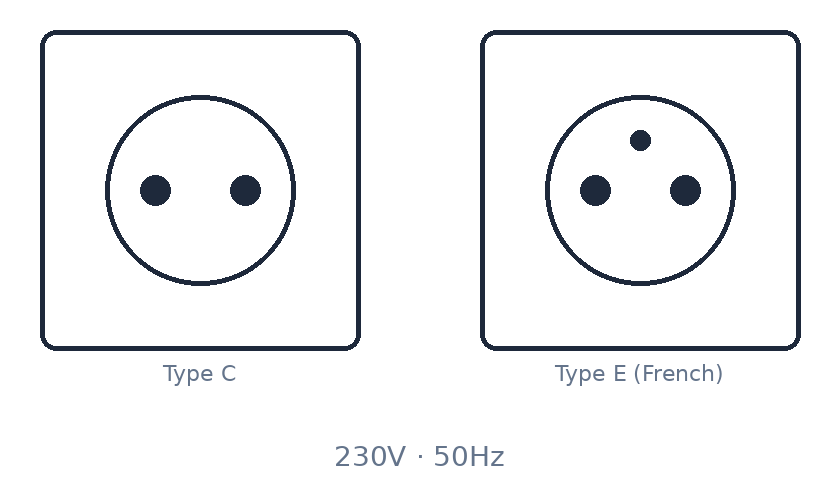
Most modern electronics (phones, laptops, cameras) handle the voltage difference automatically — check the label on your charger for “INPUT: 100-240V” to confirm. Hair dryers and straighteners from North America may need a voltage converter, or it’s easier to buy or borrow one locally.
Belgium has excellent mobile coverage and widespread Wi-Fi. EU and EEA residents benefit from “roam like at home” regulations with no extra charges. For visitors from outside the EU, purchasing a local SIM card or eSIM is straightforward — Proximus, BASE, and Orange Belgium all offer prepaid options with good nationwide coverage.
📱 Need mobile data? An eSIM is the easiest way to stay connected in Europe — no SIM swapping, activate before you land. Compare the best eSIM providers for Europe →
Health and Safety
Belgium has a high-quality healthcare system. EU citizens can use the European Health Insurance Card (EHIC) or Global Health Insurance Card (GHIC) for necessary medical treatment. Non-EU visitors should carry comprehensive travel insurance — medical costs for uninsured visitors can be substantial.
In a medical emergency, call 112 (EU-wide emergency number) or 100 (fire and ambulance). For police, call 101. Pharmacies (apotheek in Dutch, pharmacie in French) are well-stocked and pharmacists can advise on minor ailments. A duty pharmacy system ensures one is always open in each area, including nights and weekends.
Belgium is a safe country for visitors. Violent crime is rare. The most common issue is petty theft — pickpocketing can occur at Brussels-Midi station, on crowded trains, around the Grand-Place, and at major tourist spots in Bruges. The area around Brussels-Midi station and parts of the city center can feel rougher at night than you’d expect from an EU capital — standard urban awareness applies. Outside the major cities, Belgium feels very safe.
Food and Dining Culture
Belgian food culture is deeply serious and often underrated. The country punches well above its weight in Michelin stars per capita, but the real joy of eating in Belgium is the everyday quality — from a paper cone of double-fried frites with samurai sauce to a perfectly prepared plate of moules-frites in a corner brasserie.
Belgian frites — thick-cut, double-fried in beef tallow, served with dozens of sauce options — are a national institution. Get them from a friterie (frietkot in Flemish), not a restaurant. Moules-frites (mussels steamed in white wine with celery and onion, served with frites) is the quintessential Belgian meal. Waterzooi is a creamy Ghent stew made with chicken or fish. Carbonade flamande is beef slowly braised in Belgian beer. Stoofvlees, vol-au-vent, and croquettes de crevettes (shrimp croquettes) round out the comfort-food classics.
Belgian waffles come in two styles: Brussels waffles (light, rectangular, crispy) and Liège waffles (denser, sweeter, caramelized). For chocolate, Belgium is simply world-class — names like Neuhaus, Pierre Marcolini, Mary, Laurent Gerbaud, and Frédéric Blondeel are worth seeking out beyond the tourist-trap shops. And then there’s the beer: Belgium has over 400 breweries, produces ten times more beer per capita than the global average, and has a UNESCO-recognized beer culture. Trappist beers (Chimay, Orval, Rochefort, Westmalle, Westvleteren, Achel) are brewed by monks and are among the finest in the world.
Belgium: Economy and Context
Belgium has a GDP of approximately $717 billion (2025), making it a wealthy economy relative to its size. Its strategic location in the heart of Europe, the Port of Antwerp-Bruges (Europe’s second-largest port), and its role as home to the EU and NATO headquarters give it an outsized economic and political importance. The country is one of the founding members of the European Union, the Eurozone, and NATO.
Belgium welcomed 9.64 million international visitors in 2024, a new record, with total tourism spending reaching $26.4 billion — a 30% increase over pre-pandemic levels. The Netherlands, France, Germany, the UK, and the United States are the leading source markets. Brussels alone recorded nearly 9.8 million overnight stays, with business and institutional tourism accounting for over half of all visits to the capital. Belgium’s compact geography, excellent rail connections, and concentration of world-class cities make it remarkably efficient for visitors — you can see a tremendous amount in a relatively short trip.
The country’s cultural contribution extends far beyond its borders. Belgium gave the world surrealism (Magritte), early Netherlandish painting (van Eyck, Bruegel, Memling), art nouveau (Horta), the saxophone, the Belgian waffle, and what many consider the finest beer and chocolate traditions on earth.
Frequently Asked Questions
Do I need a visa to visit Belgium?
Citizens of 59 countries, including the US, UK, Canada, and Australia, can visit Belgium without a visa for up to 90 days within any 180-day period. This is the Schengen 90/180-day rule, which applies across all Schengen countries combined. Use the Europe Travel Planner at schengentraveler.com to find out if your nationality requires a visa.
Will I need ETIAS to visit Belgium in 2026?
ETIAS is expected to launch in late 2026, likely October or November. Once operational, visa-exempt visitors will need to apply online before traveling. The EU will confirm the exact date at least six months in advance. Until ETIAS launches, you only need your valid passport. See our ETIAS guide for the latest timeline.
What is the best time to visit Belgium?
Late spring (April–June) offers mild weather, blooming gardens, and manageable crowds. Summer (July–August) brings festivals — including the world-famous Tomorrowland — and the warmest weather, though popular cities get busy. Autumn (September–October) is ideal for fewer tourists and cozy beer-hall weather. December brings outstanding Christmas markets in Brussels, Bruges, Ghent, and Liège. Belgium’s maritime climate means rain is possible year-round — pack layers and a waterproof jacket regardless of when you visit.
Do people speak English in Belgium?
Yes, widely — especially in Brussels, Flanders, and tourist areas. Most Flemish Belgians speak excellent English. In Wallonia, English proficiency is lower outside major cities. French is more useful in the south. Belgium’s trilingual nature means most people are at minimum bilingual, and many speak three or four languages.
How much does a trip to Belgium cost?
Budget roughly €120–170 per day for mid-range travel in Brussels (hotel, meals, transport, and sightseeing). Smaller cities like Ghent and Bruges run €100–140 per day for comfortable travel. A one-week trip for two people typically costs €2,000–4,000 depending on accommodation choices and dining habits. Belgium’s compact size keeps transport costs low — a Brussels-to-Bruges train ticket is under €18.
Do I need to register for a Low Emission Zone?
If you’re driving a foreign-registered car into Brussels, Antwerp, or Ghent, yes — you must register your vehicle online for free before entering. Dutch-plated vehicles are automatically checked and don’t need manual registration. Check the LEZ website for your specific city to confirm your vehicle meets the emission standards. A day pass (€35, max 8 per year) is available for non-compliant vehicles.
Can I use my US driver’s license in Belgium?
Yes, a US license is valid for short-term visitors. An International Driving Permit (IDP) is recommended but not strictly required — it provides a French/Dutch translation that can be useful. Watch out for Belgium’s right-hand priority rule at intersections, which differs from what most American drivers are used to.
Is Belgium safe?
Belgium is very safe for visitors. Violent crime is rare. The main risk is petty pickpocketing in Brussels (particularly around Brussels-Midi station and the Grand-Place) and in Bruges during peak tourist hours. Use standard urban precautions, and you’re unlikely to encounter any issues.
🌍 Plan Your Trip to Belgium
Entry requirements, visa status, and a full travel briefing — personalized for your nationality.
Use the Europe Travel Planner →📚 Related Articles
- Schengen 90/180-Day Rule — How the visa-free stay limit works across Europe
- ETIAS: Europe’s New Travel Authorization — What you’ll need starting late 2026
- Entry/Exit System (EES) — How the new biometric borders work
- International Driving Permit in Europe — Country-by-country IDP requirements
- Best Travel Insurance for Europe — Protect your trip
- Travel to France: Complete Guide
- Travel to Germany: Complete Guide
- All Europe Country Guides
This article is for informational purposes only and does not constitute legal or travel advice. Entry requirements can change — always verify with official government sources before traveling. Last updated: February 2026.