
Last Updated: February 2026
Albania is Europe’s fastest-rising travel destination — and the numbers are staggering. The country welcomed 11.7 million foreign visitors in 2024, an 80% increase from pre-pandemic levels, with projections pointing toward 15 million in 2025. What’s drawing them in? A stunning Ionian coastline that rivals Greece at a fraction of the price, UNESCO-listed Ottoman towns, wild mountains perfect for trekking, and a culture of hospitality that feels genuinely warm. From the turquoise beaches of the Albanian Riviera to the ancient streets of Berat and the rugged peaks of the Accursed Mountains, here’s everything you need to know to plan your trip to Albania in 2026.
🇦🇱 Albania at a Glance
| Official Name | Republic of Albania (Republika e Shqipërisë) |
| Capital | Tirana |
| Population | ~2.75 million (2026) |
| Currency | Albanian Lek (ALL) — ~100 ALL = €1 |
| Language | Albanian |
| Time Zone | CET (UTC+1) / CEST (UTC+2) in summer |
| Plug Type | Type C and F · 230V / 50Hz |
| Driving Side | Right |
| International Driving Permit (IDP) | Required — see IDP guide |
| Schengen Member | No — Albania has its own immigration system. Time spent here does not count toward your Schengen 90 days. |
| Emergency Number | 112 |
Entry Requirements for Albania
Albania is not part of the Schengen Area or the European Union (though it is an EU candidate country with accession negotiations underway). It operates its own visa and immigration system — one of the most welcoming in Europe. Albania’s visa policy closely mirrors the Schengen Area’s: essentially all nationalities that are visa-exempt for Schengen are also visa-exempt for Albania, plus several additional countries.
🇺🇸 US Citizens: Up to One Year Visa-Free
US citizens have exceptionally generous entry terms for Albania. You can enter visa-free and stay for up to one year without a residence permit. That’s not a typo — 365 days, far longer than almost any other European country offers. No application, no fee — just show up with a valid US passport (must be valid for at least three months beyond your entry date).
After your one-year stay, you must leave Albania and remain outside the country for at least 90 days before re-entering for another visa-free period. Short trips out during the year do not reset the clock.
✅ Digital nomads take note: Albania’s one-year visa-free policy for Americans — combined with affordable living costs — has made it one of the most popular bases for remote workers in Europe. No special visa or application needed.
🇪🇺 EU Citizens: Visa-Free Entry
Citizens of all EU and EEA countries can enter Albania visa-free for up to 90 days within a 180-day period. EU citizens can enter with either a valid passport or a national ID card — no passport required. EU/EEA travelers typically don’t receive an entry or exit stamp.
Other Nationalities
Albania grants visa-free entry to nationals of over 90 countries, including the UK, Canada, Australia, New Zealand, Japan, and most Latin American countries. Holders of a valid, previously used Schengen visa, US visa, or UK visa can also enter Albania visa-free for up to 90 days, even if their nationality normally requires a visa. For nationalities that do require a visa, Albania offers an e-visa system at e-visa.al.
Use our Europe Travel Planner to check what your nationality requires for Albania.
⚠️ Important: Albania’s passport validity requirement is a minimum of three months beyond your entry date. Some sources recommend six months to be safe, especially if you plan to cross into neighboring countries during your trip.
Combining with Schengen Travel
Albania is one of the most strategically useful non-Schengen countries for travelers on a long European trip. It’s surrounded by non-Schengen neighbors (Montenegro, Kosovo, North Macedonia) and is just a short ferry ride from Greece.
Your Schengen Clock Stops in Albania
Time spent in Albania does not count toward your Schengen 90-day limit. If you’ve used 50 of your 90 Schengen days in Italy and Greece, then take the ferry to Albania for a month, that month doesn’t count. When you return to a Schengen country, you’ll still have 40 Schengen days remaining.
Albania is commonly used as part of a “Balkan rotation” — long-term travelers alternate between Schengen countries and the non-Schengen Western Balkans (Albania, Montenegro, Serbia, Bosnia, North Macedonia, Kosovo) to extend their total time in Europe well beyond 90 days. With Albania’s one-year allowance for Americans, it can serve as a home base for Schengen day-counting purposes.
✅ Planning a long Europe trip? Use our Schengen Calculator to track your 90/180-day count. A popular rotation: spend your Schengen days in Western Europe → base yourself in Albania while your days refill → return to the Schengen Area.
Separate Documents for Each
Albania’s visa-free status does not grant access to Schengen countries, and a Schengen visa does not cover Albania (though holding one does grant 90-day visa-free entry for nationalities that otherwise need a visa). When ETIAS launches in late 2026, visa-exempt travelers visiting both Albania and the Schengen Area will need separate documentation for each.
Getting to Albania
Albania has become increasingly accessible, with growing flight connections and well-established overland and ferry routes.
By Air
Tirana International Airport Nënë Tereza (TIA) is the country’s main airport, located about 25 km northwest of central Tirana. Budget carriers like Wizz Air and Ryanair, along with carriers like Turkish Airlines, Lufthansa, and Air Albania, connect Tirana to dozens of European cities. A 24-hour airport bus runs to the city center (~400 ALL / ~€4, every 30 minutes). A new international airport at Vlorë (near the Albanian Riviera) and Kukës International Airport in the north provide additional access points.
By Land
Albania shares borders with Montenegro, Kosovo, North Macedonia, and Greece. All have active border crossings with regular bus services. Popular overland routes include Budva/Kotor (Montenegro) to Shkodër, Pristina (Kosovo) to Tirana, Ohrid (North Macedonia) to Pogradec/Korçë, and Ioannina (Greece) to Gjirokastër. Border crossings can be slow in peak summer — budget extra time, especially at the Greece and Montenegro crossings.
By Sea
Ferries connect Albania to Italy and Greece. The most popular route is Durrës to Bari (Italy), taking approximately 8 hours — a convenient option for travelers coming from Italy without flying. Other ferry routes connect Durrës to Ancona. From the south, fast boats run between Sarandë and Corfu (Greece) in about 30 minutes — a fantastic way to combine Albania’s Riviera with the Greek islands. Book summer ferries in advance, as they sell out.
Getting Around Albania
Getting around Albania is an adventure in itself. The country has no functioning passenger rail network (a Tirana–Durrës rail line is under construction, expected by 2028), so buses, furgons, and rental cars are your options. Roads have improved dramatically in recent years, but the experience can still be chaotic by Western European standards.
Buses and Furgons
Intercity buses and furgons (shared minivans) are the backbone of Albanian transport. Buses connect major cities on somewhat regular schedules, while furgons serve smaller towns and villages — they leave when full rather than on a fixed timetable. Fares are very affordable: Tirana to Berat costs about 400–500 ALL (~€4–5), Tirana to Sarandë about 1,500–2,000 ALL (~€15–20). Bus stations are often informal, located on the outskirts of town, and schedules can be unreliable. Ask your accommodation for current departure times and pickup points.
⚠️ Transport reality check: Albania’s bus system works, but it requires patience. Buses may not have air conditioning, stations are often just a parking area, and you’ll frequently need a taxi from the bus drop-off to your accommodation. Google Maps is helpful but not always accurate for schedules. Ask locals.
Driving
A rental car gives you the most freedom, and Albania’s main highways (particularly the A2 from Tirana south to Vlorë) have been modernized significantly. However, mountain and rural roads can be narrow and winding, and Albanian driving culture is aggressive. Rental cars start around €15–25/day from Tirana airport. Fuel averages about €1.60/liter.
An International Driving Permit (IDP) is required for foreign license holders. See our IDP guide for details. Albania has one toll road: the A1 from Milot to Morinë (toward Kosovo), approximately €5.
Key Routes
| Route | Mode | Duration | Approximate Cost |
|---|---|---|---|
| Tirana → Berat | Bus | 2–2.5 hrs | 400–500 ALL (~€4–5) |
| Tirana → Sarandë | Bus | 5–6 hrs | 1,500–2,000 ALL (~€15–20) |
| Tirana → Gjirokastër | Bus | 4–5 hrs | 1,200–1,500 ALL (~€12–15) |
| Tirana → Shkodër | Bus | 2–2.5 hrs | 400–500 ALL (~€4–5) |
| Tirana → Vlorë | Bus | 2.5–3 hrs | 500–700 ALL (~€5–7) |
| Sarandë → Corfu | Fast Ferry | 30 min | €15–25 |
| Durrës → Bari (Italy) | Ferry | ~8 hrs | €40–80+ |
✅ Riviera access tip: The Llogara Tunnel, opened in July 2024, cuts 45 minutes off the drive from Vlorë to the Albanian Riviera. The old Llogara Pass road (one of Europe’s most scenic drives) is still open and worth taking if you have time — just not in a rush.
Where to Go in Albania
Albania packs an extraordinary variety into a small country — Adriatic and Ionian coastlines, three UNESCO World Heritage Sites, wild mountain ranges, and a capital city in the middle of a cultural renaissance.
🏖️ The Albanian Riviera
The Ionian coast from Vlorë south to Sarandë is Albania’s star attraction — crystal-clear turquoise water, dramatic cliffs, and beaches that rival anything in Greece. Ksamil, near the Greek border, has the most famous beaches (small coves with white sand and Caribbean-blue water), though it now gets very crowded in peak summer. Himara and Dhërmi offer a better balance of beauty and breathing room. Sarandë is the main resort town, with a lively waterfront, easy access to Ksamil and Butrint, and fast ferries to Corfu.
🏛️ Berat — “City of a Thousand Windows”
Berat is a UNESCO World Heritage Site and one of Albania’s most beautiful towns. Its distinctive Ottoman-era houses with large windows climb a hillside beneath a massive 13th-century fortress (Kalaja). The Mangalem and Gorica quarters, facing each other across the Osum River, create one of the most photographed scenes in the Balkans. Berat is an easy 2-hour bus ride from Tirana and a must on any Albania itinerary.
🏰 Gjirokastër — “City of Stone”
Gjirokastër, another UNESCO World Heritage Site, is built on the slopes of a mountain beneath an enormous Ottoman fortress. Its distinctive stone-roofed houses and cobblestone streets feel frozen in time. The city is the birthplace of former dictator Enver Hoxha and author Ismail Kadare — both leave their mark on the local museums. Gjirokastër makes an excellent base for exploring the southern interior, and is about an hour from Sarandë.
🌆 Tirana
Albania’s capital has transformed from a grey post-communist city into one of Europe’s most colorful and energetic urban centers. Skanderbeg Square is the heart of the city, flanked by the National History Museum, the Et’hem Bey Mosque, and the clock tower. Don’t miss Bunk’Art 1 and 2 (Cold War bunker museums), the House of Leaves (a former secret surveillance headquarters turned museum), and the Blloku district — once reserved exclusively for Communist Party elites, now Tirana’s liveliest neighborhood of cafés, restaurants, and bars.
⛰️ The Accursed Mountains (Alps of Albania)
The Theth to Valbona hike is Albania’s most famous trek — an 8-hour trail across the Albanian Alps with jaw-dropping mountain scenery. The route typically involves busing or driving to Theth or Valbona, hiking between the two villages, and taking the Koman Lake ferry (a stunningly scenic boat ride through narrow gorges). Shkodër, Albania’s northern gateway city, is the jumping-off point. The hiking season runs from June through September.
🏛️ Butrint
Butrint, a UNESCO World Heritage Site near Sarandë, is one of the Mediterranean’s most important archaeological sites — layers of Greek, Roman, Byzantine, and Venetian ruins set within a forested peninsula on a lagoon. It’s an easy half-day trip from Sarandë or Ksamil and is far less crowded than comparable sites in Greece or Turkey.
How Much Does Albania Cost?
Albania is one of Europe’s most affordable destinations, though prices — especially along the coast — have been rising rapidly as tourism has exploded. The interior remains very cheap. The currency is the Albanian Lek (ALL); euros are sometimes accepted in tourist areas but at unfavorable rates.
| Expense | Budget | Mid-Range | Comfortable |
|---|---|---|---|
| Accommodation (per night) | €10–25 (hostel / guesthouse) | €35–70 (apartment / 3-star hotel) | €100–200+ (boutique / resort) |
| Meals (per day) | €8–15 (local restaurants) | €15–30 (restaurants) | €40–60+ (upscale dining) |
| Transport (per day) | €3–8 (buses / furgons) | €10–25 (bus + taxi) | €25–45 (rental car + fuel) |
| Activities | Free–€5 (hiking, beaches) | €5–20 (museums, boat tours) | €30–70+ (rafting, guided tours) |
| Total per day | €25–50 | €65–150 | €200–400+ |
Cash is still king in much of Albania, especially outside Tirana and the Riviera. ATMs are widely available in cities and tourist towns. Many smaller restaurants, guesthouses, and shops only accept cash (lek preferred). In tourist areas, euros are often accepted at restaurants and hotels, but you’ll get a worse rate than at an ATM. Credit cards work at larger hotels, upscale restaurants, and some shops in Tirana and coastal resorts.
Practical Information
Power and Connectivity
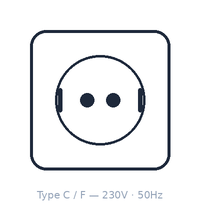
Albania uses Type C and F plugs — the same round two-pin plugs used across most of continental Europe. The standard voltage is 230V at 50Hz. If you’re already carrying a European adapter from other countries on your trip, it will work here.
Mobile coverage is generally good in cities and along the coast, with 4G available from operators like Vodafone Albania, ONE, and ALBtelecom. Coverage can be weak in mountain areas (Theth, Valbona, rural interior). Tourist SIM cards and eSIMs are available at the airport and phone shops. Free Wi-Fi is common in hotels and cafés in tourist areas.
📱 Need mobile data? An eSIM is the easiest way to stay connected in Europe — no SIM swapping, activate before you land. Compare the best eSIM providers for Europe →
Health and Safety
Albania is generally safe for travelers. Violent crime against tourists is rare. Petty theft can occur in crowded areas of Tirana and at busy beach destinations — standard precautions apply. Locals are overwhelmingly friendly and hospitable; Albania has a deep cultural tradition of guest welcome (besa).
Healthcare is adequate for basic needs in Tirana and larger cities but limited elsewhere. Private clinics offer better service than public hospitals. All visitors should carry comprehensive travel insurance. In an emergency, call 112 (or 127 for ambulance). Pharmacies (farmaci) are widely available.
Tap water quality varies — it’s generally safe in Tirana but not recommended in smaller towns and rural areas. Bottled water is cheap and widely available. In some older buildings, plumbing may not handle toilet paper (dispose in the bin provided).
Language
Albanian is the official language — a unique Indo-European language unrelated to any neighboring tongue. English is increasingly spoken among younger Albanians, especially in Tirana and tourist areas. Italian is widely understood, particularly among older generations and in the south. In rural areas and among older locals, English proficiency is limited. A few phrases go a long way: përshëndetje (hello), faleminderit (thank you), ju lutem (please).
Food and Dining Culture
Albanian cuisine draws on Mediterranean, Turkish, and Balkan influences. On the coast, expect excellent fresh seafood — grilled fish, octopus, and mussels are highlights. In the interior, look for tave kosi (lamb baked with yogurt and rice — the national dish), fergese (peppers, tomatoes, and cheese baked in a clay pot), byrek (flaky pastry filled with cheese, spinach, or meat), and qofte (seasoned grilled meat patties). Albanian salads are fresh and generous, and the country produces surprisingly good wine and rakija (grape or fruit brandy).
A full meal at a local restaurant (often called a restorant or a more casual bufe) typically costs €5–12 per person, including a drink. Coffee culture is enormous — Albanians drink more coffee per capita than many Western European countries, and the café scene in Tirana rivals that of any Mediterranean city. A macchiato runs about 80–120 ALL (~€0.80–1.20).
Albania: Economy and Context
Albania has a GDP of approximately $22 billion and is one of Europe’s lower-income countries, though it has experienced steady growth over the past decade. It is an EU candidate country, with accession negotiations formally opened in 2022. Albania is a NATO member (since 2009).
Tourism has become the country’s economic engine. Albania recorded 11.7 million foreign visitors in 2024 — a 15% increase over 2023 and an 80% increase from 2019 — making it one of the world’s fastest-growing tourism destinations. The Albanian Riviera, Tirana, and the UNESCO towns of Berat and Gjirokastër drive the majority of tourism traffic. Top source markets include Kosovo, Italy, Germany, the UK, and increasingly the US. Social media and budget airline expansion have dramatically accelerated Albania’s rise.
The rapid growth has created challenges: coastal infrastructure is straining, overtourism is emerging at hotspots like Ksamil and Sarandë, and prices are rising faster than many locals can absorb. The government’s National Tourism Strategy (2024–2030) aims to diversify beyond the coast, promoting mountain, cultural, and winter tourism to spread visitors more evenly across the country and calendar.
Frequently Asked Questions
Do Americans need a visa for Albania?
No — and the terms are exceptionally generous. US citizens can stay in Albania for up to one year without a visa or residence permit. No application or fee is required. Just bring a valid US passport with at least three months of remaining validity.
Does time in Albania count toward my Schengen 90 days?
No. Albania is completely separate from the Schengen Area. Time spent in Albania does not count toward your Schengen 90/180-day limit. Combined with the one-year allowance for Americans, Albania is one of the most strategically useful non-Schengen bases in Europe. Use our Schengen Calculator to track your days.
What is the best time to visit Albania?
May–June and September–October offer the best combination of pleasant weather, lower prices, and manageable crowds. July and August bring peak heat, packed Riviera beaches, and inflated prices. The mountains (Theth, Valbona) are best from June through September. Winter is mild on the coast but cold in the interior.
Is Albania cheap?
Still cheaper than Western Europe and neighboring Greece/Croatia, but no longer the ultra-budget destination it was a few years ago. Coastal prices have risen significantly, especially at peak Riviera spots like Ksamil. The interior remains very affordable. Budget travelers can manage on €25–50/day; mid-range travelers should expect €65–150. The currency is the Albanian Lek (ALL).
Is Albania safe?
Yes, Albania is generally safe for tourists. Violent crime against visitors is rare, and Albanians have a strong tradition of hospitality toward guests. Standard precautions apply for petty theft in tourist areas and on public transport. The U.S. State Department advises increased caution due to crime but this applies to organized crime disputes rather than tourist-targeted crime.
Do I need a car to explore Albania?
Not necessarily, but it helps enormously. Buses and furgons connect major destinations, but schedules are unreliable, stations are often outside town, and remote areas (Theth, Valbona, parts of the Riviera) are difficult without a car. Roads have improved significantly, but driving can be aggressive. An IDP is required for foreign license holders.
Do I need a different plug adapter for Albania than for Europe?
No — Albania uses the same Type C and F plugs as most of continental Europe (230V/50Hz). If you already have a European adapter, it will work here.
Can I combine Albania with other Balkan countries?
Absolutely — Albania is ideally positioned for it. Montenegro is a 3-hour drive from Shkodër. Corfu (Greece) is a 30-minute ferry from Sarandë. North Macedonia (Ohrid) is reachable from Pogradec or Korçë. Kosovo’s capital Pristina is about 3 hours from Tirana. None of the Western Balkan neighbors (Montenegro, Kosovo, North Macedonia, Serbia) are in Schengen, so your 90-day clock stays paused for the entire Balkan leg.
🌍 Plan Your Trip to Albania
Entry requirements, visa status, and a full travel briefing — personalized for your nationality.
Use the Europe Travel Planner →📚 Related Articles
- Schengen 90/180-Day Rule — How the visa-free stay limit works (Albania time doesn’t count)
- Non-Schengen Countries in Europe — Where your 90 days don’t count
- How to Split Time Between Schengen and Non-Schengen Countries
- ETIAS: Europe’s New Travel Authorization — Separate from Albania’s visa system
- International Driving Permit in Europe — Country-by-country IDP requirements
- Best Travel Insurance for Europe — Coverage for Balkans and Schengen trips
- Travel to Montenegro — Albania’s neighbor and fellow non-Schengen destination
- Travel to Serbia — Another non-Schengen Balkan destination
- All Europe Country Guides
This article is for informational purposes only and does not constitute legal or travel advice. Entry requirements can change — always verify with official government sources before traveling. Last updated: February 2026.