
Home › Country Guides › Travel to San Marino
Last Updated: August 2026
San Marino claims to be the world’s oldest republic — founded in 301 AD by a Christian stonemason fleeing Roman persecution, or so the legend goes. Perched on the slopes of Monte Titano in the heart of Italy, this tiny microstate covers just 61 km² and has a population of about 34,000, yet it has maintained its independence for over 1,700 years while empires rose and fell around it. The three medieval towers on Monte Titano’s ridgeline are its most iconic image — visible for miles across the surrounding Italian countryside and offering panoramic views from the Adriatic to the Apennines. San Marino is not part of the European Union or the Schengen Area, but it’s entirely surrounded by Italy and has no border controls. Here’s everything you need to know to plan your visit to San Marino in 2026.
🇸🇲 San Marino at a Glance
| Official Name | Most Serene Republic of San Marino (Serenissima Repubblica di San Marino) |
| Capital | City of San Marino (Città di San Marino) |
| Population | ~34,000 (2026) |
| Currency | Euro (€) — by monetary agreement with the EU, mints its own euro coins |
| Language | Italian (official) |
| Time Zone | CET (UTC+1) · CEST in summer (UTC+2) |
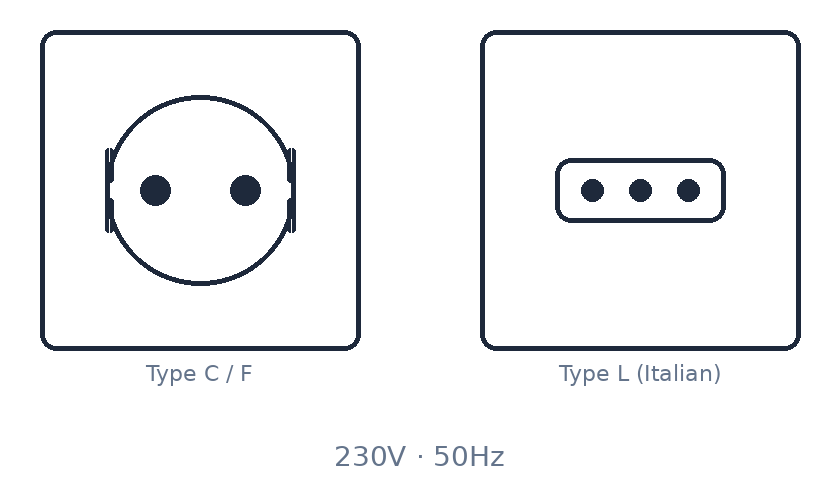
| Plug Type | Type C, F & L · 230V / 50Hz |
| Driving Side | Right |
| International Driving Permit (IDP) | Not required for short visits — a valid US license is accepted. See IDP guide |
| Schengen Member | No — San Marino is not a member of the EU or Schengen, but it has no border controls with Italy and is treated as part of the Schengen zone for practical purposes. Time spent in San Marino counts toward your Schengen 90 days in practice. |
| Emergency Number | 112 (universal) · 113 (police) · 115 (fire) · 118 (ambulance) |
Entry Requirements for San Marino
San Marino is an independent republic entirely surrounded by Italy. It is not a member of the European Union or the Schengen Area, but it has no border controls with Italy — you won’t see a checkpoint, a passport stamp, or any indication you’ve left Italy unless you notice the Sammarinese flags and license plates. Entering San Marino is identical to driving through any Italian town.
What This Means for Travelers
Because San Marino is entirely enclosed by Italy (a Schengen member) and has no border controls, the entry requirements are effectively the same as for Italy and the Schengen Area:
If you can enter Italy, you can enter San Marino. If you need a Schengen visa to visit Italy, that same visa covers San Marino in practice. When ETIAS launches for Schengen countries (2027 is now the most likely launch year after the EU removed the Q4 2026 target in July 2026), it will effectively apply to San Marino as well — you pass through Italian territory to get there.
🇺🇸 US Citizens
US citizens can visit San Marino without a visa — the same visa-free access that applies to Italy and the Schengen Area covers San Marino. You can stay for up to 90 days within any 180-day period. No separate application or documentation is needed beyond a valid passport.
EU/EEA Citizens
EU and EEA citizens can enter San Marino freely with a valid passport or national ID card, the same as entering Italy.
Other Nationalities
Whatever entry requirements apply to you for Italy and the Schengen Area apply to San Marino. Use our Europe Travel Planner to check your specific requirements.
Passport Stamps
San Marino offers a novelty passport stamp — you can get one at the tourist information office in the historic center for a small fee (approximately €5). It’s a souvenir, not an immigration stamp, but it’s a fun memento from one of the world’s smallest countries.
🛂 Need a Schengen visa to reach San Marino?
San Marino has no visa system of its own — you enter through Italy. If your nationality needs a Schengen visa for Italy, iVisa handles the application end to end.
Start your application on iVisa →Affiliate partner — we may earn a commission at no extra cost to you.
Getting to San Marino
San Marino has no airport, no train station, and no seaport. The only way in is by road from Italy.
From Rimini (Most Common)
Rimini, on the Adriatic coast, is the gateway to San Marino — just 22 km away. The drive from Rimini to the City of San Marino takes about 30 minutes. A regular bus service operated by Bonelli Bus connects Rimini train station with San Marino (approximately 40–50 minutes, €5–6 each way, multiple departures daily). Rimini is well-connected by train to Bologna (1 hour), Florence (2 hours), Rome (3.5 hours), and Venice (3 hours).
By Air (via Regional Airports)
Federico Fellini International Airport (RMI) in Rimini has limited seasonal flights, mainly charters and Ryanair connections. For more options, Bologna Guglielmo Marconi Airport (BLQ) is about 120 km away (1.5 hours by car) with extensive European connections. From either airport, take a train or drive to Rimini, then bus or drive to San Marino.
By Car
Driving to San Marino from anywhere in Italy is straightforward. The approach from Rimini via the SP72 road climbs into the hills with increasingly dramatic views of Monte Titano. Parking is available in several lots around the City of San Marino — the largest are P1 (near the cable car) and P9 (near the Porta San Francesco entrance to the old town). Parking costs approximately €2–4 per hour. During peak summer weekends and holidays, parking fills up quickly — arrive early or take the bus.
Getting Around San Marino
San Marino is tiny — the entire country is 61 km² and the historic center is compact enough to walk in an afternoon.
Walking
The historic center of the City of San Marino sits on the slopes and ridgeline of Monte Titano. It’s entirely pedestrianized and best explored on foot. Be prepared for steep climbs — the three towers sit along the ridge at approximately 750 meters elevation, and the streets involve significant uphill walking. Comfortable shoes are essential.
Cable Car (Funivia)
A cable car connects Borgo Maggiore (the town at the base of Monte Titano) with the City of San Marino at the top. It runs every 15 minutes and costs approximately €3 each way. It’s a practical alternative to the steep walk up and offers nice views.
Driving
If you want to explore beyond the historic center — the nine municipalities of San Marino include villages and countryside in the surrounding hills — a car is useful. But for the main tourist attractions, walking and the cable car are sufficient.
Bus
A small internal bus network connects the City of San Marino with other municipalities. Services are infrequent and primarily serve residents. Most visitors don’t need them.
Where to Go in San Marino
San Marino is a half-day to full-day destination for most visitors. The historic center on Monte Titano is the main attraction, and it delivers — medieval towers, panoramic views, and the novelty of visiting one of the world’s smallest and oldest countries.
🏰 The Three Towers of San Marino
The Tre Torri (Three Towers) along the ridgeline of Monte Titano are San Marino’s defining image and appear on the national flag and coat of arms.
Guaita (First Tower) — the oldest and most imposing, built in the 11th century. It’s the most visited and offers spectacular views over the surrounding Romagna countryside toward the Adriatic. You can enter and climb the tower.
Cesta (Second Tower) — sits on the highest point of Monte Titano (755 m). It houses the Museum of Ancient Weapons, with a collection of medieval and Renaissance arms and armor. The walk between Guaita and Cesta along the ridgeline path (Passo delle Streghe, the “Witches’ Pass”) is the highlight of any San Marino visit — a dramatic cliff-edge walkway with views in every direction.
Montale (Third Tower) — the smallest and not open to the public, but visible from the path. A combined ticket for Guaita and Cesta costs approximately €8.
🏛️ Piazza della Libertà and Palazzo Pubblico
Piazza della Libertà is San Marino’s main square — a compact, elegant space dominated by the Palazzo Pubblico (Government Palace), which serves as the town hall and parliament. The changing of the guard takes place here during summer months. The Statue of Liberty in the center of the square is a small neoclassical figure — San Marino’s own version, a gift from a German countess in 1876.
⛪ Basilica di San Marino
The Basilica del Santo is the main church, built in neoclassical style in the 1830s on the site of a much older church. It contains the relics of Saint Marinus, the Christian stonemason whose founding of a small community on Monte Titano in 301 AD is the origin story of the republic. The adjacent Chiesa di San Pietro has rock-hewn niches said to be the beds of Saints Marinus and Leo.
🛍️ Shopping
San Marino has lower taxes than Italy, making it a minor shopping destination — particularly for perfume, electronics, alcohol, and souvenirs. The main shopping streets are Contrada del Collegio and Contrada del Pianello, lined with shops. The savings compared to Italy are modest (not as dramatic as Andorra’s duty-free) but can be worthwhile for specific purchases. San Marino also mints its own euro coins and issues its own postage stamps — both are popular collector’s items available at shops and the philatelic office.
🏛️ Museums
For its size, San Marino has a surprising number of museums. The State Museum (Museo di Stato) covers the republic’s history from Neolithic times to the present. The Museum of Curiosities is a quirky collection of oddities. Several smaller museums cover topics from medieval torture instruments to vintage cars. A combined museum ticket offers good value if you plan to visit multiple sites.
🌄 The Views
Honestly, the views are the main attraction. On a clear day, the panorama from the towers and ridgeline extends from the Adriatic coast (about 15 km away) across the entire Romagna plain, with the Apennine Mountains visible to the west. The contrast between the dramatic clifftop setting and the flat Italian countryside below is stunning. Sunrise and sunset from Monte Titano are exceptional.
How Much Does San Marino Cost?
Most visitors experience San Marino as a day trip from Rimini or the wider Emilia-Romagna region, so accommodation costs are rarely an issue. Prices in San Marino are comparable to or slightly below those in the surrounding Italian region.
| Expense | Day Trip Budget | Mid-Range (Staying Overnight) |
|---|---|---|
| Accommodation (per night) | Stay in Rimini (€60–120) | €80–160 (hotel in San Marino) |
| Meals (per day) | €15–30 (lunch in historic center) | €30–60 |
| Transport | €10–12 (bus round trip from Rimini) | €5–15 (parking + cable car) |
| Activities | €8–15 (tower entry + museums) | €15–30 |
Day trip total: A day trip to San Marino from Rimini costs approximately €35–60 per person including transport, lunch, and tower/museum entry. It’s one of Europe’s most affordable microstate visits.
Staying overnight: There are hotels and guesthouses in the City of San Marino and surrounding towns. Staying overnight lets you experience the towers at sunset and sunrise without the day-trip crowds — Monte Titano is dramatically quieter after the tour buses leave in the late afternoon. Prices are reasonable by Italian standards.
Currency note: San Marino uses the euro (€) and mints its own euro coins (highly collectible). ATMs are available in the historic center. Credit cards are accepted at most shops and restaurants.
Tipping: Same as Italy — service charge (coperto) is usually included in restaurant bills. Additional tipping is not expected but rounding up is appreciated.
Practical Information
Money
San Marino uses the euro (€) and mints its own coins — look for them in your change, as they’re collector’s items (the 2-euro coins in particular are sought after by numismatists). ATMs are available in the historic center and Borgo Maggiore. Credit cards are widely accepted.
Power and Connectivity
San Marino uses the same power system as Italy — Type C, F, and L plugs at 230V/50Hz. The Type L plug (with three round pins in a row) is an Italian standard not found in most other European countries. Most European adapters with Type C will work, but if your device has a Type F plug (with grounding clips), it may not fit an Italian Type L socket. A universal adapter is the safest choice.
Mobile coverage is excellent. Italian operators (TIM, Vodafone, WindTre) work seamlessly in San Marino. San Marino also has its own operator (San Marino Telecom). EU roaming regulations don’t technically apply in San Marino (it’s not in the EU), but in practice, most EU SIM cards work normally since Italian towers provide coverage. Wi-Fi is available in most hotels and restaurants.
📱 Need mobile data? An eSIM is the easiest way to stay connected in Europe — no SIM swapping, activate before you land. Compare the best eSIM providers for Europe →
Health and Safety
San Marino has a small hospital (Ospedale di Stato). For serious medical needs, the larger hospitals in Rimini are 20 minutes away. San Marino is not in the EU, so EHIC/GHIC cards don’t apply, and non-EU visitors face full private rates for any medical care. Comprehensive travel insurance for Europe is recommended — a single policy covering San Marino alongside Italy and the wider Schengen area handles the whole trip cleanly.
🏥 Cover San Marino + your Italy trip with one policy
SafetyWing Nomad Insurance covers San Marino alongside Italy and the rest of your route — emergency medical, evacuation from Monte Titano’s steep ridgeline paths, travel delay, and lost luggage in one plan. Perfect if you’re basing yourself in Rimini and doing day trips, or including San Marino on a broader Emilia-Romagna or Adriatic tour. Buy it before you leave or even mid-trip.
Get a quote from SafetyWing →Affiliate partner — we may earn a commission at no extra cost to you.
In an emergency, call 112 (universal), 113 (police), 115 (fire), or 118 (ambulance).
San Marino is extremely safe — one of the safest places in Europe. The main practical hazards are the steep, sometimes slippery stone paths in the historic center (wear proper shoes) and sun exposure on the exposed ridgeline in summer.
Language
Italian is the official language and spoken by everyone. English is spoken in tourist-oriented shops and restaurants in the historic center. You’ll have no communication issues if you speak Italian or basic English in the tourist areas.
Food and Dining
San Marino’s cuisine is essentially Romagnol Italian — the food traditions of the Emilia-Romagna region with a few local specialties. Torta Tre Monti (Three Towers Cake) is San Marino’s signature sweet — layers of wafer and chocolate or hazelnut, named after the three towers. Piadina (flatbread, the iconic Romagnol street food) with local cheese, cured meats, or arugula is everywhere. Pasta dishes follow Romagnol traditions — tagliatelle al ragù, passatelli, and cappelletti in brodo. Local wines from the small Sammarinese vineyards exist (Brugneto red, Biancale white) but are mainly curiosities — the surrounding Romagna wine region is excellent.
Restaurants in the tourist center tend toward average quality at slightly inflated prices (a common issue in heavily touristed Italian hilltop towns). For better food at better prices, eat in Borgo Maggiore at the base of the mountain or in nearby Rimini.
Weather
San Marino has a Mediterranean-influenced continental climate. Summers are warm (25–32°C) with occasional thunderstorms. The hilltop position means it’s often slightly cooler and windier than the coastal plain below. Winters are cool (2–10°C) with occasional snow on Monte Titano, which makes for beautiful photos. Fog can obscure views in autumn and winter. Spring (April–May) and autumn (September–October) offer the best combination of pleasant weather and manageable crowds.
San Marino: Economy and Context
San Marino claims to be the world’s oldest surviving sovereign state and republic — its founding date of September 3, 301 AD, makes it older than most nations by many centuries. The republic has maintained its independence through a combination of strategic neutrality, mountain geography, and diplomatic skill — Napoleon reportedly offered to expand its territory, but San Marino declined, preferring to remain small and independent.
The economy is driven by tourism (over 2 million visitors annually, mostly day-trippers from Italy), banking and financial services, ceramics, and light manufacturing. San Marino has one of the world’s highest GDPs per capita. The republic mints its own euro coins and issues collectible postage stamps — both are meaningful revenue sources. The country has no national debt.
San Marino’s governance is unusual — two Captains Regent (Capitani Reggenti) serve as joint heads of state for six-month terms, elected by the Grand and General Council (parliament). This tradition of rotating leadership dates back centuries and is one of the republic’s most distinctive features. New Captains Regent are inaugurated on April 1 and October 1 — the ceremonies are colorful public events.
Frequently Asked Questions
Do I need a visa for San Marino?
No separate visa exists for San Marino. Since you must enter through Italy (a Schengen member), Schengen entry requirements apply. If you can enter Italy, you can enter San Marino.
Is San Marino in the Schengen Area?
Technically no. In practice, yes. San Marino has no border controls with Italy and is treated as part of the Schengen zone. Time spent in San Marino effectively counts toward your Schengen 90/180-day limit.
Does time in San Marino count toward my Schengen 90 days?
Effectively yes. Because there are no border controls and you transit through Italian territory, your time here counts as part of your Schengen stay. Use our Schengen Calculator to track your days.
Will I need ETIAS to visit San Marino?
Not for San Marino itself — but yes for Italy to reach it. Since San Marino can only be accessed through Italian territory, visa-exempt travelers will need ETIAS to enter Italy (2027 is now the most likely ETIAS launch year after the EU removed the Q4 2026 target in July 2026). Get the €20 ETIAS for the Schengen leg; nothing extra is needed to cross into San Marino.
Can I visit San Marino as a day trip?
Absolutely — this is how most people visit. Rimini is the most common base, just 30–40 minutes away by bus (€5–6 each way). You can comfortably see the main sights in half a day to a full day.
Is San Marino worth visiting?
If you’re in the Rimini area or Emilia-Romagna region, yes. The three towers and ridgeline walk are genuinely impressive, the views are spectacular, and the novelty of visiting one of the world’s oldest and smallest countries is fun. It’s not worth a major detour from distant Italian cities unless you’re a microstate enthusiast.
Do I need travel insurance for San Marino?
Yes — San Marino is not in the EU, so EHIC/GHIC cards don’t apply, and non-EU visitors face full private rates for any medical care. See our Europe travel insurance guide for policies that cover San Marino alongside Italy and the Schengen area in a single plan.
Can I get a passport stamp in San Marino?
Yes — the tourist information office in the historic center offers a novelty passport stamp for approximately €5. It’s a souvenir, not an official immigration stamp.
Do I need a different plug adapter for San Marino than for Italy?
No — San Marino uses the same power system as Italy, including Type C, F, and L plugs at 230V/50Hz. A standard European Type C adapter works for most devices, but a universal adapter is safest due to the Italian Type L socket.
How long should I spend in San Marino?
Most visitors spend 3–5 hours. That’s enough to walk the ridgeline between the towers, see Piazza della Libertà, have lunch, and explore the shops. Staying overnight lets you enjoy sunset and sunrise views without the crowds.
🌍 Plan Your Trip to San Marino
Entry requirements, visa status, and a full travel briefing — personalized for your nationality.
Use the Europe Travel Planner →📚 Related Articles
- Schengen 90/180-Day Rule — San Marino time effectively counts toward your 90 days
- Non-Schengen Countries in Europe
- ETIAS: Europe’s New Travel Authorization — Effectively applies via Italy
- Best Travel Insurance for Europe
- Travel to Italy — San Marino’s surrounding country
- Travel to Monaco — Another non-EU microstate surrounded by Schengen
- Travel to Vatican City — Another microstate within Italy
- All Europe Country Guides
This article is for informational purposes only and does not constitute legal or travel advice. Entry requirements can change — always verify with official government sources before traveling. Last updated: August 2026.