
Last Updated: February 2026
Slovenia is one of Europe’s most astonishing small countries — a place where the Julian Alps, the Mediterranean coast, vast underground cave systems, and rolling wine country all fit into a territory smaller than New Jersey. With one of the continent’s most charming capital cities, a near-fanatical commitment to sustainability, and landscapes that shift from alpine to Adriatic within a two-hour drive, Slovenia consistently ranks among Europe’s most rewarding destinations. Here’s everything a visitor needs to know to plan a trip to Slovenia in 2026.
🇸🇮 Slovenia at a Glance
| Capital | Ljubljana |
| Population | ~2.1 million (2026) |
| Currency | Euro (€) |
| Language | Slovenian |
| Time Zone | CET (UTC+1) · CEST in summer (UTC+2) |
| Plug Type | Type C and F · 230V / 50Hz |
| Driving Side | Right |
| International Driving Permit (IDP) | Recommended — see IDP guide |
| Schengen Member | Yes — since 2007 |
| Emergency Number | 112 (EU-wide) |
Entry Requirements for Slovenia
Slovenia is part of the Schengen Area, meaning it follows the same entry rules as the other 28 Schengen member countries. What you need to enter Slovenia depends on your nationality.
Visa-Exempt Visitors (US, UK, Canada, Australia, and Others)
Citizens of 59 visa-exempt countries — including the United States, United Kingdom, Canada, Australia, New Zealand, Japan, and most Latin American nations — can enter Slovenia without a visa for short stays of up to 90 days within any 180-day period. This is the standard Schengen 90/180-day rule, and it applies across all 29 Schengen countries combined, not just Slovenia.
To enter Slovenia as a visa-exempt visitor, your passport must meet two requirements. It must have been issued within the last 10 years at the time of entry, and it must remain valid for at least three months after your planned departure date from the Schengen area.
At the border, Slovenian officials may ask for proof of accommodation, proof of sufficient funds, and evidence of onward or return travel. In practice, Slovenia has open Schengen borders with Austria, Italy, and Hungary. The border with Croatia became a Schengen internal border in 2023, so there are no longer border checks there either. Carry your passport regardless, as random checks can occur.
Visitors Who Need a Visa
If your country is not on the visa-exempt list, you’ll need to apply for a Schengen short-stay visa (Type C) through the Slovenian consulate in your home country before traveling. This visa allows stays of up to 90 days within a 180-day period and typically costs €80 for adults.
For longer stays — work, study, or family reunification — you’ll need a Slovenian national long-stay visa (Type D), which must be applied for separately from a Schengen visa. Use our Europe Travel Planner to find out exactly what your nationality requires.
What’s Changing at Slovenia’s Borders in 2026
Two major systems are transforming how non-EU visitors enter Slovenia and the rest of the Schengen area. Both are rolling out in 2026, and travelers need to be aware of the timeline.
Entry/Exit System (EES)
The Entry/Exit System began its phased rollout on October 12, 2025, and is expected to be fully operational at all Schengen border crossings by April 10, 2026. EES replaces the old passport-stamping process with a digital system that records biometric data — fingerprints and facial images — along with your passport details and entry/exit dates.
The first time you enter the Schengen area under EES, border officials will collect your fingerprints and take a facial photograph. This is done either at a self-service kiosk (if you have a biometric passport) or by a border guard. Once you’re registered, the data stays valid for three years, and subsequent entries only require identity verification rather than a full re-registration.
Since all of Slovenia’s neighbors are now Schengen members (Austria, Italy, Hungary, and Croatia), EES will primarily affect travelers arriving at Ljubljana Airport. If you enter the Schengen area through another country first, EES will be processed there.
ETIAS — Europe’s New Travel Authorization
The European Travel Information and Authorization System (ETIAS) is expected to launch in late 2026, likely in October or November. Once operational, all visa-exempt travelers — including Americans, Britons, Canadians, and Australians — will need to apply for ETIAS authorization before traveling to any Schengen country, including Slovenia.
The ETIAS application is completed online and takes roughly 10 minutes. It asks for personal details, passport information, and security-related questions. The fee is €20 for travelers aged 18 to 70 (free for those younger or older). Once approved, ETIAS is valid for three years or until your passport expires, whichever comes first. It covers all 29 Schengen countries, so you don’t need a separate authorization for each destination.
Getting to Slovenia
Slovenia’s central position — tucked between Austria, Italy, Hungary, and Croatia — makes it easy to reach from all directions. Many visitors arrive overland from neighboring countries.
By Air
Ljubljana Jože Pučnik Airport (LJU) is the country’s main international airport, located about 25 km north of the capital. It handles a moderate selection of European routes — easyJet, Wizz Air, Turkish Airlines, Air France, Lufthansa, and others connect Ljubljana to cities across Europe. The airport is small and efficient.
For wider flight options, nearby international airports offer excellent alternatives. Venice Marco Polo Airport (VCE) is about 2.5 hours from Ljubljana by car or bus. Trieste Airport (TRS) in Italy is just 1.5 hours away. Klagenfurt Airport (KLU) in Austria is about 1.5 hours from Ljubljana. Graz and Zagreb airports are also within easy reach.
By Train
Direct trains connect Ljubljana to several neighboring capitals and cities. Services run to Vienna (approximately 6 hours), Munich (approximately 6 hours), Venice (approximately 4 hours, seasonal direct services), Zagreb (approximately 2.5 hours), and Budapest (approximately 8 hours, with transfer). Austrian Railways (ÖBB) and Slovenian Railways (SŽ) operate the main international routes. The Venice–Ljubljana route is one of the most scenic rail journeys in the region.
By Bus
FlixBus and other operators connect Ljubljana to major European cities including Venice, Trieste, Vienna, Munich, Zagreb, Budapest, and others. Buses are often cheaper and sometimes faster than trains for certain routes — particularly the Ljubljana–Venice and Ljubljana–Trieste connections. The central bus station in Ljubljana is adjacent to the train station.
By Car
Slovenia shares open Schengen borders with Austria, Italy, Hungary, and Croatia — no border controls at any crossing point. The country sits on the route between Central Europe and the Adriatic. From Venice, the drive to Ljubljana takes about 2.5 hours; from Vienna, about 3.5 hours; from Zagreb, about 1.5 hours; from Munich, about 4 hours. A motorway vignette is required — see the driving section below.
Getting Around Slovenia
Slovenia is tiny — the drive from Ljubljana to any corner of the country takes roughly 1.5–2.5 hours. This compact geography is one of the country’s greatest assets. A car is the most practical way to explore, though trains and buses cover major routes.
Trains
Slovenian Railways (SŽ) operates a modest domestic network. Trains connect Ljubljana to Maribor (approximately 2 hours), Koper on the coast (approximately 2.5 hours via a scenic route), Bled Jezero (approximately 1 hour, the station nearest the lake), and several other towns. Trains are affordable but can be slow on some routes. The Ljubljana–Koper line through the karst region is particularly scenic.
| Route | Duration | Approximate Cost |
|---|---|---|
| Ljubljana → Bled Jezero | ~55 min | €5–7 |
| Ljubljana → Maribor | ~2 hours | €10–15 |
| Ljubljana → Koper | ~2.5 hours | €9–12 |
| Ljubljana → Postojna | ~1 hour | €5–7 |
| Ljubljana → Nova Gorica | ~2.5 hours | €8–11 |
Buses
Buses supplement the rail network and are sometimes the only public transit option for certain destinations. Buses to Lake Bled (approximately 1.25 hours from Ljubljana), Postojna (approximately 1 hour), and the coastal towns run regularly. The Slovenian bus network is searchable at ap-ljubljana.si. Schedules can be limited on weekends and to smaller destinations.
Driving
A rental car is the best way to experience Slovenia — the Soča Valley, Vršič Pass, wine regions, and many smaller attractions are difficult to reach by public transit. The country’s compact size means even the most ambitious road trip covers short distances. Rental companies operate at Ljubljana Airport and in the city center.
Slovenia drives on the right. Speed limits are 130 km/h on motorways, 110 km/h on express roads, 90 km/h on rural roads, and 50 km/h in urban areas. Roads are in good condition, though mountain roads — particularly the Vršič Pass (50 hairpin bends) — demand confident driving. The road over the pass is closed in winter, when the Karavanke tunnel provides year-round access between Slovenia and Austria.
Winter driving: Winter equipment (winter tires or chains) is mandatory from November 15 to March 15. Mountain roads can be snowy and icy, and some passes close in winter. The Vršič Pass typically closes from November through May.
International Driving Permit: An IDP is recommended for non-EU drivers. See our International Driving Permit guide for how to get one in your country.
Ljubljana Public Transit
Ljubljana has a bus network operated by LPP. A single ride costs €1.30 (via the Urbana prepaid card, available at newsstands and the LPP office). The old town is car-free and best explored on foot. BicikeLJ, the city’s bike-sharing system, is free for the first hour and an excellent way to get around — the city is flat and bike-friendly.
Where to Go in Slovenia
Slovenia’s extraordinary geographic diversity means the scenery changes dramatically within short distances. The country packs alpine, Mediterranean, karst, and Pannonian landscapes into a space you can drive across in under three hours.
Ljubljana
Slovenia’s capital is one of Europe’s most liveable and walkable cities — small enough to feel intimate but vibrant enough to hold your attention. The car-free old town stretches along the Ljubljanica River, crossed by atmospheric bridges including Jože Plečnik’s iconic Triple Bridge and the Dragon Bridge. Ljubljana Castle, reached by funicular, overlooks the city from its hilltop perch. The architect Plečnik shaped much of modern Ljubljana’s character, and his library, market colonnade, and river embankments give the city a cohesive elegance. Ljubljana was European Green Capital in 2016, and the commitment to sustainability is visible everywhere — green spaces, pedestrian zones, and a relaxed cafe culture that spills onto every available riverside terrace.
Lake Bled
Lake Bled is Slovenia’s most iconic sight — a glacial lake with an island church at its center, a medieval castle on the cliff above, and the Julian Alps as a backdrop. It’s a postcard image that somehow looks exactly as perfect in person. The lake is walkable in about 90 minutes. Traditional pletna boats row visitors to Bled Island, where you ring the wishing bell in the Church of the Assumption. Bled Castle offers panoramic views and a museum. The kremna rezina (cream cake) is the town’s signature dessert — a mandatory indulgence. Bled is easily reached from Ljubljana (about an hour by bus or train) and makes a perfect day trip or overnight base for exploring the Julian Alps.
Triglav National Park and the Julian Alps
Slovenia’s only national park covers much of the Julian Alps in the country’s northwest — a landscape of jagged limestone peaks, turquoise rivers, alpine meadows, and glacial valleys. Mount Triglav (2,864 m), the highest peak, is a national symbol that appears on the flag and coat of arms. The park offers world-class hiking for all levels, from valley walks to multi-day mountain hut traverses. The Vršič Pass, the highest road pass in Slovenia (1,611 m), winds through the park with 50 numbered hairpin bends and breathtaking views.
The Soča Valley
The Soča River is one of Europe’s most beautiful waterways — a startling emerald green that cuts through narrow gorges, past World War I battlefields, and into wide gravel valleys beneath the Alps. The town of Bovec is the adventure sports hub, offering rafting, kayaking, canyoning, and zip-lining on and above the river. Kobarid (Caporetto in Italian) has an outstanding World War I museum documenting the Soča/Isonzo Front — one of the war’s most devastating campaigns. The Soča Trail hiking path follows the river from its source to the town of Bovec.
Postojna Cave and Predjama Castle
Postojna Cave is the most visited cave in Europe — a 24 km cave system that you explore partly by underground train, gliding past massive stalactites, stalagmites, and cathedral-sized chambers carved by the Pivka River over millions of years. The cave is home to the olm (proteus), a blind aquatic salamander known as the “human fish” — one of the rarest creatures in Europe. Just 10 km away, Predjama Castle is built into the mouth of a cliff cave — a jaw-dropping medieval fortress that looks like it was designed by a film set director. The two sites are easily combined in a half-day trip from Ljubljana.
Škocjan Caves
Less famous than Postojna but arguably more impressive, the Škocjan Caves are a UNESCO World Heritage Site featuring an underground canyon so vast that you could fit a cathedral inside it. The highlight is the Murmuring Cave, where the Reka River disappears into an enormous underground gorge crossed by a 45-meter-high bridge. The experience is more raw and dramatic than Postojna — fewer tourists, no train, and a stronger sense of the sheer geological power at work. The caves are about an hour from Ljubljana.
Piran and the Slovenian Coast
Slovenia’s coastline is just 46 km long — one of the shortest in Europe — but it’s a beautiful stretch of Venetian-influenced towns on the Adriatic. Piran is the gem, a medieval town on a narrow peninsula with terracotta roofs, a campanile inspired by St. Mark’s in Venice, and Tartini Square named after the violinist born here. The town feels more Italian than Slovenian, reflecting centuries of Venetian rule. Nearby Portorož is a modern resort town with beaches and spas, and the salt pans of Sečovlje (still producing salt by traditional methods) offer a unique coastal landscape and nature reserve.
Maribor and the Wine Regions
Slovenia’s second city sits on the Drava River in the country’s northeast, surrounded by wine-growing hills. Maribor is home to the Old Vine — officially the oldest grape vine in the world, still producing grapes after over 400 years. The Lent riverside district and the old town are atmospheric, and Maribor serves as the gateway to the Slovenian wine country. The wine regions — particularly the Goriška Brda hills (Slovenia’s answer to Tuscany, near the Italian border), the Vipava Valley, and the Štajerska region around Maribor — produce excellent wines that are just beginning to gain international recognition. Orange wines from the Karst region are a specialty.
Practical Information for Visitors
Money and Costs
Slovenia uses the euro (€), adopted in 2007 — the first former Yugoslav country to join the eurozone. Credit and debit cards are widely accepted in cities and tourist areas. Contactless payment is standard. Cash is more commonly needed in rural areas, mountain huts, and some smaller restaurants. ATMs are plentiful in cities and towns.
Slovenia is moderately priced — more expensive than Croatia or the rest of the Western Balkans, but cheaper than Austria or Italy. Budget travelers can manage on €45–65 per day with hostel accommodation, local food, and public transit. Mid-range travel — comfortable hotels, restaurant meals, and activities — runs €80–140 per day. Ljubljana and Lake Bled are the most expensive areas; the Soča Valley and smaller towns offer better value.
Tipping in Slovenia is appreciated but not obligatory. Leaving 10% at restaurants for good service is the norm. At cafes, rounding up is typical. Tipping is not expected in taxis or hotels.
Language
Slovenian is the official language — a South Slavic language distinct from Croatian and Serbian, using the Latin alphabet. It has one of the most complex grammar systems in Europe, with six cases and a rare dual grammatical number (a special form used when referring to exactly two of something).
English is widely spoken in Ljubljana, tourist areas, and by younger Slovenians. Slovenia has one of the highest English proficiency rates in continental Europe. Italian is spoken along the coast and in the western border area. Hungarian is spoken in the northeast near the Hungarian border. German is understood in many areas due to Austria’s proximity. As an English-speaking visitor, you’ll have very few communication difficulties in Slovenia.
Power and Connectivity
Slovenia uses Type C and Type F power plugs at 230V/50Hz. If you’re traveling from the US, Canada, UK, or Australia, you’ll need a plug adapter.
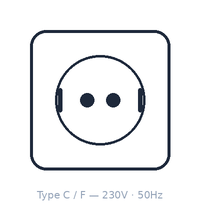
Most modern electronics (phones, laptops, cameras) handle the voltage difference automatically — check the label on your charger for “INPUT: 100-240V” to confirm. Hair dryers and straighteners from North America may need a voltage converter, or it’s easier to buy or borrow one locally.
Slovenia has excellent mobile coverage in cities and along main routes. Coverage can be limited in deep mountain valleys and caves. EU residents benefit from “roam like at home” regulations. For visitors from outside the EU, local SIM cards and eSIMs are available from Telekom Slovenije, A1, and T-2 at airports, shops, and kiosks. Free Wi-Fi is available in most cafes, hotels, and urban areas. Ljubljana offers free city-wide Wi-Fi in the center.
📱 Need mobile data? An eSIM is the easiest way to stay connected in Europe — no SIM swapping, activate before you land. Compare the best eSIM providers for Europe →
Health and Safety
Slovenia has a good healthcare system. EU citizens can use the European Health Insurance Card (EHIC) or Global Health Insurance Card (GHIC) for necessary medical treatment. Non-EU visitors should carry comprehensive travel insurance — mountain activities warrant coverage for outdoor sports and mountain rescue.
In a medical emergency, call 112 (EU-wide emergency number). Mountain rescue is available through the same number. Pharmacies (lekarna) are well-stocked, and pharmacists can provide advice for minor ailments.
Slovenia is very safe for visitors — one of the safest countries in Europe. Petty theft is rare even in Ljubljana. The main safety considerations are mountain-related — the Julian Alps are real mountains with genuine hazards. Trails can be exposed, weather changes rapidly at altitude, and via ferrata routes require proper equipment. Check conditions, carry appropriate gear, and don’t overestimate your experience level. Tick-borne diseases (Lyme disease and tick-borne encephalitis) are present in forested areas from spring through autumn.
Food and Dining Culture
Slovenian cuisine reflects the country’s geographic diversity — alpine, Mediterranean, Central European, and Balkan influences combine into something distinctive. Štruklji (rolled dumplings with various fillings — tarragon, cottage cheese, walnut) are a national specialty. Žlikrofi (Idrija-style stuffed pasta, similar to ravioli) from the town of Idrija carry an EU-protected designation. Potica (a rolled nut bread) is the definitive festive treat. Kraški pršut (dry-cured ham from the Karst region) is Slovenia’s answer to prosciutto — wind-dried by the Bora wind and exceptional quality.
Slovenian wines are increasingly acclaimed. The country has three main wine regions — Primorska (bordering Italy, known for reds and orange wines), Podravje (northeast, known for whites, particularly around Maribor), and Posavje (southeast). Orange wines from the Karst — whites fermented on their skins in a tradition that predates modern winemaking trends by centuries — have attracted international attention. Local wine is excellent and affordable, particularly at farm-stay restaurants (tourist farms).
Dining is affordable. A meal at a mid-range restaurant costs €10–20 per person. Many restaurants offer a daily lunch menu (dnevno kosilo) at €7–10 for a full meal — excellent value. Tourist farms (turistične kmetije) serve multi-course traditional meals with local wine in rustic settings, often for surprisingly modest prices. Ljubljana’s food scene has expanded rapidly, with excellent modern restaurants alongside traditional gostilne (taverns).
Slovenia: Economy and Context
Slovenia was the most prosperous republic of the former Yugoslavia and has maintained its economic lead since independence in 1991 — achieved after a brief ten-day war. The country joined the EU and NATO in 2004, the Schengen Area in 2007, and was the first former communist country to adopt the euro (also in 2007). Slovenia has the highest GDP per capita of any former Yugoslav or post-communist EU member state.
The economy is driven by manufacturing (particularly automotive components and pharmaceuticals), services, and increasingly by tourism. Slovenia’s commitment to green tourism is genuine — Ljubljana was European Green Capital in 2016, and the country has developed the Slovenia Green certification scheme for sustainable tourism businesses. Over 60% of the country is forested, and environmental consciousness is embedded in the national character.
Tourism has grown dramatically, with visitor numbers roughly doubling in the decade before the pandemic and recovering strongly since. Lake Bled and Ljubljana are the primary draws, but the government actively promotes distribution to lesser-known regions. Slovenia receives roughly 5–6 million international visitors annually — a remarkable number for a country of just over 2 million people. The combination of alpine landscapes, Mediterranean coast, world-class caves, excellent wine, and a genuine commitment to quality makes Slovenia one of Europe’s standout destinations.
Frequently Asked Questions
Do I need a visa to visit Slovenia?
Citizens of 59 countries, including the US, UK, Canada, and Australia, can visit Slovenia without a visa for up to 90 days within any 180-day period. This is the Schengen 90/180-day rule, which applies across all Schengen countries combined. Use our Europe Travel Planner to find out if your nationality requires a visa.
Will I need ETIAS to visit Slovenia in 2026?
ETIAS is expected to launch in late 2026, likely October or November. Once operational, visa-exempt visitors will need to apply online before traveling. The EU will confirm the exact date at least six months in advance. Until ETIAS launches, you only need your valid passport. See our ETIAS guide for the latest timeline.
What is the best time to visit Slovenia?
May through September offers the best weather for outdoor activities, with July and August warmest (and busiest at Lake Bled). June and September are the sweet spots — warm enough for swimming and hiking, with fewer crowds. The Soča Valley is best from May through October. Winter (December through March) brings skiing in the Julian Alps and atmospheric Christmas markets. Spring brings wildflowers and waterfalls at peak flow.
Do people speak English in Slovenia?
Yes — Slovenia has one of the highest English proficiency rates in continental Europe. English is widely spoken in Ljubljana, tourist areas, and by younger Slovenians. Italian is spoken along the coast, and German is understood in many areas. You’ll have very few communication difficulties.
How much does a trip to Slovenia cost?
Slovenia is moderately priced — cheaper than Austria or Italy, more expensive than Croatia. Budget travelers can manage on €45–65 per day. Mid-range travel runs €80–140 per day. Ljubljana and Lake Bled are the most expensive areas. A two-week trip for two people typically costs €2,200–4,500 total.
Is Slovenia safe for tourists?
Slovenia is one of the safest countries in Europe. Petty theft is rare. The main risks are mountain-related — the Julian Alps have genuine alpine hazards including weather changes, exposed trails, and challenging terrain. Tick-borne diseases are present in forested areas from spring through autumn.
Is Slovenia the same as Slovakia?
No — they are two completely different countries. Slovenia (capital: Ljubljana) borders Italy, Austria, Hungary, and Croatia in the western Balkans. Slovakia (capital: Bratislava) borders Austria, Czech Republic, Poland, Hungary, and Ukraine in Central Europe. The confusion is common but the countries are distinct in language, culture, geography, and history.
Can I combine Slovenia with Croatia or Italy?
Absolutely — Slovenia’s location makes it ideal for multi-country trips. Ljubljana is 1.5 hours from Zagreb, 2.5 hours from Venice, and 3.5 hours from Vienna. All borders are Schengen (including Croatia since 2023), so there are no border checks. A popular route combines Ljubljana, Lake Bled, the Soča Valley, the Slovenian coast, and then continues to Istria (Croatia) or northeast Italy.
🌍 Plan Your Trip to Slovenia
Entry requirements, visa status, and a full travel briefing — personalized for your nationality.
Use the Europe Travel Planner →📚 Related Articles
- Schengen 90/180-Day Rule — How the visa-free stay limit works across Europe
- ETIAS: Europe’s New Travel Authorization — What you’ll need starting late 2026
- Entry/Exit System (EES) — How the new biometric borders work
- International Driving Permit in Europe — Country-by-country IDP requirements
- Best Travel Insurance for Europe — Protect your trip
- Travel to Croatia: Complete Guide
- Travel to Austria: Complete Guide
- All Europe Country Guides
This article is for informational purposes only and does not constitute legal or travel advice. Entry requirements can change — always verify with official government sources before traveling. Last updated: February 2026.