
Last Updated: February 2026
Slovakia is one of Central Europe’s best-kept secrets — a country of dramatic mountain scenery, medieval castle ruins, thermal spas, and vibrant cities that most travelers skip on their way between Vienna and Budapest. That’s their loss. With the High Tatras offering some of the most accessible alpine scenery in Europe, a capital city just an hour from Vienna, and prices that make Western Europe look extravagant, Slovakia rewards visitors who take the time to discover it. Here’s everything a visitor needs to know to plan a trip to Slovakia in 2026.
🇸🇰 Slovakia at a Glance
| Capital | Bratislava |
| Population | ~5.4 million (2026) |
| Currency | Euro (€) |
| Language | Slovak |
| Time Zone | CET (UTC+1) · CEST in summer (UTC+2) |
| Plug Type | Type C and E · 230V / 50Hz |
| Driving Side | Right |
| International Driving Permit (IDP) | Recommended — see IDP guide |
| Schengen Member | Yes — since 2007 |
| Emergency Number | 112 (EU-wide) · 150 (fire) · 155 (ambulance) · 158 (police) |
Entry Requirements for Slovakia
Slovakia is part of the Schengen Area, meaning it follows the same entry rules as the other 28 Schengen member countries. What you need to enter Slovakia depends on your nationality.
Visa-Exempt Visitors (US, UK, Canada, Australia, and Others)
Citizens of 59 visa-exempt countries — including the United States, United Kingdom, Canada, Australia, New Zealand, Japan, and most Latin American nations — can enter Slovakia without a visa for short stays of up to 90 days within any 180-day period. This is the standard Schengen 90/180-day rule, and it applies across all 29 Schengen countries combined, not just Slovakia.
To enter Slovakia as a visa-exempt visitor, your passport must meet two requirements. It must have been issued within the last 10 years at the time of entry, and it must remain valid for at least three months after your planned departure date from the Schengen area.
At the border, Slovak officials may ask for proof of accommodation, proof of sufficient funds, and evidence of onward or return travel. In practice, Slovakia has open Schengen borders with all its neighbors, so most visitors arrive without encountering any border checks. Carry your passport regardless, as random checks can occur.
Visitors Who Need a Visa
If your country is not on the visa-exempt list, you’ll need to apply for a Schengen short-stay visa (Type C) through the Slovak consulate in your home country before traveling. This visa allows stays of up to 90 days within a 180-day period and typically costs €80 for adults.
For longer stays — work, study, or family reunification — you’ll need a Slovak national long-stay visa (Type D), which must be applied for separately from a Schengen visa. Use our Europe Travel Planner to find out exactly what your nationality requires.
What’s Changing at Slovakia’s Borders in 2026
Two major systems are transforming how non-EU visitors enter Slovakia and the rest of the Schengen area. Both are rolling out in 2026, and travelers need to be aware of the timeline.
Entry/Exit System (EES)
The Entry/Exit System began its phased rollout on October 12, 2025, and is expected to be fully operational at all Schengen border crossings by April 10, 2026. EES replaces the old passport-stamping process with a digital system that records biometric data — fingerprints and facial images — along with your passport details and entry/exit dates.
The first time you enter the Schengen area under EES, border officials will collect your fingerprints and take a facial photograph. This is done either at a self-service kiosk (if you have a biometric passport) or by a border guard. Once you’re registered, the data stays valid for three years, and subsequent entries only require identity verification rather than a full re-registration.
Since all of Slovakia’s neighbors are Schengen members (Austria, Czech Republic, Poland, Hungary, and — since 2025 — Ukraine’s border crossings are the exception), EES will primarily affect travelers arriving at Bratislava or Košice airports. If you enter the Schengen area through another country first, EES will be processed there.
ETIAS — Europe’s New Travel Authorization
The European Travel Information and Authorization System (ETIAS) is expected to launch in late 2026, likely in October or November. Once operational, all visa-exempt travelers — including Americans, Britons, Canadians, and Australians — will need to apply for ETIAS authorization before traveling to any Schengen country, including Slovakia.
The ETIAS application is completed online and takes roughly 10 minutes. It asks for personal details, passport information, and security-related questions. The fee is €20 for travelers aged 18 to 70 (free for those younger or older). Once approved, ETIAS is valid for three years or until your passport expires, whichever comes first. It covers all 29 Schengen countries, so you don’t need a separate authorization for each destination.
Getting to Slovakia
Slovakia’s central European location gives it excellent overland connections, though its airports are smaller than those of its neighbors. Many visitors arrive via Vienna, Budapest, or Prague and travel onward by train or car.
By Air
Bratislava Airport (BTS) serves a growing number of European routes, with Ryanair and Wizz Air as the primary carriers. Direct flights connect Bratislava to London, Dublin, Milan, Barcelona, Athens, and many other European cities. Košice Airport (KSC) in eastern Slovakia has a smaller selection of routes.
For wider flight options, Vienna International Airport (VIE) is just 60 km from Bratislava — roughly 45 minutes by car or bus. Many visitors fly into Vienna and take the bus or train directly to Bratislava. Budapest Airport (BUD) is another option, approximately 2 hours by car from Bratislava.
By Train
Slovakia has good rail connections to its neighbors. Direct trains run from Bratislava to Vienna (approximately 1 hour, frequent), Budapest (approximately 2.5 hours), Prague (approximately 4 hours), and Warsaw (approximately 6–7 hours). Košice connects to Budapest and Kraków. RegioJet and Leo Express operate comfortable, affordable private trains on several routes, competing with the state railway ZSSK and often offering better service.
By Bus
FlixBus, RegioJet, and other operators connect Bratislava to major European cities including Vienna, Budapest, Prague, Kraków, and Berlin. RegioJet in particular offers excellent service with onboard entertainment, drinks, and snacks. The main bus station (Autobusová stanica Nivy) in Bratislava is modern and centrally located in the Nivy shopping complex.
By Car
Slovakia shares open Schengen borders with Austria, Czech Republic, Poland, and Hungary — no border controls or checkpoints. The country sits on major European motorway routes. From Vienna, the drive to Bratislava takes about 45 minutes; from Budapest, about 2 hours; from Prague, about 3.5 hours. A motorway vignette is required for driving on Slovak motorways — see the driving section below.
Getting Around Slovakia
Slovakia is a compact country — Bratislava to Košice, the two main cities at opposite ends, is about 400 km. The transport network is adequate, with trains and buses covering most destinations.
Trains
ZSSK (Slovak State Railways) operates the national network, supplemented by private operators RegioJet and Leo Express on popular routes. Trains are affordable, though speeds vary — the Bratislava to Košice route takes about 4.5–5.5 hours depending on the service. RegioJet trains are generally more comfortable than ZSSK and similarly priced.
| Route | Duration | Approximate Cost |
|---|---|---|
| Bratislava → Košice | ~4.5–5.5 hours | €10–20 |
| Bratislava → Žilina | ~2–2.5 hours | €8–14 |
| Bratislava → Banská Bystrica | ~3–4 hours | €8–14 |
| Žilina → Poprad-Tatry | ~1.5–2 hours | €5–8 |
| Poprad-Tatry → Košice | ~1–1.5 hours | €4–7 |
Buses
Buses supplement trains and are sometimes faster for routes not well served by rail. FlixBus and RegioJet handle major intercity routes. Local buses connect smaller towns and villages, though schedules can be infrequent in rural areas. The journey planner at cp.hnonline.sk covers both bus and train options.
Driving
A rental car is the best way to explore Slovakia’s countryside — the castles, mountain valleys, traditional villages, and national parks are often difficult to reach by public transit. Major rental companies operate at Bratislava Airport and in the city center.
Slovakia drives on the right. Speed limits are 130 km/h on motorways, 90 km/h on rural roads, and 50 km/h in urban areas. Main motorways (particularly the D1 connecting Bratislava to eastern Slovakia) are modern, though the route through central Slovakia involves winding mountain sections. Secondary roads vary in quality. Headlights must be on at all times while driving.
Winter driving: Winter tires are mandatory from November 15 to March 31 (and whenever winter conditions exist). Mountain roads, particularly in the High Tatras and central Slovakia, can be challenging in winter. Snow chains may be required on some passes.
International Driving Permit: An IDP is recommended for non-EU drivers. See our International Driving Permit guide for how to get one in your country.
Bratislava Public Transit
Bratislava has a well-functioning network of buses, trams, and trolleybuses operated by DPB. A single ticket costs €1 (30-minute), with 24-hour (€4.50) and 72-hour (€10) passes available. Tickets can be purchased via the IDS BK app or at machines at major stops. The old town is compact and best explored on foot.
Where to Go in Slovakia
Slovakia’s landscapes range from the Danube lowlands in the southwest to dramatic alpine peaks in the north, with a heartland of rolling hills, forests, medieval towns, and more castles per capita than almost any other country.
Bratislava
Slovakia’s capital sits on the Danube at the crossroads of Austria, Hungary, and the Czech Republic — no other European capital is so close to two international borders. The compact old town is a pleasant mix of pastel baroque buildings, narrow lanes, and quirky bronze statues. Bratislava Castle, perched on a hill above the Danube, offers sweeping views across the city to Austria. The city’s personality is youthful and unpretentious — a strong cafe culture, a growing food scene, and nightlife that’s lively without being overwhelming. The UFO Bridge observation deck and the brutalist Slavín memorial are architectural contrasts worth seeking out.
High Tatras (Vysoké Tatry)
The High Tatras are the smallest alpine mountain range in the world — but what they lack in size they make up for in accessibility and dramatic scenery. Jagged granite peaks rising above 2,600 meters, glacial lakes, waterfalls, and well-marked trails are all accessible from resort towns at the base. Štrbské Pleso (a glacial lake with a striking mountain backdrop), Starý Smokovec (the main resort hub), and Tatranská Lomnica (home to a cable car to Lomnický štít at 2,634 meters) are the primary bases. The hiking season runs roughly from June through October, with the highest trails open July through September.
In winter, the Tatras offer affordable skiing with modern infrastructure — Jasná in the Low Tatras is Slovakia’s largest and most modern ski resort, while the High Tatras resorts offer smaller but scenic slopes. Prices are a fraction of Alpine resort costs.
Spiš Region and Spiš Castle
Spiš Castle (Spišský hrad) is one of the largest castle complexes in Central Europe — a sprawling hilltop ruin that dominates the landscape for miles and is a UNESCO World Heritage Site. The nearby town of Levoča has a perfectly preserved medieval center, also UNESCO-listed, with the world’s tallest Gothic wooden altar in the Church of St. James. The broader Spiš region in eastern Slovakia is scattered with historic towns, minor castles, and a landscape that feels like it’s barely changed in centuries.
Banská Štiavnica
This former mining town in central Slovakia is one of the most beautiful small towns in Europe — a UNESCO World Heritage Site built across steep hillsides around a now-silent silver and gold mining heritage. The Old Castle, New Castle, open-air mining museum, and the Calvary complex on the hill above town are highlights. The town has a growing arts and cafe scene, and its quiet, slightly melancholy atmosphere makes a striking contrast to the livelier cities. Banská Štiavnica is also surrounded by artificial lakes (tajchy) built for the mines, now used for swimming and recreation.
Slovak Paradise National Park (Slovenský Raj)
Slovak Paradise is one of the most unique hiking experiences in Europe — a network of gorges with trails that involve ladders, chains, bridges, and walkways bolted to cliff faces above rushing waterfalls. The Suchá Belá gorge is the most popular route, and the Prielom Hornádu canyon walk is spectacular. Despite the name, the terrain is challenging enough to require a basic level of fitness and a head for heights. The park is best accessed from the town of Hrabušice or from Podlesok.
Košice
Slovakia’s second city, in the far east of the country, has the largest historic center in Slovakia after Bratislava. The Gothic Cathedral of St. Elizabeth is the easternmost Gothic cathedral in Western-style Europe. The main street (Hlavná ulica) is a long, elegant pedestrian boulevard lined with palaces, churches, and cafes. Košice was European Capital of Culture in 2013, and the cultural infrastructure — including the Kunsthalle contemporary art center in a converted swimming pool — remains strong. The city is also the gateway to the vineyards of the Tokaj wine region, which extends across the Hungarian border.
Čičmany and Traditional Villages
Slovakia’s rural heartland preserves traditional wooden architecture and folk culture that has largely disappeared elsewhere in Central Europe. Čičmany is the most famous example — a village of dark log houses decorated with distinctive white geometric patterns that were the inspiration for Slovak folk art and even national symbols. Vlkolínec, a UNESCO-listed village near Ružomberok, is another beautifully preserved example. These villages offer a window into a pre-industrial way of life that’s remarkably intact.
Thermal Spas
Slovakia has over 1,000 mineral and thermal springs, and spa culture runs deep. Piešťany is the most famous spa town, known for its therapeutic mud treatments and elegant spa island in the Váh River. Trenčianske Teplice, Rajecké Teplice, and Bardejovské Kúpele are other notable spa destinations. Many thermal parks (aquaparks with thermal pools) offer a more casual, family-friendly version of the spa experience — Tatralandia near Liptovský Mikuláš is one of the largest in Central Europe.
Practical Information for Visitors
Money and Costs
Slovakia uses the euro (€), adopted in 2009. Credit and debit cards are widely accepted in cities and tourist areas. Contactless payment is standard in most businesses. Cash is more commonly needed in rural areas, smaller restaurants, and mountain huts. ATMs are plentiful in cities and towns.
Slovakia is affordable by Western European standards — significantly cheaper than Austria or Germany, roughly comparable to the Czech Republic, and slightly more expensive than Poland or Hungary. Budget travelers can manage on €35–55 per day with hostel accommodation, local food, and public transit. Mid-range travel — comfortable hotels, restaurant meals, and activities — runs €70–120 per day. Bratislava is the most expensive area; the High Tatras and spa towns are moderate; smaller cities and the countryside are very affordable.
Tipping in Slovakia is customary. Leaving 10% at restaurants is standard. At cafes, rounding up is typical. Tipping taxi drivers by rounding up the fare is common.
Language
Slovak is the official language — a West Slavic language closely related to Czech (the two are largely mutually intelligible). It uses the Latin alphabet with several diacritical marks (á, ä, č, ď, é, í, ĺ, ľ, ň, ó, ô, ŕ, š, ť, ú, ý, ž).
English is spoken in Bratislava, Košice, and tourist areas, particularly by younger Slovaks. Outside the main cities, English proficiency drops off. German is useful in western Slovakia, and Hungarian is widely spoken in the south, where a significant ethnic Hungarian minority lives. Czech is universally understood. Learning a few Slovak phrases — “dobrý deň” (hello/good day), “ďakujem” (thank you), “prosím” (please) — is appreciated.
Power and Connectivity
Slovakia uses Type C and Type E power plugs at 230V/50Hz. If you’re traveling from the US, Canada, UK, or Australia, you’ll need a plug adapter.
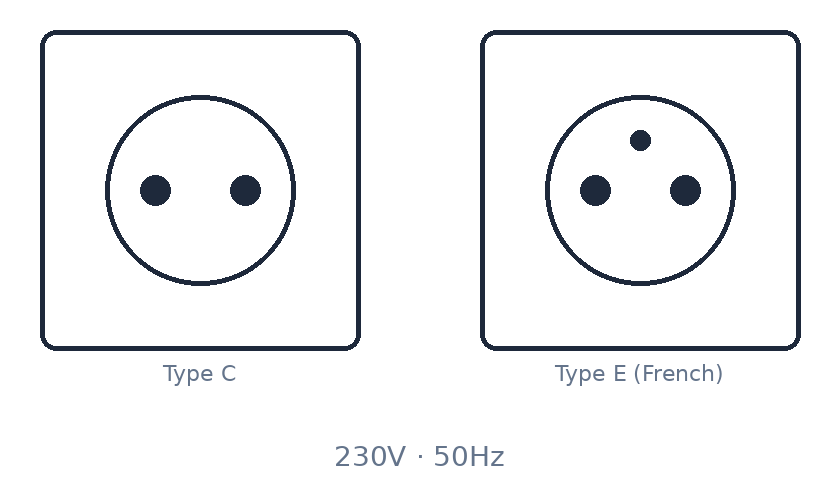
Most modern electronics (phones, laptops, cameras) handle the voltage difference automatically — check the label on your charger for “INPUT: 100-240V” to confirm. Hair dryers and straighteners from North America may need a voltage converter, or it’s easier to buy or borrow one locally.
Slovakia has good mobile coverage in cities and along main routes, with patchier service in mountain areas and deep valleys. EU residents benefit from “roam like at home” regulations. For visitors from outside the EU, local SIM cards and eSIMs are available from Orange, O2, Telekom, and 4ka at airports, shops, and kiosks. Free Wi-Fi is available in most cafes, hotels, and urban areas.
📱 Need mobile data? An eSIM is the easiest way to stay connected in Europe — no SIM swapping, activate before you land. Compare the best eSIM providers for Europe →
Health and Safety
Slovakia’s healthcare system is adequate in cities but limited in rural and mountain areas. EU citizens can use the European Health Insurance Card (EHIC) or Global Health Insurance Card (GHIC) for necessary medical treatment. Non-EU visitors should carry comprehensive travel insurance — mountain rescue in the Tatras is not free, and insurance covering outdoor activities is important if you plan to hike.
In a medical emergency, call 112 (EU-wide emergency number) or 155 (ambulance). For police, call 158. For fire, call 150. Mountain rescue: call 18300. Pharmacies (lekáreň) are well-stocked in cities and towns.
Slovakia is generally safe for visitors. Petty theft can occur in Bratislava’s old town and on public transit, but is uncommon. The main safety considerations are mountain-related — the High Tatras are real mountains with real alpine hazards, including sudden weather changes, exposed ridges, and challenging terrain. Stick to marked trails, check weather forecasts, and don’t attempt high-altitude routes without proper equipment and experience.
Tick-borne diseases (Lyme disease and tick-borne encephalitis) are present in forested areas from spring through autumn. TBE vaccination is recommended if you plan extensive outdoor activities. Use repellent and check for ticks after woodland walks.
Food and Dining Culture
Slovak cuisine is hearty, meat-heavy, and built around the staples of potatoes, dumplings, cheese, and pork. Bryndzové halušky — small potato dumplings with sheep cheese (bryndza) and crispy bacon bits — is the undisputed national dish and a must-try. Kapustnica (sauerkraut soup with smoked sausage and mushrooms) is the traditional Christmas soup served year-round at many restaurants. Pirohy (filled dumplings, similar to Polish pierogi) come with various fillings. Šúľance (sweet potato noodles with poppy seeds and sugar) is a popular dessert.
Slovak wine is an underappreciated pleasure. The Small Carpathian Wine Route near Bratislava produces excellent whites, particularly Grüner Veltliner, Riesling, and Frankovka (a light red). The Tokaj region in eastern Slovakia shares the same volcanic terroir as Hungary’s famous Tokaji wine region and produces its own distinctive sweet wines. Beer is also important — Zlatý Bažant, Šariš, and Urpiner are popular Slovak brands, and a growing craft beer scene is emerging in Bratislava and Košice.
Dining is affordable. A meal at a mid-range restaurant costs €8–15 per person. Daily lunch menus (denné menu) are widely available at €5–8 for a full two or three-course meal — this is how most working Slovaks eat at lunchtime, and it’s excellent value for visitors. A half-liter of beer at a restaurant costs €1.50–3.
Slovakia: Economy and Context
Slovakia’s transformation since the fall of communism in 1989 and the peaceful split from the Czech Republic in 1993 (the “Velvet Divorce”) has been remarkable. The country joined the EU and NATO in 2004, the Schengen Area in 2007, and adopted the euro in 2009. Slovakia has become a major automotive manufacturing hub — the country produces more cars per capita than any other nation in the world, with Volkswagen, Kia, Stellantis (Peugeot/Citroën), and Jaguar Land Rover all operating plants here.
Tourism has grown steadily but remains underdeveloped relative to Slovakia’s potential. The country received roughly 6–7 million international visitors annually before the pandemic, with the High Tatras, Bratislava, and the spa towns as the primary draws. Slovakia is increasingly positioned as an affordable alternative to Austria and Switzerland for mountain tourism, and its castle heritage (over 100 castles and castle ruins) and folk culture offer cultural depth that few visitors expect.
The combination of eurozone membership, Schengen access, Central European location, dramatic landscapes, and prices that are roughly half of neighboring Austria makes Slovakia one of the strongest value propositions in European travel.
Frequently Asked Questions
Do I need a visa to visit Slovakia?
Citizens of 59 countries, including the US, UK, Canada, and Australia, can visit Slovakia without a visa for up to 90 days within any 180-day period. This is the Schengen 90/180-day rule, which applies across all Schengen countries combined. Use our Europe Travel Planner to find out if your nationality requires a visa.
Will I need ETIAS to visit Slovakia in 2026?
ETIAS is expected to launch in late 2026, likely October or November. Once operational, visa-exempt visitors will need to apply online before traveling. The EU will confirm the exact date at least six months in advance. Until ETIAS launches, you only need your valid passport. See our ETIAS guide for the latest timeline.
What is the best time to visit Slovakia?
June through September is best for hiking and general sightseeing, with the High Tatras trails fully open in July and August. December through March is ski season, with Jasná and the Tatras resorts offering affordable slopes. Spring (April–May) and autumn (September–October) offer pleasant weather, fewer crowds, and beautiful foliage — particularly in the forests and wine regions. Christmas markets in Bratislava and Košice run from late November through December.
Do people speak English in Slovakia?
English is spoken in Bratislava, Košice, and tourist areas, particularly by younger Slovaks. Outside the main cities, English proficiency drops off. German is useful in western Slovakia, and Hungarian in the south. Czech is universally understood. Learning a few Slovak phrases is appreciated.
How much does a trip to Slovakia cost?
Slovakia is affordable — significantly cheaper than neighboring Austria. Budget travelers can manage on €35–55 per day. Mid-range travel runs €70–120 per day. Lunch menus at restaurants are exceptional value at €5–8. A two-week trip for two people typically costs €1,800–3,500 total.
Is Slovakia safe for tourists?
Slovakia is generally safe. Petty theft is uncommon but possible in Bratislava. The main safety considerations are mountain-related — the High Tatras have real alpine hazards. Mountain rescue is not free, so ensure your travel insurance covers it. Tick-borne diseases are present in forested areas.
How do I get from Vienna to Bratislava?
Bratislava is just 60 km from Vienna. Direct trains take about 1 hour (from €10). Buses (FlixBus, Slovak Lines) run frequently and take about 1 hour (from €5). You can also take a seasonal boat along the Danube (75 minutes). It’s one of the easiest cross-border trips in Europe.
What is bryndzové halušky?
Slovakia’s national dish — small potato dumplings topped with bryndza (a tangy sheep’s milk cheese unique to the region) and crispy bacon pieces. It’s hearty, savory, and available at traditional restaurants across the country. If you try one Slovak dish, make it this one.
🌍 Plan Your Trip to Slovakia
Entry requirements, visa status, and a full travel briefing — personalized for your nationality.
Use the Europe Travel Planner →📚 Related Articles
- Schengen 90/180-Day Rule — How the visa-free stay limit works across Europe
- ETIAS: Europe’s New Travel Authorization — What you’ll need starting late 2026
- Entry/Exit System (EES) — How the new biometric borders work
- International Driving Permit in Europe — Country-by-country IDP requirements
- Best Travel Insurance for Europe — Protect your trip
- Travel to Austria: Complete Guide
- Travel to Czech Republic: Complete Guide
- All Europe Country Guides
This article is for informational purposes only and does not constitute legal or travel advice. Entry requirements can change — always verify with official government sources before traveling. Last updated: February 2026.