
Home › Country Guides › Travel to Czech Republic
Last Updated: August 2026
The Czech Republic — officially Czechia — is the Central European destination that has it all at a fraction of Western European prices. Prague alone would be reason enough to visit, with its Gothic spires, baroque palaces, and legendary beer culture. But look beyond the capital and you’ll find the fairytale medieval town of Český Krumlov, the elegant spa towns of western Bohemia, the wine cellars of South Moravia, and some of the most unspoiled landscapes in continental Europe. With 22.8 million visitors in 2024 — a new all-time record — Czechia has firmly established itself as one of Europe’s most popular destinations. Here’s everything you need to know to plan a trip in 2026.
🇨🇿 Czech Republic at a Glance
| Capital | Prague (Praha) |
| Population | ~10.9 million (2026) |
| Currency | Czech koruna (CZK / Kč) — not the euro |
| Language | Czech |
| Time Zone | CET (UTC+1) · CEST in summer (UTC+2) |
| Plug Type | Type C and E · 230V / 50Hz |
| Driving Side | Right |
| International Driving Permit (IDP) | Recommended — see IDP guide |
| Schengen Member | Yes — since 2007 |
| Emergency Number | 112 (EU-wide) · 155 (ambulance) · 158 (police) · 150 (fire) |
Entry Requirements for the Czech Republic
The Czech Republic is part of the Schengen Area, meaning it follows the same entry rules as the other 28 Schengen member countries. What you need to enter the Czech Republic depends on your nationality.
Visa-Exempt Visitors (US, UK, Canada, Australia, and Others)
Citizens of 59 visa-exempt countries — including the United States, United Kingdom, Canada, Australia, New Zealand, Japan, and most Latin American nations — can enter the Czech Republic without a visa for short stays of up to 90 days within any 180-day period. This is the standard Schengen 90/180-day rule, and it applies across all 29 Schengen countries combined, not just the Czech Republic.
To enter as a visa-exempt visitor, your passport must meet two requirements. It must have been issued within the last 10 years at the time of entry, and it must remain valid for at least three months after your planned departure date from the Schengen area.
At the border, Czech officials may ask for proof of accommodation, proof of sufficient funds, and evidence of onward or return travel. These documents aren’t always requested, but having them available avoids potential complications.
Visitors Who Need a Visa
If your country is not on the visa-exempt list, you’ll need to apply for a Schengen short-stay visa (Type C) through the Czech consulate or embassy in your home country before traveling. This visa allows stays of up to 90 days within a 180-day period and typically costs €80 for adults. The application requires travel medical insurance with minimum €30,000 coverage — see our guide to the best travel insurance for Europe for policies that meet Schengen visa requirements.
For longer stays — work, study, or family reunification — you’ll need a Czech national long-stay visa (Type D), which must be applied for separately from a Schengen visa. Use our Europe Travel Planner to find out exactly what your nationality requires.
🛂 Need a Schengen visa for the Czech Republic?
If your nationality isn’t visa-exempt, iVisa handles your Schengen visa application end to end — forms, appointment guidance, and document review before you submit.
Start your application on iVisa →Affiliate partner — we may earn a commission at no extra cost to you.
What’s Changing at Czech Borders
Two major systems are transforming how non-EU visitors enter the Czech Republic and the rest of the Schengen area. One is fully in place; the other has been pushed back.
Entry/Exit System (EES)
The Entry/Exit System completed its phased rollout and has been fully operational at all Schengen border crossings since April 2026. EES replaced the old passport-stamping process with a digital system that records biometric data — fingerprints and facial images — along with your passport details and entry/exit dates.
The first time you enter the Schengen area under EES, border officials will collect your fingerprints and take a facial photograph. This is done either at a self-service kiosk (if you have a biometric passport) or by a border guard. Once you’re registered, the data stays valid for three years, and subsequent entries only require identity verification rather than a full re-registration.
Since the Czech Republic is landlocked, most visitors arriving from outside the Schengen area encounter EES at Václav Havel Airport Prague (PRG). Visitors arriving by train or car from another Schengen country — Germany, Austria, Poland, or Slovakia — won’t go through EES at the Czech border, as there are no routine border checks between Schengen states.
ETIAS — Europe’s New Travel Authorization
The European Travel Information and Authorization System (ETIAS) will require visa-exempt travelers — including Americans, Britons, Canadians, and Australians — to apply for a travel authorization online before boarding a flight or train to the Czech Republic or any other Schengen country. The EU removed the previously confirmed Q4 2026 launch target in July 2026, and 2027 is now the most likely launch year.
The ETIAS application is completed online and takes roughly 10 minutes. It asks for personal details, passport information, and security-related questions. The fee is €20 for travelers aged 18 to 70 (free for those younger or older). Once approved, ETIAS is valid for three years or until your passport expires, whichever comes first. It covers all 29 Schengen countries, so you don’t need a separate authorization for each destination.
Getting to the Czech Republic
The Czech Republic’s central location in Europe makes it well connected by air, rail, and road, with Prague serving as the primary gateway.
By Air
Václav Havel Airport Prague (PRG) is the country’s main international airport and the only one with significant scheduled passenger traffic. It’s a hub for Czech Airlines (now part of the Smartwings group) and serves nonstop routes from major cities across Europe, North America, the Middle East, and Asia. Budget carriers including Ryanair, easyJet, and Wizz Air connect Prague with dozens of European cities at competitive prices. From North America, Delta and United offer seasonal nonstop flights to Prague, with year-round connections available via major European hubs.
By Train
Prague is an increasingly important European rail node. ÖBB Railjet trains connect Prague with Vienna (4 hours) and onward to Graz and Budapest. Deutsche Bahn and Czech Railways (ČD) jointly operate EuroCity services linking Prague with Berlin (4 hours 25 minutes), Dresden (2 hours 15 minutes), Munich, Hamburg, and Frankfurt. The Prague–Berlin route follows the scenic Elbe Valley — one of Europe’s most beautiful rail journeys. RegioJet, a popular Czech private operator, runs services to Vienna, Budapest, Bratislava, and Kraków. Nightjet sleeper trains connect Prague with Zürich and Amsterdam.
By Car
The Czech Republic shares land borders with Germany, Austria, Poland, and Slovakia. As a Schengen member, there are normally no border controls between the Czech Republic and its neighbors. Major highways connect Prague directly with Dresden, Nuremberg, Vienna, Bratislava, and Wrocław. Carry your passport even when crossing from another Schengen country, as random checks do occur.
Getting Around the Czech Republic
The Czech Republic has one of the densest rail networks in Europe relative to its size, and trains reach virtually every corner of the country. The rail network is complemented by efficient long-distance buses and a well-maintained road system.
Trains
Czech Railways (ČD — České dráhy) is the national operator, but the Czech market is unusually competitive, with several private companies running parallel services on major routes. This competition keeps prices low and quality high.
| Mode | Best For | Cost Range | Notes |
|---|---|---|---|
| Railjet (RJ) | Prague–Brno–Vienna | From 239 CZK (€10) | ÖBB/ČD joint service · Air-conditioned · Bistro car · Prague–Brno ~2h 30min · Prague–Vienna ~4h |
| SuperCity Pendolino (SC) | Prague–Ostrava | From 239 CZK (€10) | Tilting train · Up to 230 km/h · Prague–Ostrava ~3h 15min · Free Wi-Fi · Seat reservation included |
| InterCity / Express (IC/Ex) | Domestic long-distance | From 169 CZK (€7) | Prague–České Budějovice ~2h · Prague–Karlovy Vary ~3h · Bistro car on most services |
| RegioJet | Prague–Brno, international | From 149 CZK (€6) | Private operator · Yellow trains · Free coffee, newspapers · Prague–Brno ~2h 30min · Also serves Vienna, Budapest, Kraków |
| Leo Express | Prague–Ostrava, Prague–Kraków | From 149 CZK (€6) | Private operator · Black and gold trains · Free Wi-Fi · Competitive with ČD on eastern routes |
| Regional (Os/Sp) | Local travel, small towns | 30–120 CZK (€1–5) | No reservation needed · Hop on with ticket · Covers branch lines and rural areas |
Booking tips: Czech domestic trains are very affordable, and advance-purchase fares on ČD, RegioJet, and Leo Express offer even deeper savings. Check all three operators for any given route — the competition often means you’ll find excellent deals. The ČD app and website (cd.cz) handle bookings well in English. For regional trains, there’s no advantage to booking ahead — just buy at the station and take any train.
Prague Public Transit
Prague has an excellent public transit system — three metro lines, 26 tram routes, and a comprehensive bus network, all operated by DPP (Dopravní podnik hlavního města Prahy). A 30-minute ticket costs 30 CZK (~€1.20), a 90-minute ticket is 40 CZK (~€1.60), and a 72-hour pass is 330 CZK (~€13). The historic tram network is particularly useful for visitors — routes 22 and 17 pass many of Prague’s top sights and serve as unofficial sightseeing lines. Night trams and buses run after the metro closes at midnight.
Driving
A car is useful for exploring the Bohemian and Moravian countryside, the spa towns of western Bohemia, and smaller destinations off the main rail lines. Major international rental companies are available at Prague Airport and city stations.
The Czech Republic drives on the right. Speed limits are 130 km/h on motorways, 90 km/h on rural roads, and 50 km/h in built-up areas. Headlights must be on at all times, even in daylight. The country has a strict zero-tolerance policy on alcohol — the drink-drive limit is 0.00%, and random testing is common.
Winter tires: Mandatory from November 1 to March 31 when there is compacted snow or ice on the road, or when temperatures drop below 4°C with a possibility of ice. Rental cars in winter are typically equipped with winter tires, but confirm when booking.
International Driving Permit: The Czech Republic recognizes US, Canadian, and Australian licenses for short-term visits. An IDP is recommended but not strictly required — it provides a useful translation for police interactions. See our International Driving Permit guide for details.
Where to Go in the Czech Republic
The Czech Republic is compact — roughly the size of South Carolina — but packed with variety. From one of Europe’s most beautiful capitals to medieval towns, Bohemian forests, and Moravian wine country, here’s where to focus your time.
Prague
The Czech capital is a city that has survived centuries virtually intact. Prague Castle — the largest ancient castle complex in the world — towers over the Vltava River, with St. Vitus Cathedral, the Old Royal Palace, and Golden Lane within its walls. Below, the Charles Bridge connects the Lesser Town (Malá Strana) to the Old Town (Staré Město), where the medieval Astronomical Clock draws crowds every hour. The Jewish Quarter (Josefov), the art nouveau Municipal House, the Kafka Museum, and the sprawling Vyšehrad fortress round out the highlights. But Prague is more than its monuments — it has a thriving café culture, innovative restaurants, legendary beer halls (try U Fleků, founded in 1499), and a nightlife scene that ranges from underground jazz clubs to rooftop cocktail bars. Prague attracted over 8 million overnight stays in 2024.
Český Krumlov
This UNESCO-listed town in southern Bohemia looks like it was pulled from an illustrated storybook. A massive castle — the second-largest in the Czech Republic — overlooks a medieval town center wrapped in a horseshoe bend of the Vltava River. The cobblestoned streets, Renaissance and baroque architecture, the revolving open-air theater in the castle gardens, and the Egon Schiele Art Centrum all make Český Krumlov one of Europe’s most enchanting small towns. In summer, rafting the Vltava through town is a quintessential Czech experience. Reachable from Prague by direct train (2 hours 30 minutes) or bus (2 hours 35 minutes).
Brno and South Moravia
The Czech Republic’s second city, Brno, has emerged as a creative, youthful alternative to Prague. The Špilberk Castle, the Cathedral of Saints Peter and Paul, and the stunning functionalist Villa Tugendhat (a UNESCO World Heritage Site designed by Mies van der Rohe) are the headline attractions. But Brno’s real charm is its café culture, craft beer scene, and unpretentious energy — it’s a university city that doesn’t feel overrun by tourists. South of Brno, the South Moravian wine country — rolling hills covered in vineyards, dotted with wine cellars (sklepy) — is the Czech Republic’s answer to Tuscany. The Pálava region and the village of Valtice are popular starting points for wine trails.
Karlovy Vary and the Spa Triangle
Western Bohemia is home to Europe’s most famous spa towns. Karlovy Vary (Carlsbad), with its grand colonnaded promenades and thermal springs, has drawn visitors for centuries — it also hosts one of Europe’s most prestigious film festivals each July. Nearby Mariánské Lázně (Marienbad) and Františkovy Lázně (Franzensbad) complete the Spa Triangle, each offering a more intimate atmosphere. The tradition of “taking the waters” — walking the colonnades while sipping thermal spring water from a special porcelain drinking cup — is an experience unique to this part of Europe.
Kutná Hora
This UNESCO-listed medieval town, an easy day trip from Prague (about 1 hour by train), was once one of the wealthiest cities in Europe thanks to its silver mines. The Gothic Cathedral of St. Barbara — built to rival Prague’s St. Vitus — is a masterpiece. The town is also known for the Sedlec Ossuary (the “Bone Church”), a small chapel decorated with the bones of approximately 40,000 people, creating a macabre but fascinating interior. The Italian Court, a former royal mint, and the medieval silver mines offer further depth.
Bohemian and Saxon Switzerland
The sandstone landscapes of northern Bohemia — dramatic rock formations, deep gorges, and forested plateaus — form the Bohemian Switzerland National Park. The iconic Pravčická brána (Pravčice Gate), Europe’s largest natural sandstone arch, is the park’s star attraction. The Kamenice Gorge boat ride through narrow rocky channels is another highlight. The park connects with Germany’s Saxon Switzerland across the border, making for excellent multi-day hiking. Reachable from Prague in about 2 hours by car or train to Děčín.
Olomouc
Often described as a smaller, quieter version of Prague, Olomouc is a beautiful baroque city in central Moravia with a massive main square dominated by the UNESCO-listed Holy Trinity Column — the largest group of baroque statues in Central Europe. The city has six centuries of university history, a lively student atmosphere, and excellent local cuisine, including the famously pungent Olomoucké tvarůžky cheese. It’s an ideal stop between Prague and Kraków or on the way to the Moravian countryside.
Practical Information for Visitors
Money and Costs
The Czech Republic uses the Czech koruna (CZK or Kč), not the euro. While some tourist-oriented businesses in Prague accept euros, the exchange rate they offer is typically poor — always pay in koruna for the best value. ATMs (bankomaty) are widely available in cities and towns. Credit and debit cards are accepted at most hotels, restaurants, and shops, and contactless payment has become standard. Avoid the exchange bureaus clustered around Prague’s tourist areas, which are notorious for terrible rates and hidden fees.
The Czech Republic is significantly cheaper than Western Europe — one of its biggest appeals. Prague is the most expensive city but still offers excellent value compared to Paris, London, or Amsterdam. Outside Prague, prices drop considerably.
A half-liter of Czech beer in a local pub costs 50–80 CZK (€2–3), a coffee is 60–80 CZK (€2.50–3.50), and a main course at a mid-range restaurant runs 200–400 CZK (€8–16). A full Czech lunch — soup, main course, and a beer — can cost as little as 200 CZK (€8) at a local hospoda (pub). Budget around €80–130 per day for mid-range travel in Prague (hotel, meals, transport, and sightseeing). Outside Prague, €60–100 per day is realistic for comfortable travel.
Tipping in the Czech Republic is customary at around 10% in restaurants, though rounding up is also common. When paying by card, tell the server the total amount you’d like to pay (including tip) before they process the transaction, as adding a tip after card payment isn’t always possible.
Language
Czech is the official language — a Slavic language that can look intimidating on paper but follows consistent pronunciation rules once you know the basics. English is widely spoken in Prague, especially by younger people and in the tourism industry. Outside Prague, English proficiency drops, though it’s generally fine in major tourist destinations. German is more commonly understood than you might expect, particularly among older generations and in border areas. A few Czech phrases — “Dobrý den” (hello), “Prosím” (please), “Děkuji” (thank you), “Pivo, prosím” (beer, please) — go a long way and are genuinely appreciated.
Power and Connectivity
The Czech Republic uses Type C and Type E power plugs at 230V/50Hz. Type E sockets have a grounding pin that protrudes from the socket, but a standard European two-pin Type C adapter fits perfectly. If you’re traveling from the US, Canada, UK, or Australia, you’ll need a plug adapter.
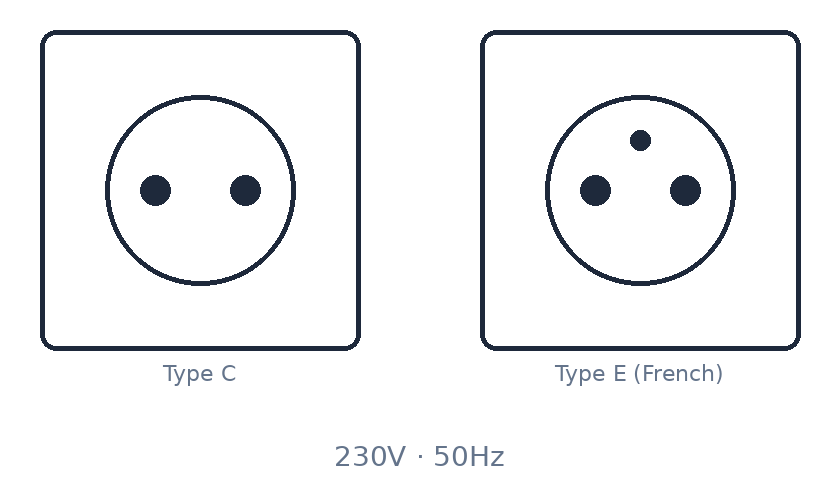
Most modern electronics (phones, laptops, cameras) handle the voltage difference automatically — check the label on your charger for “INPUT: 100-240V” to confirm. Hair dryers and straighteners from North America may need a voltage converter, or it’s easier to buy or borrow one locally.
The Czech Republic has good mobile coverage and widespread Wi-Fi, including in smaller towns. EU and EEA residents benefit from “roam like at home” regulations with no extra charges. For visitors from outside the EU, purchasing a local SIM card or eSIM is straightforward — T-Mobile, O2, and Vodafone all offer prepaid options with solid coverage nationwide.
📱 Need mobile data? An eSIM is the easiest way to stay connected in Europe — no SIM swapping, activate before you land. Compare the best eSIM providers for Europe →
Health and Safety
The Czech Republic has a good healthcare system. EU/EEA citizens can use the European Health Insurance Card (EHIC) or Global Health Insurance Card (GHIC) for necessary medical treatment at public facilities. Non-EU visitors aren’t covered — private treatment costs are moderate by European standards, but an unexpected hospital stay still adds up. Comprehensive travel insurance for Europe is strongly recommended.
🏥 Cover your whole trip to the Czech Republic with one policy
SafetyWing Nomad Insurance covers the Czech Republic and every other stop on your route — emergency medical coverage, evacuation, travel delay, and lost luggage protection in one plan. It meets the €30,000 Schengen visa medical minimum too. Buy it before you leave or even mid-trip.
Get a quote from SafetyWing →Affiliate partner — we may earn a commission at no extra cost to you.
In a medical emergency, call 155 (ambulance) or 112 (EU-wide emergency number). For police, call 158. For fire, call 150. Pharmacies (lékárna) are well-stocked, and pharmacists can advise on minor ailments. A 24-hour pharmacy system operates in major cities.
The Czech Republic is a very safe country. Violent crime targeting tourists is extremely rare. The most common issue is petty theft — pickpocketing occurs in Prague’s tourist zones (Old Town Square, Charles Bridge, Wenceslas Square, and on tram routes 22 and 17). Watch out for taxi scams in Prague — use apps like Bolt or Liftago rather than hailing cabs on the street, especially near tourist attractions. Restaurant scams — being charged for items you didn’t order or receiving unfavorable exchange rates — also occur in tourist-trap establishments. Check bills carefully and always ask for a menu with prices.
Food and Dining Culture
Czech cuisine is hearty, meat-heavy, and designed to pair perfectly with the country’s world-famous beer. It’s comfort food elevated to a national art form.
Svíčková na smetaně (marinated beef sirloin in a creamy vegetable sauce with dumplings and cranberries) is the national dish and a must-try. Vepřo-knedlo-zelo (roast pork, dumplings, and sauerkraut) is the other quintessential Czech meal. Guláš (goulash) served with bread dumplings, smažený sýr (fried cheese — essentially a fried Edam cutlet), and trdelník (a sweet pastry rolled on a spit, though it’s more of a tourist novelty than a traditional Czech food) are everywhere. Czech dumplings (knedlíky) — bread dumplings, potato dumplings, and sweet fruit dumplings — are a cornerstone of the cuisine.
Czech beer needs no introduction. The Czechs invented pilsner (in the city of Plzeň in 1842) and drink more beer per capita than any country on earth. Pilsner Urquell, Budweiser Budvar, Staropramen, Kozel, and Bernard are among the most famous brands, but the real treasures are the local craft and microbreweries that have exploded in recent years. A hospoda (traditional beer hall) is the center of Czech social life — find one away from the tourist zone, order a světlý ležák (pale lager), and settle in. South Moravia’s wine country produces excellent whites (particularly Grüner Veltliner, Riesling, and Pálava) and reds that rival those of neighboring Austria at a fraction of the price.
Czech Republic: Economy and Context
The Czech Republic has a GDP of approximately $383 billion (2025), with a highly diversified industrial economy anchored by automotive manufacturing, engineering, electronics, and a growing tech sector. The country consistently ranks among the most economically developed in Central and Eastern Europe, with unemployment typically among the lowest in the EU.
Tourism exceeded pre-pandemic levels for the first time in 2024, with 22.8 million guests recorded in accommodation establishments and 57.3 million overnight stays — both all-time records. Foreign visitors accounted for 46% of all guests, with Germany as the leading source market followed by Poland, Slovakia, the United States, and the United Kingdom. Prague dominates international arrivals, but interest in regional destinations — particularly South Moravia, Karlovy Vary, and South Bohemia — is growing steadily.
The Czech Republic joined the EU in 2004 and the Schengen Area in 2007, but has not adopted the euro — the Czech koruna remains the national currency, and euro adoption has no set timeline. The country’s central location, excellent infrastructure, competitive prices, and deep cultural heritage make it one of Central Europe’s most compelling destinations.
Frequently Asked Questions
Do I need a visa to visit the Czech Republic?
Citizens of 59 countries, including the US, UK, Canada, and Australia, can visit the Czech Republic without a visa for up to 90 days within any 180-day period. This is the Schengen 90/180-day rule, which applies across all Schengen countries combined. Use the Europe Travel Planner to find out if your nationality requires a visa.
Will I need ETIAS to visit the Czech Republic in 2026?
Not in 2026. The EU removed the Q4 2026 ETIAS launch target in July 2026, and 2027 is now the most likely launch year. Once operational, visa-exempt visitors will need to apply online before traveling — €20 for adults, valid for three years, covering all 29 Schengen countries. Until ETIAS launches, you only need your valid passport. See our ETIAS guide for the latest timeline.
What is the best time to visit the Czech Republic?
Late spring (May–June) and early autumn (September–October) offer the best combination of pleasant weather, manageable crowds, and lower prices. Summer (July–August) is warm and lively but Prague gets very crowded. Winter (December–February) brings Christmas markets, snowy landscapes, and off-season prices, though temperatures can drop well below freezing. The South Moravian wine harvest in September is a particularly special time to visit.
Do people speak English in the Czech Republic?
English is widely spoken in Prague, especially by younger people and in tourist areas. Outside Prague, proficiency drops but is generally adequate at hotels, restaurants, and major tourist sites. German is also commonly understood, particularly near the Austrian and German borders. Learning a few Czech phrases is appreciated.
How much does a trip to the Czech Republic cost?
The Czech Republic is significantly cheaper than Western Europe. Budget around €80–130 per day for mid-range travel in Prague (hotel, meals, transport, and sightseeing). Outside Prague, €60–100 per day is realistic. A half-liter of beer costs €2–3, and a full lunch with beer can be as little as €8. A one-week trip for two people typically costs €1,500–3,500.
Does the Czech Republic use the euro?
No. The Czech Republic uses the Czech koruna (CZK). While some tourist-oriented businesses in Prague accept euros, the exchange rate is unfavorable. Always pay in koruna and withdraw cash from ATMs rather than using exchange bureaus in tourist areas.
Do I need travel insurance for the Czech Republic?
Not required for entry for visa-exempt visitors, but strongly recommended — non-EU visitors aren’t covered by Czech public healthcare, and unexpected private treatment adds up. If you need a Schengen visa, travel medical insurance with at least €30,000 coverage is mandatory for your application. See our Europe travel insurance guide for options that meet the requirement.
Do I need a vignette to drive in the Czech Republic?
Yes, if you’re using motorways and expressways. An electronic vignette (e-známka) is required for all vehicles up to 3.5 tonnes. A 10-day e-vignette costs 300 CZK (~€12) as of 2026. Purchase online at edalnice.cz before driving. Enforcement is automatic via license plate cameras, and fines can reach 20,000 CZK (~€800).
Is the Czech Republic safe?
The Czech Republic is very safe for visitors. Violent crime is rare. The main risks in Prague are pickpocketing in tourist areas and occasional taxi or restaurant scams. Outside Prague, the country feels extremely safe. Use common sense and you’ll have no issues.
🌍 Plan Your Trip to the Czech Republic
Entry requirements, visa status, and a full travel briefing — personalized for your nationality.
Use the Europe Travel Planner →📚 Related Articles
- Schengen 90/180-Day Rule — How the visa-free stay limit works across Europe
- ETIAS: Europe’s New Travel Authorization — What you’ll need when it launches
- Entry/Exit System (EES) — How the new biometric borders work
- International Driving Permit in Europe — Country-by-country IDP requirements
- Best Travel Insurance for Europe — Protect your trip
- Travel to Austria: Complete Guide
- Travel to Germany: Complete Guide
- Travel to Poland: Complete Guide
- All Europe Country Guides
This article is for informational purposes only and does not constitute legal or travel advice. Entry requirements can change — always verify with official government sources before traveling. Last updated: August 2026.