
Home › Country Guides › Travel to Germany
Last Updated: August 2026
Germany is Europe’s economic powerhouse and cultural heavyweight — a country where medieval castles overlook autobahn highways, beer halls sit alongside Michelin-starred restaurants, and Christmas markets light up cities that were rebuilt from rubble less than a century ago. With roughly 40 million international visitors per year and some of the continent’s best train infrastructure, Germany is one of the most rewarding and easiest countries to explore in Europe. Here’s everything you need to know to plan a trip in 2026.
🇩🇪 Germany at a Glance
| Capital | Berlin |
| Population | ~84 million (2026) |
| Currency | Euro (€) |
| Language | German |
| Time Zone | CET (UTC+1) · CEST in summer (UTC+2) |
| Plug Type | Type C and F · 230V / 50Hz |
| Driving Side | Right |
| International Driving Permit (IDP) | Required for non-EU licenses — see IDP guide |
| Schengen Member | Yes — founding member |
| Emergency Number | 112 (all emergencies) · 110 (police) |
Entry Requirements for Germany
Germany is part of the Schengen Area, meaning it follows the same entry rules as the other 28 Schengen member countries. What you need to enter Germany depends on your nationality.
Visa-Exempt Visitors (US, UK, Canada, Australia, and Others)
Citizens of 59 visa-exempt countries — including the United States, United Kingdom, Canada, Australia, New Zealand, Japan, and most Latin American nations — can enter Germany without a visa for short stays of up to 90 days within any 180-day period. This is the standard Schengen 90/180-day rule, and it applies across all 29 Schengen countries combined, not just Germany.
To enter Germany as a visa-exempt visitor, your passport must meet two requirements. It must have been issued within the last 10 years at the time of entry, and it must remain valid for at least three months after your planned departure date from the Schengen area.
⚠️ The 10-year rule catches people off guard. If you renewed your passport early and extra months were added, the issue date — not the expiry date — is what matters. A passport that’s still technically valid might be rejected if the issue date is more than 10 years ago.
At the border, German officials may ask for proof of accommodation, proof of sufficient funds, and evidence of onward or return travel. These documents aren’t always requested, but having them available avoids potential complications.
Visitors Who Need a Visa
If your country is not on the visa-exempt list, you’ll need to apply for a Schengen short-stay visa (Type C) through the German consulate or a visa application center (VFS Global or TLScontact) in your home country before traveling. This visa allows stays of up to 90 days within a 180-day period and typically costs €80 for adults. The application requires travel medical insurance with minimum €30,000 coverage — see our guide to the best travel insurance for Europe for policies that meet Schengen visa requirements.
For longer stays — work, study, or family reunification — you’ll need a German national visa (Type D), which must be applied for separately. Germany is one of the most popular destinations for skilled worker visas and freelancer visas in Europe. Use our Europe Travel Planner to find out exactly what your nationality requires.
🛂 Need a Schengen visa for Germany?
If your nationality isn’t visa-exempt, iVisa handles your Schengen visa application end to end — forms, appointment guidance, and document review before you submit.
Start your application on iVisa →Affiliate partner — we may earn a commission at no extra cost to you.
What’s Changing at Germany’s Borders
Two major systems are transforming how non-EU visitors enter Germany and the rest of the Schengen area. One is fully in place; the other has been pushed back.
Entry/Exit System (EES)
The Entry/Exit System completed its phased rollout and has been fully operational at all Schengen border crossings since April 2026. EES replaced the old passport-stamping process with a digital system that records biometric data — fingerprints and facial images — along with your passport details and entry/exit dates.
The first time you enter the Schengen area under EES, border officials will collect your fingerprints and take a facial photograph. Once registered, the data stays valid for three years, and subsequent entries only require identity verification rather than full re-registration.
ℹ️ No advance action needed for EES. Everything happens at the border when you arrive. There are no forms to fill out, no applications to submit, and no fees to pay. Just bring your valid passport and allow a few extra minutes on your first entry, when your biometric registration takes place.
Germany’s major airports — Frankfurt, Munich, Berlin Brandenburg, Düsseldorf, and Hamburg — invested in upgraded kiosks and expanded border processing areas ahead of the rollout. Frankfurt Airport, as Europe’s fourth-busiest hub, deployed automated e-gates extensively, and EES processing there now runs as part of normal border flow.
ETIAS — Europe’s New Travel Authorization
The European Travel Information and Authorization System (ETIAS) will require visa-exempt travelers — including Americans, Britons, Canadians, and Australians — to apply for a travel authorization online before boarding a flight or train to Germany or any other Schengen country. The EU removed the Q4 2026 launch target in July 2026, and 2027 is now the most likely launch year.
The ETIAS application is completed online and takes roughly 10 minutes. The fee is €20 for travelers aged 18 to 70 (free for those younger or older). Once approved, ETIAS is valid for three years or until your passport expires, whichever comes first. It covers all 29 Schengen countries.
✅ What to do now: If you’re traveling to Germany before ETIAS launches, you don’t need it. Just bring your valid passport. Bookmark our ETIAS launch date tracker for the confirmed timeline once the EU announces it.
Getting to Germany
Germany sits at the center of Europe, making it one of the most connected countries on the continent by air, rail, and road.
By Air
Frankfurt Airport (FRA) is Germany’s primary international gateway and one of the busiest airports in Europe, serving as a major hub for Lufthansa and Star Alliance carriers. Munich Airport (MUC) is the second-largest hub, also a Lufthansa base with extensive intercontinental routes. Berlin Brandenburg Airport (BER) serves the capital with a growing network of European and long-haul destinations.
Düsseldorf, Hamburg, Stuttgart, Cologne/Bonn, and Hanover handle significant European traffic. Budget carriers including Eurowings (Lufthansa’s low-cost brand), Ryanair, easyJet, and Wizz Air serve numerous German airports with cheap connections across Europe.
By Train
Germany’s central position makes it a European rail crossroads. ICE high-speed trains connect directly to Paris (via Strasbourg, ~4 hours), Amsterdam (~6 hours), Brussels (~3.5 hours from Cologne), Vienna (~4 hours from Munich), and Zurich (~4 hours from Munich or Stuttgart). Deutsche Bahn and partner railways operate extensive cross-border services.
A direct Paris–Berlin high-speed route launched in December 2024, operated jointly by Deutsche Bahn and SNCF, taking approximately 8 hours. The Nightjet sleeper trains run by Austrian Federal Railways (ÖBB) connect Germany to Vienna, Zurich, Rome, Venice, and other cities overnight.
By Car
Germany shares land borders with nine countries — Denmark, Poland, Czech Republic, Austria, Switzerland, France, Luxembourg, Belgium, and the Netherlands. As a Schengen member, there are normally no border controls between Germany and its Schengen neighbors, though Germany has maintained temporary border checks at some crossings since 2024 for security reasons.
Getting Around Germany
Germany has one of the most comprehensive transportation networks in Europe. The rail system is the backbone of long-distance travel, while the Deutschland-Ticket has transformed local and regional transport.
Trains
The German rail network, operated primarily by Deutsche Bahn (DB), is extensive. Understanding the different train types helps you plan and save money.
| Train Type | What It Is | Key Details |
|---|---|---|
| ICE | High-speed trains connecting major cities | Up to 300 km/h · Seat reservation recommended · Book early for best fares · Berlin to Munich ~4 hrs, Frankfurt to Cologne ~1 hr, Hamburg to Berlin ~1.5 hrs |
| ICE L | New low-floor high-speed trains (launched Dec 2025) | Up to 230 km/h · Step-free boarding · First route: Berlin–Cologne · Expanding to more routes through 2026 |
| IC / EC | Intercity and EuroCity express trains | Slightly slower than ICE · Often cheaper · Connects medium cities and cross-border routes |
| RE / RB | Regional Express and Regional trains | No reservation needed · Covered by Deutschland-Ticket · Connect smaller towns and cities within regions |
| S-Bahn | Suburban rail in major metro areas | Covered by Deutschland-Ticket · Frequent service in Berlin, Munich, Hamburg, Frankfurt, and other cities |
✅ Booking tip: Deutsche Bahn releases Sparpreis (saver) tickets roughly 180 days before departure. Early bookings on ICE routes can start from just €17.90. Use the DB website or DB Navigator app for schedules and bookings.
FlixTrain: A private competitor to Deutsche Bahn, FlixTrain operates low-cost services on popular routes like Berlin–Munich, Berlin–Cologne, and Hamburg–Frankfurt. Fares start from €4.99 and can significantly undercut DB prices, though frequencies are lower.
The Deutschland-Ticket
Germany’s Deutschland-Ticket (D-Ticket) is one of the best deals in European transport. For €63 per month (as of January 2026), you get unlimited travel on all local and regional public transport across the entire country — including RE, RB, S-Bahn trains, U-Bahn (metro), trams, and buses. It does not cover ICE, IC, or EC long-distance trains.
ℹ️ Is the Deutschland-Ticket worth it for tourists? If you’re staying for a week or more and plan to use public transit daily, absolutely — the €63 flat rate replaces the hassle of navigating different city fare zones. It’s a monthly subscription that auto-renews, but you can cancel by the 10th of any month to stop the following month. Purchase it digitally through the DB Navigator app or local transit authority apps.
Driving
Germany is famous for the Autobahn — the federal motorway system where some sections have no speed limit (Richtgeschwindigkeit of 130 km/h is advisory only). In practice, about 30% of the Autobahn network is unrestricted. Speed limits apply in construction zones, urban areas, and many stretches of highway. Variable speed signs are common and strictly enforced.
Germany drives on the right. Speed limits in towns are typically 50 km/h, 100 km/h on rural roads, and variable on the Autobahn. Speed cameras are widespread and fines are steep — exceeding the limit by 21–25 km/h costs €115, and violations over 40 km/h can mean a one-month driving ban.
⚠️ Umweltzone (Environmental Zone): Most German cities operate low-emission zones that require all vehicles to display a green Umweltplakette (emissions sticker). Without one, you face a €100 fine. Rental cars should already have the sticker. If you’re bringing a vehicle from abroad, order one online before your trip — it costs around €6–15 depending on the provider.
International Driving Permit: Germany legally requires drivers from non-EU countries to carry an IDP alongside their national license. This is enforced — rental companies will typically refuse to hand over a car without one, and police can fine you during a traffic stop. Get your IDP before you travel. See our International Driving Permit guide for details.
Tolls: Germany has no general motorway toll for passenger cars. Unlike France, Spain, or Italy, you can drive the entire Autobahn network without paying tolls. There are some toll tunnels and bridges, but they’re rare.
Other driving rules: The blood alcohol limit is 0.5 g/L (0.05%) — lower than the US and UK. For drivers under 21 or with less than two years of experience, the limit is 0.0 g/L (zero tolerance). You must carry a warning triangle, first aid kit, and high-visibility vest. Headlights must be used in tunnels. Using a handheld phone while driving is prohibited, with fines starting at €100.
Where to Go in Germany
Germany’s 16 federal states offer an extraordinary range of experiences, from cosmopolitan capitals to fairy-tale castles, alpine scenery to Baltic beaches, and industrial heritage to wine country.
Berlin
Germany’s capital is one of Europe’s most dynamic, creative, and historically significant cities. The Berlin Wall’s remnants — including the East Side Gallery and Checkpoint Charlie — sit alongside the Brandenburg Gate, the Reichstag (parliament building with its glass dome), Museum Island (five world-class museums clustered on a single island in the Spree), and the sobering Holocaust Memorial. Berlin’s nightlife is legendary, its street art is world-famous, and its food scene has exploded beyond its traditional currywurst roots into a diverse, international culinary landscape. The city is also remarkably affordable compared to other Western European capitals.
Munich and Bavaria
Munich is Germany’s third-largest city and the gateway to the Bavarian Alps. Marienplatz and its Glockenspiel, the vast Englischer Garten, the Deutsches Museum (one of the world’s largest science and technology museums), and the city’s legendary beer halls — especially Hofbräuhaus — anchor the downtown experience. Oktoberfest, the world’s largest folk festival, runs from late September to early October and draws roughly 6 million visitors annually.
Beyond Munich, Bavaria offers Neuschwanstein Castle (the fairy-tale castle that inspired Disney), the medieval walled town of Rothenburg ob der Tauber along the Romantic Road, the alpine resort of Garmisch-Partenkirchen at the foot of Germany’s highest peak (Zugspitze, 2,962 m), and the historic cities of Nuremberg, Regensburg, and Augsburg.
Hamburg
Germany’s second-largest city is a major port on the Elbe River, with a maritime character that sets it apart from the rest of the country. The Speicherstadt (a UNESCO-listed red-brick warehouse district), the Elbphilharmonie concert hall with its striking wave-shaped glass roof, the lively fish market, and the nightlife district of St. Pauli and the Reeperbahn are the main draws. Hamburg’s fleet of canals — more bridges than Venice, Amsterdam, and London combined — gives the city a distinct waterfront atmosphere.
The Rhine Valley and Cologne
Cologne (Köln) is dominated by its enormous Gothic cathedral, a UNESCO World Heritage Site that took over 600 years to complete. The city is also famous for its carnival celebrations (rivaling those of Rio de Janeiro in enthusiasm, if not scale) and its distinctive local beer, Kölsch, served in small 200ml glasses. The Middle Rhine Valley between Koblenz and Bingen — another UNESCO site — is lined with vineyards, medieval castles, and the legendary Lorelei rock. A Rhine River cruise through this stretch is one of Germany’s classic travel experiences.
Dresden and Saxony
Dresden was nearly destroyed in World War II but has been meticulously rebuilt, including the Frauenkirche (reconstructed from rubble and reopened in 2005), the Zwinger palace complex, and the Semperoper opera house. The old town feels almost Baroque-era authentic. Nearby, Saxon Switzerland National Park offers dramatic sandstone formations and some of Germany’s best hiking.
The Black Forest (Schwarzwald)
Southwest Germany’s Black Forest is a region of dense woodland, spa towns, cuckoo clock workshops, and the source of the Danube River. The university city of Freiburg is the gateway, known for its sustainable urban planning and the most sunshine in Germany. The region is famous for Schwarzwälder Kirschtorte (Black Forest cake), hiking trails, and the scenic Black Forest High Road (Schwarzwaldhochstraße).
Heidelberg and the Romantic Road
Heidelberg’s ruined castle overlooking the Neckar River and its historic university (Germany’s oldest, founded 1386) make it one of the most photogenic cities in the country. The Romantic Road (Romantische Straße) runs 350 km from Würzburg to Füssen, passing through medieval towns, vineyards, and rolling countryside — ending dramatically at Neuschwanstein Castle.
The North Sea and Baltic Coast
Germany’s northern coastline is often overlooked by international visitors. The East Frisian Islands and North Frisian Islands offer windswept beaches, mudflat hiking (Wadden Sea, a UNESCO site), and a maritime atmosphere. On the Baltic side, the elegant resort towns of Rügen and Usedom, the Hanseatic cities of Lübeck (famous for marzipan) and Rostock, and the seaside town of Warnemünde offer a quieter, distinctly Northern European travel experience.
Practical Information for Visitors
Money and Costs
Germany uses the euro (€). Credit and debit cards are accepted at most hotels, restaurants, and larger shops, but Germany is notably more cash-dependent than other Western European countries. Many smaller restaurants, bakeries, market stalls, and even some mid-range establishments are cash-only or cash-preferred. Always carry some cash.
⚠️ Germany’s cash culture is real. Despite being Europe’s largest economy, many businesses still prefer Bargeld (cash). It’s changing, especially in Berlin and among younger establishments, but don’t rely on cards alone — particularly at restaurants, bakeries, beer gardens, and smaller shops. ATMs (Geldautomaten) are widely available.
Germany is moderately priced by Western European standards. Berlin is notably cheaper than Paris, London, or Amsterdam. Budget roughly €120–200 per day for mid-range travel in Berlin or Hamburg (including accommodation, meals, transport, and activities). Munich is pricier, especially during Oktoberfest, where hotel rates triple. Smaller cities and rural areas offer excellent value — expect €80–140 per day.
Tipping in Germany is customary but not as formal as in the US. The standard is to round up or add 5–10% at restaurants by telling your server the total you’d like to pay when they bring the bill. Don’t leave cash on the table — it’s considered impolite. Tipping in bars, taxis, and for hotel services follows the same round-up approach.
Language
German is the official language. English is widely spoken, especially in major cities, tourist areas, and among younger people — Germany has one of the highest English proficiency rates in continental Europe. You can generally navigate Berlin, Munich, Hamburg, Frankfurt, and Cologne entirely in English.
In smaller towns and rural areas, especially in eastern Germany, English may be less reliable. Learning a few basic German phrases goes a long way: “Hallo” (hello), “bitte” (please), “danke” (thank you), “Entschuldigung” (excuse me), and “Sprechen Sie Englisch?” (Do you speak English?).
Regional dialects can be strong — Bavarian German in the south sounds quite different from Standard German (Hochdeutsch), and Plattdeutsch (Low German) in the north has its own character. But everyone understands Standard German.
Power and Connectivity
Germany uses Type C and Type F power plugs at 230V/50Hz. If you’re traveling from the US, Canada, UK, or Australia, you’ll need a plug adapter.
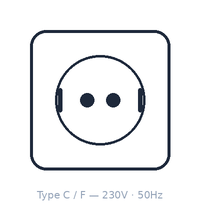
Most modern electronics (phones, laptops, cameras) handle the voltage difference automatically — check the label on your charger for “INPUT: 100-240V” to confirm.
Germany has good mobile coverage across the country, though it can be patchy in rural eastern Germany and mountainous areas. EU residents benefit from “roam like at home” regulations. For non-EU visitors, purchasing a local SIM or eSIM is straightforward — Telekom, Vodafone, O2, and budget providers like Aldi Talk offer prepaid options. Free Wi-Fi is available at most hotels, cafés, and train stations, though Germany was historically slower to adopt public Wi-Fi than other European countries.
📱 Need mobile data? An eSIM is the easiest way to stay connected in Europe — no SIM swapping, activate before you land. Compare the best eSIM providers for Europe →
Health and Safety
Germany has excellent healthcare. EU citizens can use the European Health Insurance Card (EHIC) or Global Health Insurance Card (GHIC) for necessary medical treatment. Non-EU visitors aren’t covered by the public system, and costs for private treatment or medical repatriation can be substantial, so comprehensive travel insurance for Europe is strongly recommended.
🏥 Cover your whole trip to Germany with one policy
SafetyWing Nomad Insurance covers Germany and every other stop on your route — emergency medical coverage, travel delay, and lost luggage protection in one plan. It meets the €30,000 Schengen visa medical minimum too. Buy it before you leave or even mid-trip.
Get a quote from SafetyWing →Affiliate partner — we may earn a commission at no extra cost to you.
In a medical emergency, call 112 (all emergencies) or 110 (police). Pharmacies (Apotheken, marked with a red “A”) are well-stocked and pharmacists can advise on minor ailments. Outside normal hours, every area has a rotating night pharmacy (Notapotheke) — check the sign on any closed pharmacy door for the nearest one open.
Germany is very safe for visitors. Violent crime is rare. The most common issues are pickpocketing in crowded tourist areas (particularly in Berlin at Alexanderplatz and on the U-Bahn, and in Munich during Oktoberfest) and bicycle theft. General street safety is excellent, even late at night in most cities.
Food and Dining Culture
German cuisine is more diverse than its reputation for sausages and beer might suggest — though both are genuinely excellent and deeply embedded in the culture. Regional specialties vary dramatically across the country.
In Bavaria, expect Weißwurst (white sausage, eaten before noon with sweet mustard), Schweinshaxe (roasted pork knuckle), Brezn (pretzels), and Obatzda (a cheese spread). In the Rhineland, Sauerbraten (marinated pot roast) and Himmel un Ääd (black pudding with mashed potatoes and apple sauce) dominate. Northern Germany favors fish — Fischbrötchen (fish sandwiches) in Hamburg, Labskaus (a sailors’ dish of corned beef, potatoes, and beetroot) along the coast. Berlin’s street food icons are Currywurst and the Döner Kebab, the latter reflecting Germany’s large Turkish community and arguably the country’s most popular fast food.
German beer culture is world-famous. The Reinheitsgebot (beer purity law, dating to 1516) still influences brewing. Each region has its own style — Weissbier in Bavaria, Kölsch in Cologne, Altbier in Düsseldorf, Pilsner in the north, Rauchbier (smoked beer) in Bamberg. Beer gardens are a quintessential German experience, especially in Bavaria, where you’re typically welcome to bring your own food as long as you buy your drinks on-site.
Mealtimes are generally earlier than southern Europe. Lunch is served from around noon to 2:00 PM, and dinner from 6:00–9:00 PM. Many traditional restaurants (Gasthäuser or Gaststätten) close between lunch and dinner. Bakeries (Bäckereien) are ubiquitous and essential — Germany has over 3,000 registered types of bread, and a good bakery is the heart of every neighborhood.
Germany: Economy and Context
Germany has the largest economy in Europe and the fourth-largest in the world, with a GDP of approximately €4.1 trillion. It’s the EU’s most populous country and its economic engine, home to global companies like Volkswagen, Siemens, BMW, Mercedes-Benz, BASF, and SAP. The country is a founding member of the EU, the Eurozone, and the Schengen Area.
Tourism contributes roughly 4.5% of GDP and supports over 2 million jobs. Germany consistently ranks among the top 10 most-visited countries in the world, with particular strength in business travel (Frankfurt and Munich are major conference cities), cultural tourism, and Christmas market tourism — the seasonal markets across the country draw millions of visitors from November through December.
Since reunification in 1990, eastern Germany has undergone a dramatic transformation, with cities like Dresden, Leipzig, and Weimar emerging as cultural destinations. Berlin, once divided by the Wall, has become one of Europe’s most vibrant and creative capitals — and remains remarkably affordable for a city of its stature.
Frequently Asked Questions
Do I need a visa to visit Germany?
Citizens of 59 countries, including the US, UK, Canada, and Australia, can visit Germany without a visa for up to 90 days within any 180-day period. This is the Schengen 90/180-day rule, which applies across all Schengen countries combined. Use our Europe Travel Planner to find out if your nationality requires a visa.
Will I need ETIAS to visit Germany in 2026?
Not in 2026. The EU removed the Q4 2026 ETIAS launch target in July 2026, and 2027 is now the most likely launch year. Once operational, visa-exempt visitors will need to apply online before traveling. Until ETIAS launches, you only need your valid passport. See our ETIAS guide for the latest timeline.
What is the best time to visit Germany?
May through October offers the best weather and the longest days. June through August is peak summer with warm temperatures and outdoor festivals. September and October bring Oktoberfest and autumn foliage. November through December is Christmas market season — cold but magical. Winter (January–March) is quieter and cheapest, ideal for skiing in the Bavarian Alps.
Do people speak English in Germany?
Yes — Germany has very high English proficiency, especially in major cities and among younger people. You can navigate Berlin, Munich, Hamburg, and Frankfurt almost entirely in English. Smaller towns and rural eastern Germany may be more challenging, but you’ll rarely be completely stuck.
How much does a trip to Germany cost?
Budget roughly €120–200 per day for mid-range travel in Berlin or Hamburg (including accommodation, meals, transport, and activities). Munich runs €140–220, more during Oktoberfest. Smaller cities and rural areas cost €80–140 per day. A two-week trip for two people typically costs €3,000–6,000, depending on destinations and style.
Is Germany really that cash-dependent?
More than you’d expect. Card acceptance has improved significantly, especially in Berlin and at chain establishments, but many restaurants, bakeries, markets, and smaller shops still prefer or require cash. Always have €50–100 in cash on hand.
Do I need travel insurance for Germany?
Visa-exempt visitors aren’t required to show travel insurance to enter Germany, but it is strongly recommended — non-EU visitors aren’t covered by Germany’s public healthcare, and costs for private treatment or medical repatriation can be substantial. If you need a Schengen visa, travel medical insurance with at least €30,000 in coverage is mandatory for your application. See our Europe travel insurance guide for options that meet the requirement.
What is the Deutschland-Ticket and can tourists use it?
The Deutschland-Ticket costs €63 per month and gives you unlimited travel on all local and regional public transport across Germany — trains (RE, RB, S-Bahn), U-Bahn, trams, and buses. It does not cover ICE, IC, or EC long-distance trains. Tourists can buy it digitally through the DB Navigator app. It’s a monthly subscription — cancel by the 10th to stop the next month.
Are there really no speed limits on the Autobahn?
About 30% of the Autobahn network has no enforced speed limit. The rest has variable or fixed limits, especially near cities, construction zones, and interchanges. The advisory speed is 130 km/h. Where limits exist, they’re strictly enforced by cameras. Even on unrestricted sections, driving at extreme speeds in poor conditions can result in increased liability in an accident.
🌍 Plan Your Trip to Germany
Beyond entry rules — get currencies, plug types, driving permits, and eSIM options for 45+ European countries in one personalized briefing. Free, no signup.
Use the Europe Travel Planner →📚 Related Articles
- Schengen 90/180-Day Rule — How the visa-free stay limit works across Europe
- ETIAS: Europe’s New Travel Authorization — What you’ll need when it launches
- Entry/Exit System (EES) — How the new biometric borders work
- International Driving Permit in Europe — Country-by-country IDP requirements
- Best Travel Insurance for Europe — Protect your trip
- Travel to Italy: Complete Guide
- Travel to the Netherlands: Complete Guide
- All Europe Country Guides
This article is for informational purposes only and does not constitute legal or travel advice. Entry requirements can change — always verify with official government sources before traveling. Last updated: August 2026.