
Home › Country Guides › Travel to France
Last Updated: August 2026
France is the most visited country on Earth — and for good reason. From the Eiffel Tower to the lavender fields of Provence, the beaches of the French Riviera to the vineyards of Bordeaux, France packs an extraordinary amount of variety into a single country. Here’s everything a visitor needs to know to plan a trip to France in 2026.
🇫🇷 France at a Glance
| Capital | Paris |
| Population | ~69.1 million (2026) |
| Currency | Euro (€) |
| Language | French |
| Time Zone | CET (UTC+1) · CEST in summer (UTC+2) |
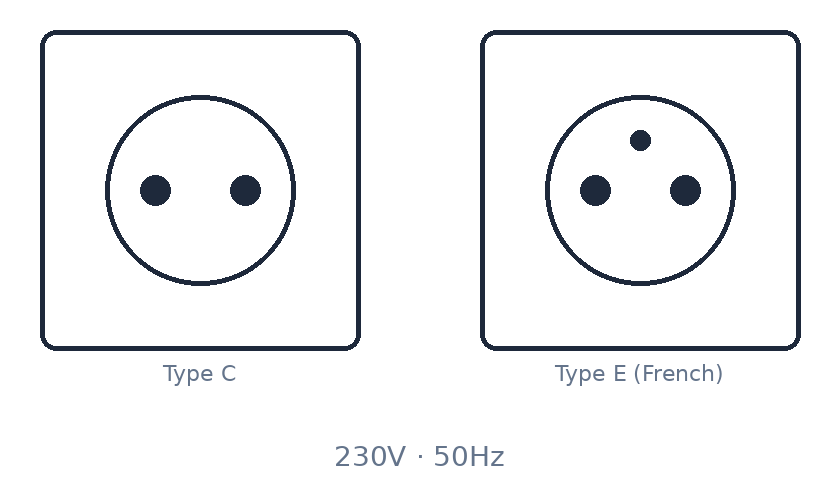
| Plug Type | Type C and E · 230V / 50Hz |
| Driving Side | Right |
| International Driving Permit (IDP) | Recommended — see IDP guide |
| Schengen Member | Yes — founding member |
| Emergency Number | 112 (EU-wide) · 15 (medical) · 17 (police) · 18 (fire) |
Entry Requirements for France
France is part of the Schengen Area, meaning it follows the same entry rules as the other 28 Schengen member countries. What you need to enter France depends on your nationality.
Visa-Exempt Visitors (US, UK, Canada, Australia, and Others)
Citizens of 59 visa-exempt countries — including the United States, United Kingdom, Canada, Australia, New Zealand, Japan, and most Latin American nations — can enter France without a visa for short stays of up to 90 days within any 180-day period. This is the standard Schengen 90/180-day rule, and it applies across all 29 Schengen countries combined, not just France.
To enter France as a visa-exempt visitor, your passport must meet two requirements. It must have been issued within the last 10 years at the time of entry, and it must remain valid for at least three months after your planned departure date from the Schengen area.
⚠️ The 10-year rule catches people off guard. If you renewed your passport early and extra months were added, the issue date — not the expiry date — is what matters. A passport that’s still technically valid might be rejected if the issue date is more than 10 years ago.
At the border, French officials may also ask for proof of accommodation (hotel bookings or an “attestation d’accueil” from a French host), proof of sufficient funds (€32.50 per day minimum), and evidence of onward or return travel. These documents aren’t always requested, but having them available avoids potential complications.
Visitors Who Need a Visa
If your country is not on the visa-exempt list, you’ll need to apply for a Schengen short-stay visa (Type C) through the French consulate in your home country before traveling. This visa allows stays of up to 90 days within a 180-day period and typically costs €80 for adults. The application requires travel medical insurance with minimum €30,000 coverage — see our guide to the best travel insurance for Europe for policies that meet Schengen visa requirements.
For longer stays — work, study, or family reunification — you’ll need a French national long-stay visa (Type D), which must be applied for separately from a Schengen visa. Use our Europe Travel Planner to find out exactly what your nationality requires.
🛂 Need a Schengen visa for France?
If your nationality isn’t visa-exempt, iVisa handles your Schengen visa application end to end — forms, appointment guidance, and document review before you submit.
Start your application on iVisa →Affiliate partner — we may earn a commission at no extra cost to you.
What’s Changing at France’s Borders
Two major systems are transforming how non-EU visitors enter France and the rest of the Schengen area. One is fully in place; the other has been pushed back.
Entry/Exit System (EES)
The Entry/Exit System completed its phased rollout and has been fully operational at all Schengen border crossings since April 2026. EES replaced the old passport-stamping process with a digital system that records biometric data — fingerprints and facial images — along with your passport details and entry/exit dates.
The first time you enter the Schengen area under EES, border officials will collect your fingerprints and take a facial photograph. This is done either at a self-service kiosk (if you have a biometric passport) or by a border guard. Once you’re registered, the data stays valid for three years, and subsequent entries only require identity verification rather than a full re-registration.
ℹ️ No advance action needed for EES. Everything happens at the border when you arrive. There are no forms to fill out, no applications to submit, and no fees to pay. Just bring your valid passport and allow a few extra minutes on your first entry, when your biometric registration takes place.
The rollout-period disruptions at French borders — including the early technical problems with the Parafe e-gates at Paris Charles de Gaulle and the phased introduction of car passenger checks at the Port of Dover and Eurostar terminals — are now behind us. First-time EES registration still adds a few minutes, so build in a small buffer at busy entry points in peak season.
ETIAS — Europe’s New Travel Authorization
The European Travel Information and Authorization System (ETIAS) will require visa-exempt travelers — including Americans, Britons, Canadians, and Australians — to apply for a travel authorization online before boarding a flight or train to France or any other Schengen country. The EU removed the Q4 2026 launch target in July 2026, and 2027 is now the most likely launch year.
The ETIAS application is completed online and takes roughly 10 minutes. It asks for personal details, passport information, and security-related questions. The fee is €20 for travelers aged 18 to 70 (free for those younger or older). Once approved, ETIAS is valid for three years or until your passport expires, whichever comes first. It covers all 29 Schengen countries, so you don’t need a separate authorization for each destination.
✅ What to do now: If you’re traveling to France before ETIAS launches, you don’t need it. Just bring your valid passport. Bookmark our ETIAS launch date tracker for the confirmed timeline once the EU announces it.
Getting to France
France has excellent connectivity from virtually everywhere in the world, with multiple airports and international train routes making it one of the easiest European countries to reach.
By Air
Paris is served by two major airports. Charles de Gaulle (CDG) is the main international hub, handling most long-haul flights. Orly (ORY) handles many European and domestic routes plus some international flights. Beyond Paris, major international airports at Nice, Lyon, Marseille, Toulouse, and Bordeaux receive direct flights from many European and some intercontinental destinations.
Budget carriers like easyJet, Ryanair, Transavia, and Vueling offer affordable flights from across Europe. For transatlantic routes, Air France, Delta, United, and American Airlines offer nonstop service from numerous US cities to Paris CDG.
By Train
France’s rail connections to neighboring countries are outstanding. The Eurostar links London St Pancras to Paris Gare du Nord in about 2 hours 15 minutes, passing through the Channel Tunnel. Thalys (now branded as Eurostar) connects Paris with Brussels, Amsterdam, and Cologne. TGV Lyria runs high-speed service between Paris and major Swiss cities. Direct TGV connections also serve Barcelona (via SNCF and Renfe), Frankfurt and Stuttgart (via SNCF and Deutsche Bahn), and Italian cities (via Trenitalia and SNCF).
A new direct Paris–Berlin high-speed route launched in December 2024, taking approximately 8 hours and operated jointly by Deutsche Bahn and SNCF.
By Car
France shares land borders with Belgium, Luxembourg, Germany, Switzerland, Italy, Monaco, Andorra, and Spain. As a Schengen member, there are normally no border controls between France and its Schengen neighbors, though France has temporarily reestablished border checks at several crossings for security reasons. You may encounter passport checks, so carry your documents even when crossing from another Schengen country.
Getting Around France
France has one of the best transportation networks in Europe, but the best option depends on whether you’re exploring cities, touring the countryside, or covering long distances between regions.
Trains
The French rail network, operated by SNCF, is extensive and efficient. Understanding the different train types helps you plan and save money.
| Train Type | What It Is | Key Details |
|---|---|---|
| TGV InOui | High-speed trains connecting major cities | Up to 320 km/h · Seat reservation required · Book early for best fares · Paris to Lyon ~2 hrs, Paris to Marseille ~3 hrs, Paris to Bordeaux ~2 hrs |
| Ouigo | Low-cost high-speed trains | Same tracks as TGV, fewer amenities · From €10 for adults · Limited luggage · No Wi-Fi or outlets included · Not covered by Eurail passes |
| Intercités | Express trains connecting regional cities | Advance booking recommended · Night trains available (Paris to Nice, Toulouse, Perpignan) |
| TER | Regional trains for shorter distances | No reservation needed — hop on with your ticket · Perfect for town-to-town travel within a region |
Rail passes: The Eurail France Pass (for non-Europeans) or Interrail France Pass (for Europeans) provides unlimited travel on 31,000 km of French railways. These passes cover TGV InOui, Intercités, TER, and night trains, but not Ouigo services. Seat reservations on TGV trains cost an additional €10–30 per journey. If you’re planning multiple long-distance trips, a pass can save significant money. For one or two journeys, booking individual advance tickets on the SNCF Connect app is often cheaper.
✅ Booking tip: SNCF releases tickets roughly 90 days before departure. The earliest bookings get the cheapest fares — sometimes up to 50% off. Use the SNCF Connect app for schedules, bookings, and real-time updates.
Paris Public Transit
Paris has one of the most comprehensive urban transit systems in the world. The Métro covers 16 lines and over 300 stations across central Paris. The RER (suburban express trains) connect Paris to the surrounding Île-de-France region, including CDG airport (RER B), Versailles (RER C), and Disneyland Paris (RER A). Buses, trams, and the new Grand Paris Express lines (under construction) round out the network.
A single ticket (t+) costs €2.15 and covers one journey on the Métro, bus, or tram within central Paris. The Navigo Easy card is a rechargeable contactless card that simplifies paying for individual tickets. For multi-day visits, the Navigo Découverte weekly pass (€30.75, valid Monday to Sunday) offers unlimited travel on Métro, RER, buses, and trams across all zones — including airport transfers.
Driving
A car is the best way to explore rural France — the Alps, Pyrenees, Dordogne, Lot, Provence, and Normandy’s countryside are difficult to access by public transit. Major rental companies are available at airports and train stations throughout the country.
France drives on the right. Speed limits are 130 km/h on dry motorways (110 km/h in rain), 110 km/h on dual carriageways, 80 km/h on rural roads, and 50 km/h in urban areas. Speed cameras are widespread and automated — France is particularly aggressive about camera enforcement, and fines are sent directly to your rental company, who will charge your credit card plus an administrative fee.
⚠️ Priorité à droite: In French towns, unless a yellow diamond sign says otherwise, vehicles joining from the right have right of way. This includes some roundabouts, particularly older ones. It’s the single most confusing rule for foreign drivers and causes the most near-misses.
Tolls: Most French motorways (autoroutes) are toll roads. You collect a ticket when entering and pay at the exit based on distance traveled. A drive from Paris to Lyon costs approximately €35 in tolls; Paris to Nice runs around €80–90. The Liber-t electronic tag (available to EU residents) lets you pass through dedicated toll lanes without stopping.
Crit’Air sticker: France’s low emission zones (Zones à Faibles Émissions, or ZFE) require all vehicles to display a Crit’Air sticker when driving in or through major cities. As of 2025, every French city with more than 150,000 residents must operate a low-emission zone. Paris, Lyon, Marseille, Toulouse, Nice, Strasbourg, Grenoble, Bordeaux, Lille, and many others are covered. The sticker costs €4.76 and must be ordered from the official government website at certificat-air.gouv.fr — allow two weeks for delivery. Driving without one in a restricted zone carries a €68 fine. If you’re renting a car, the vehicle should already have one.
International Driving Permit: French law doesn’t strictly require an IDP for short visits by license holders from countries with Roman-script licenses, but most rental companies demand one. Getting an IDP before you travel avoids being turned away at the rental counter. See our International Driving Permit guide for how to get one in your country.
Other driving rules: France requires a warning triangle and high-visibility vest in every vehicle. The blood alcohol limit is 0.5 g/L (0.05%) — significantly lower than the US and UK limit of 0.8 g/L. Handheld phones are prohibited while driving, and headphones or earbuds are banned even for hands-free calls. Devices that display exact speed camera locations are illegal.
Where to Go in France
France offers an extraordinary diversity of destinations, from world capitals to medieval villages, alpine peaks to Mediterranean beaches. Here are the regions and highlights most visitors focus on.
Paris and Île-de-France
The capital needs no introduction. The Eiffel Tower, Louvre Museum, Notre-Dame Cathedral (reopened December 2024 after a five-year restoration), Musée d’Orsay, Sacré-Cœur, the Champs-Élysées, and countless neighborhood gems make Paris a destination that rewards multiple visits. The surrounding Île-de-France region includes the Palace of Versailles and Disneyland Paris (France’s most-visited single attraction with roughly 15 million visitors per year).
Provence and the French Riviera
The south of France offers Mediterranean coastline along the Côte d’Azur (Nice, Cannes, Antibes, Saint-Tropez), plus the lavender fields and hilltop villages of inland Provence (Gordes, Roussillon, Aix-en-Provence). Marseille, France’s second-largest city, combines a gritty port atmosphere with outstanding cuisine — it’s the birthplace of bouillabaisse. The region is best visited from May through October.
Loire Valley
Known as the “Garden of France,” the Loire Valley is famous for its châteaux — over 300 of them line the Loire River and its tributaries. Chambord, Chenonceau, and Amboise are the most iconic. The region is also a major wine-producing area, particularly known for Sancerre, Vouvray, and Chinon. It’s an easy day trip from Paris by TGV (just over an hour to Tours) or a perfect road-trip destination.
Normandy and Brittany
Normandy’s D-Day beaches draw history enthusiasts, while Mont Saint-Michel — the island abbey rising dramatically from tidal flats — is one of France’s most photographed landmarks. The region is known for cider, Calvados, Camembert, and cream-rich cuisine. Neighboring Brittany offers rugged Atlantic coastline, charming fishing villages, and a distinct Celtic cultural identity.
Bordeaux and Southwest France
Bordeaux has been transformed over the past two decades from a somewhat sleepy wine capital into one of France’s most dynamic cities, with a beautifully restored 18th-century center now classified as a UNESCO World Heritage Site. The surrounding vineyards (Saint-Émilion, Médoc, Pauillac) are the heart of French wine culture. Further south and east, the Dordogne and Lot valleys offer medieval villages, prehistoric cave art (Lascaux), and some of France’s most spectacular rural scenery.
The French Alps
Chamonix, Annecy, Megève, and Courchevel anchor one of the world’s premier ski regions in winter and offer outstanding hiking, cycling, and lake activities in summer. Mont Blanc, Western Europe’s highest peak at 4,808 meters, towers over the region. The Alps are most easily accessed from Lyon or Geneva.
Alsace and Eastern France
Strasbourg and Colmar anchor the Alsace wine route, where half-timbered villages, Riesling vineyards, and Franco-German cultural influences create a unique atmosphere unlike anywhere else in France. Strasbourg also serves as a seat of the European Parliament, giving the city an international character. The region is famous for its Christmas markets, among the oldest and most celebrated in Europe.
Practical Information for Visitors
Money and Costs
France uses the euro (€). Credit and debit cards are widely accepted, though small purchases under €5 are sometimes cash-only at markets, bakeries, and small shops. Contactless payment is standard virtually everywhere. ATMs are abundant in cities and towns.
Costs vary dramatically by location. Paris and the Côte d’Azur are expensive — budget €150–250 per day for mid-range travel including accommodation, meals, transport, and activities. Provincial cities like Lyon, Bordeaux, Toulouse, and Nantes are more affordable, roughly €100–180 per day. Rural areas and smaller towns offer the best value, with excellent gîtes (holiday rentals) and farm-to-table meals at a fraction of Parisian prices.
Tipping in France is not obligatory — service is included in all restaurant bills by law (service compris). Leaving a few euros for good service at restaurants is common but not expected. At cafés, rounding up or leaving small change is typical. Hotel housekeeping and taxi drivers are occasionally tipped €1–2, but it’s never required.
Language
French is the official language and the primary language spoken throughout the country. English is widely understood in Paris, major tourist areas, and among younger French people, but proficiency drops off significantly in rural areas and smaller towns. Regional languages — Breton in Brittany, Alsatian in Alsace, Basque in the southwest, Occitan in the south, Corsican in Corsica, and Catalan near the Spanish border — still have cultural significance, though French dominates daily life everywhere.
Making an effort with basic French is genuinely appreciated and changes how people interact with you. Start conversations with “Bonjour” (hello/good day), say “s’il vous plaît” (please), and “merci” (thank you). Even a few phrases signal respect for the culture and almost always result in warmer, more helpful responses.
Power and Connectivity
France uses Type C and Type E power plugs at 230V/50Hz. If you’re traveling from the US, Canada, UK, or Australia, you’ll need a plug adapter.
Most modern electronics (phones, laptops, cameras) handle the voltage difference automatically — check the label on your charger for “INPUT: 100-240V” to confirm. Hair dryers and straighteners from North America may need a voltage converter, or it’s easier to buy or borrow one locally.
France has excellent mobile coverage and widespread Wi-Fi. EU residents benefit from “roam like at home” regulations with no extra charges. For visitors from outside the EU, purchasing a local SIM card or eSIM is straightforward — Free Mobile, Orange, SFR, and Bouygues all offer prepaid tourist options.
📱 Need mobile data? An eSIM is the easiest way to stay connected in Europe — no SIM swapping, activate before you land. Compare the best eSIM providers for Europe →
Health and Safety
France has one of the best healthcare systems in the world. EU citizens can use the European Health Insurance Card (EHIC) or its replacement, the Global Health Insurance Card (GHIC), for necessary medical treatment. Non-EU visitors aren’t covered by the French healthcare system, and costs for private treatment or medical repatriation can be substantial, so comprehensive travel insurance for Europe is strongly recommended.
🏥 Cover your whole trip to France with one policy
SafetyWing Nomad Insurance covers France and every other stop on your route — emergency medical coverage, travel delay, and lost luggage protection in one plan. It meets the €30,000 Schengen visa medical minimum too. Buy it before you leave or even mid-trip.
Get a quote from SafetyWing →Affiliate partner — we may earn a commission at no extra cost to you.
In a medical emergency, call 15 (SAMU — emergency medical services) or 112 (EU-wide emergency number). For police, call 17. For fire, call 18. Pharmacies (marked with a green cross) are well-stocked and pharmacists can provide advice for minor ailments.
France is generally very safe for visitors. The most common issue is petty theft — pickpocketing is prevalent in Paris (especially at tourist sites, on the Métro, and around train stations), on the French Riviera, and in other popular tourist areas. Keep valuables secure, be wary of distraction scams, and don’t leave belongings visible in parked cars.
Food and Dining Culture
French food culture is central to daily life and a major reason people visit the country. A few customs are worth knowing. Lunch is traditionally the main meal, typically served from noon to 2:00 PM — many restaurants close between lunch and dinner service (around 7:00–7:30 PM). Bakeries (boulangeries) and patisseries are cornerstones of every town. Sunday closures are still common for many shops and some restaurants, particularly outside Paris.
Each region has its own specialties: bouillabaisse in Marseille, cassoulet in Toulouse, choucroute (sauerkraut with sausages) in Alsace, crêpes and galettes in Brittany, tarte flambée in Strasbourg, and coq au vin in Burgundy. The wine regions are reason enough to visit — Bordeaux, Burgundy, Champagne, the Rhône Valley, Alsace, and the Loire Valley each offer distinct varieties and tasting experiences.
France: Economy and Context
France has the world’s seventh-largest economy with a GDP of approximately €3 trillion, making it the second-largest economy in the European Union behind Germany. The country is a founding member of the EU, the Eurozone, and the Schengen Area, and it holds a permanent seat on the United Nations Security Council.
Tourism is a critical sector, contributing approximately 8–9% of GDP and employing nearly 3 million people. France’s record-breaking 2024 — with over 100 million international visitors and €71 billion in international tourism revenue — was bolstered by the Paris Olympics, the reopening of Notre-Dame, and strong growth from American, Chinese, and Japanese visitors.
The country’s infrastructure is among the best in Europe, with high-speed rail, modern airports, and an extensive highway network. This combination of world-class transport, cultural depth, and geographic diversity — from Atlantic beaches to Alpine peaks to Mediterranean islands — is what makes France uniquely positioned as the world’s top tourist destination.
Frequently Asked Questions
Do I need a visa to visit France?
Citizens of 59 countries, including the US, UK, Canada, and Australia, can visit France without a visa for up to 90 days within any 180-day period. This is the Schengen 90/180-day rule, which applies across all Schengen countries combined. Use our Europe Travel Planner to find out if your nationality requires a visa.
Will I need ETIAS to visit France in 2026?
Not in 2026. The EU removed the Q4 2026 ETIAS launch target in July 2026, and 2027 is now the most likely launch year. Once operational, visa-exempt visitors will need to apply online before traveling. Until ETIAS launches, you only need your valid passport. See our ETIAS guide for the latest timeline.
What is the best time to visit France?
Spring (April–June) and autumn (September–October) offer the best combination of pleasant weather, manageable crowds, and reasonable prices. Summer (July–August) is peak season with the highest prices and largest crowds, but also the best weather for beaches and outdoor activities. Winter is ideal for skiing in the Alps and Christmas markets in Alsace, though many rural attractions have reduced hours.
Do people speak English in France?
English is widely spoken in Paris, major tourist areas, and among younger people. Outside these areas, particularly in rural France and smaller towns, English proficiency drops significantly. Learning basic French phrases will noticeably improve your experience and the warmth of local interactions.
How much does a trip to France cost?
Budget roughly €150–250 per day for mid-range travel in Paris (including hotel, meals, transport, and activities). Provincial cities run €100–180 per day. Rural areas are significantly cheaper. A two-week trip for two people typically costs €3,500–7,000 total, depending heavily on where you stay and how you eat.
Is Paris safe for tourists?
Paris is generally safe, but pickpocketing is a persistent issue at major tourist sites, on the Métro, and around train stations (particularly Gare du Nord). Keep valuables secure, be aware of distraction scams, and don’t leave items visible in parked cars. Violent crime against tourists is rare.
Do I need travel insurance for France?
Visa-exempt visitors aren’t required to show travel insurance to enter France, but it is strongly recommended — non-EU visitors aren’t covered by the French healthcare system, and costs for private treatment or medical repatriation can be substantial. If you need a Schengen visa, travel medical insurance with at least €30,000 in coverage is mandatory for your application. See our Europe travel insurance guide for options that meet the requirement.
Do I need a Crit’Air sticker to drive in France?
If you’re driving in or through any French city with more than 150,000 residents — which includes Paris, Lyon, Marseille, Toulouse, Nice, Bordeaux, and many others — yes. The sticker costs €4.76 and must be ordered from the official site at certificat-air.gouv.fr. Allow two weeks for delivery. Rental cars should already have one. Driving without the sticker in a restricted zone carries a €68 fine.
Can I use my US driver’s license in France?
Legally, a US driver’s license is valid for short-term visitors to France. However, most rental car companies require an International Driving Permit (IDP) in addition to your license. An IDP costs $20 from AAA and takes minutes to obtain — get one before you travel to avoid being refused at the rental counter.
🌍 Plan Your Trip to France
Beyond entry rules — get currencies, plug types, driving permits, and eSIM options for 45+ European countries in one personalized briefing. Free, no signup.
Use the Europe Travel Planner →📚 Related Articles
- Schengen 90/180-Day Rule — How the visa-free stay limit works across Europe
- ETIAS: Europe’s New Travel Authorization — What you’ll need when it launches
- Entry/Exit System (EES) — How the new biometric borders work
- International Driving Permit in Europe — Country-by-country IDP requirements
- Best Travel Insurance for Europe — Protect your trip
- Travel to Italy: Complete Guide
- Travel to Germany: Complete Guide
- All Europe Country Guides
This article is for informational purposes only and does not constitute legal or travel advice. Entry requirements can change — always verify with official government sources before traveling. Last updated: August 2026.